How to get audio feed from DJ's mix board into my wireless transmitter?

crydercohen

Active member
Hey All-

I will be shooting my friends wedding this weekend and needed some help with the audio. I wanted to get an audio feed from the DJs mixboard to plug into my sennheiser wireless transmitter (which has a 1/8 jack). What kind of adapters would I need? I know that mix boards have different set-ups, but I'm not really familiar with them. Any help is greatly appreciated.

Thanks!

Stan
 
For this type of thing, I connect a small digital recorder to the mix board and record the music "wild" which I will synch up in post. It takes a little practice if you've never done the synching before, but I've done this so many times over the years that I can do this in my sleep. Just make sure you correct for sych drift. ( i.e My Olympus LS-10 recorder is 8 frames long every hour of recording )
 
Not a direct answer to your question but if all else fails (getting a feed directly out of the DJ mixer)
you can try placing the lav mic on or near the PA speaker. If you can play around with it you can probably find a sweet spot
where you will get pretty good sound. (could be near the horn, could be near the woofer, could be on top, could be 3ft away..etc)

Obviously make sure the mic isn't clipping at the element or at the transmitter.
 
It depends on what kind of mixing board the DJ has (what kind of outputs-- RCA tape-outs, maybe?), and whether or not you are going into your own mixing board before camera, or straight into your camera...

But, it sounds like you might need a cable that has two RCA (L&R/stereo) on one end, and a single 1/8" Male stereo end on the other (two rings).

GJ
 
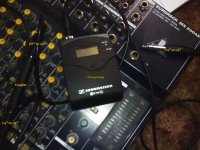
1/8" female phono to 1/4" male phono (comes with headphones or just get one from Radio Shack) adaptor to a 1/4" female to female coupler to a 1/4" male to 1/4" male phono cable to one of the DJ's aux outs on the mixer. Ideally pre-fader. It's VERY important to get a mic test before the event to set the transmitter's sensitivity. And all auxillary knobs for your channel to unity/12 o'clock position. See the attached photo for an example of the rig:


mixeroutrig-small.jpg

Also Gregg's solution may work but I haven't tried it that way. I haven't went that route as you have more 1/4" outputs to work with on a typical mixer board. So if the DJ is already using tape out for some reason you are limited in your options. Either way *should* work.

P.S. Are you doing this to record music? If so it'll be mono...at receptions I usually just shoot with the on-camera mic except during the ceremony and when doing guest interviews. At the church the speaker's podium and groom are miced up.
 
Last edited:
tape out rca's to an 1/8", commonly used to go from an ipod to dual rca's for a stereo. i then run my transmitter sensitivity at -30. i do it almost every weekend unfortunately….
 
Adam-

Thanks for the set-up tip, but why wouldn't you just go from 1/4 to 1/8? why all the steps and adapters in between?

thanks,

stan
 
Adam-

Thanks for the set-up tip, but why wouldn't you just go from 1/4 to 1/8? why all the steps and adapters in between?

thanks,

stan

Because I already own the stuff, hehehe. I was thinking about this post while driving yesterday and thought, "Damn, I forgot to mention the reason I had the rig that way was because I already owned all the gear."

Sennheiser LOCKING (key feature) 1/8" to 1/8" stereo (TRS) cable is included with the set.

Headphone 1/8" to 1/4" adaptor, included with headphones I bought.

Stereo 1/4" (TRS) cable, purchased for music studio hardware compressor

Back up 1/8" to 1/8" male phono cables...came with the two monitors that I bought for the computers. I never use them because CPU monitor speakers suck.

Coupler, purchased for music studio as an extender for headphones.

If you don't already have those cables then a 1/4" female phono to 1/8" female phono coupler and a 1/4" male to male cable will work great. The cable that comes with the Sennheiser system is very short so I'd prefer to give it a little length, which is also why I chose to rig it that way. You can also buy cables with smaller ends but again I already own the cables and 1/4" male to male cables can be found all over the place. 1/4" male to 1/8" female cables, not so much.
 
So to reduce that even more, probably just that dual RCA to 1/8" cable. If you wind up needing the 1/4" males, you can just get RCA to 1/4" adaptors.

Radio Shack still has a few things that you can use that aren't telephones or computer accessories. You can get the items listed above there, or for most-likely a slightly higher price, at any Guitar Center...

GJ
 
Remember that he's going to a Sennheiser transmitter. Even though it has a 1/8 TRS input such as is commonly used for stereo, in this case the input is MONO and two different cables are used depending on whether the signal sent to the transmitter is line or mic level. Line level signal go to the ring with tip grounded while mic level signals go to tip with ring grounded. If he's going to take a stereo signal from the board, regardless of whether it's on a pair of RCAs, or a 1/4 TRS, he needs to parallel the left and right channels to mix them and send the result to the ring of the Senn input. And further to complicate things, just because it's a 1/4 TRS coming off the board doesn't mean he's getting a stereo signal. My Mackie board, for example, has a 1/4 mono mix output available on a balanced TRS connection. The wiring to get that into a Senn transmitter is totally different from what it would be if one was connecting to a 1/4 stereo output.

Stacking adapters is a sure-fire way to end up with completely screwed-up audio - crackles, drop-outs from jiggling, ground problems, level mismatches, and the wrong signal going to the wrong place. There's no substitute for finding out what makes and models of equipment are going to be used, reviewing its documentation, and acquiring the proper interconnects, transformers, DI-boxes, etc to connect everything together.
 
Last edited:
yeah i also run with the dual 1/8" cable with a 1/4" adapter but i've found some DJ "mixer" boards are problematic with either their headphone jacks or their 1/4". unfortunately i've shot a wedding every weekend for the past 2 months(this past saturday was hopefully my last wedding EVER!) and i worked with 9 different mixing boards for those weddings and i used my dual rca to 1/8" cable on every one of them and got a great board feed. but i generally run with a few adapters just to be safe. also, some speakers like the jbl's will have an xlr pass through so i've just stuck my g2 butt plug on that before with a non compliant DJ.
 
Yeah Steve, I should have said mono 1/8", but we did establish that "it depends on what type of mixing board/outputs."

ManglerBMX-- "non-compliant DJ"-- Quote of the month, easily!

GJ
 
Yeah Steve, I should have said mono 1/8", but we did establish that "it depends on what type of mixing board/outputs."

ManglerBMX-- "non-compliant DJ"-- Quote of the month, easily!

GJ
More than just mono 1/8. The normal wiring of a mono 1/8 is either TS with signal to tip and ground to sleeve, or TRS with signal to both tip and ring jumpered together and ground to sleeve. The Senn transmitter, for a line level mono signal, expects a TRS connector with signal hot to ring, ground to sleeve, and tip grounded through a jumper to sleeve (NOT to ring).

The problem with a 1/4 stereo to 1/8 stereo adapter is that many boards output a balanced mono signal on 1/4. If you use a simple adapter you have signal on the tip, signal phase inverted on the ring. If you mix them to mono you get silence.
 
Last edited:
Hey All-

Thanks so much for all the feedback. What about connecting an the transmitter to one of the speakers via a 1/8 to xlr female? would that work?

thanks,
stan
 
The only speaker that would have an XLR out would be a self-amplified speaker... so, assuming your DJ has an un-amplified mixing board that he is running to a pair of self-amplified speakers, he is probably running stereo out of his board into one speaker from the left channel and one speaker from the right. So, assuming that these self-amplified speakers had a line-level XLR out, you could theoretically patch into them with something like the Sennheiser CL2, but you would only be getting the left or right half of his mix (depending on which speaker you plugged into).

OK, so that was a lot of assumptions and theory, so let me say this about a practical application: in my experience, just because a self-amplified speaker bills itself as having a line-level output doesn't necessarily mean that it will play nicely with other gear expecting a line-level output. I have seen people bitten by that assumption before. I think you're better off to get a feed directly from the board.
 
Back
Top