How to fire up a 5K fresnel?

I'm thinking about picking up a 5K Mole fresnel. Since I can't afford top notch HMI's (yet) I'm going the tungsten route. Just wondering how I would need to wire that thing so I don't blow anything up or cause an electrical fire. The light would be used INT. & EXT. Also, how much power am I losing if I were to CTB it.

Thanks for your help.
 
You can't power that off a household circuit. You'd need a tie-in by a qualified professional electrician, or a generator that can handle the huge draw.

CTB cuts the light output to 1/4 of what it's rated. So a 5K would output about 1250 "watts" worth of blue light (as measured in light intensity as per tungsten.) Which means it'd be about equivalent to a 400w HMI, which outputs about 3x as much light per watt as tungsten does.

In terms of sheer light output, a 400w HMI would emit about as many footcandles as a 1200 tungsten fixture (they just wouldn't be the same color, is all). So when you color-correct with CTB, you'd need a 5K tungsten fixture to output as many footcandles in blue light, as a 400w HMI could do.
 
+1

You're better off with a Joker 400 / 800 or other similarly sized HMI. These will power off of a standard household Edison outlet.
 
Not to mention that a 5k tungsten unit inside would be extremely uncomfortable to work around. Very hot.
 
If you really want to go the tungsten route because of the cost savings, might I instead suggest looking around for an old used 9 Light Molefay. Get all diacrhroic globes and wire it up so that it goes to three edisons instead of a 60amp bates paddle (or if you're not savvy with the electricity, pay someone else to do it.) This way you can have a light that's about 6000 watts, but you don't need to waste time gelling it blue and you can run it off of 3 normal household circuits.

I'm not too sure about Jokers though. Those units are quite expensive and the only pluses are the fact that they are lightweight and that you can make them into a Joe-Leko. Maybe a good light to supplement your HMI package down the road, but when you're just looking for sheer power, a 1.2 fresnel or par is IMHO a much better investment.

And yeah, all this tungsten stuff...so hot. So so hot.
 
Budget-minded producers (and those not-so-budget-minded) would do well to rent when the cost of G&E purchases is such a concern.
 
If it were me, I'd get a couple of 2ks or five 1K fixtures, then you could run them off separate circuits from different angles or bunch them together (adding CTB of course). If that's the budget range you are at then that's the best bet. Once you get into a higher budget range then you can rent an HMI for the shoot. (100-200$/day) Once you get enough frequency of rentals then it will make sense to buy an HMI.
 
I'm thinking about picking up a 5K Mole fresnel. Since I can't afford top notch HMI's (yet) I'm going the tungsten route. Just wondering how I would need to wire that thing so I don't blow anything up or cause an electrical fire. The light would be used INT. & EXT. Also, how much power am I losing if I were to CTB it.

Thanks for your help.

Hmmm. What are you trying to accomplish? What is the camera? ISO? Aperture? Etc., etc. It's impossible to recommend much without knowing what you have and what you want to do.
 
Thanks for the suggestion fellas. HMI is sure the way to go with sheer power and convenience. I liked Ryan's suggestion about the Molefay. I will look into that, seems like its a more practical way to go.
 
"Two lite" Molefays can be powered off of a 15A household circuit. Nice fixtures. Dichroic FAY lamps are abuot $35 a piece.

e
 
I have a couple of the 650w"One lite and Two lite" Molefays, with tungstern and Dichroic fay lamps. They are great little lites, they're sometimes called the "Poor man's HMI's". The only sought of down side is that the lamps don't last as long.
 
Hmmm. What are you trying to accomplish? What is the camera? ISO? Aperture? Etc., etc. It's impossible to recommend much without knowing what you have and what you want to do.

I agree with Slondon: without knowing the application and what Michael is trying to accomplish it is not possible to make a recommendation. If Michael is looking for a big source that he can bring through windows from outside as a sun like source that will cut crisp shadows, a 5k with half CTB will work a lot better than a 575 Par or 9 Light Molefay. It all depends on what effect you are after.

You can't power that off a household circuit. You'd need a tie-in by a qualified professional electrician, or a generator that can handle the huge draw.

This statement is not completely accurate. There are a number 240 volt wall outlets in a typical house, office, or industrial plant that you can safely and legally use to power a 5k. The most common are air conditioner outlets, dryer outlets, range outlets, outlets for large copy machines in offices, and the outlets for motorized equipment and compressors in industrial plants.

If you look at the breaker of these circuits on the building service panel you will notice that they use two pole breakers - either 30A or 50A. Each pole of the breaker is in a sense an independent 30A or 50A 120 volt circuit. That is, if you measure the voltage from each pole of the breaker to ground it will be 120 volts, and if you measure the voltage between the two poles of the breaker you will notice that it is 240 volts. The 120 volts of the two poles adds up to 240V because the 120V circuits are on opposing legs (and are therefore additive) of either a single phase electrical service of a house, or a single phase secondary step down transformer of a office or industrial plant. In residential settings, this is how higher voltages are supplied to household appliances like Dryers, Electric Ranges, Air Conditioners, Motors, etc. that require more power than can be reasonably supplied by a single 120V circuit. Many of these household and industrial 240V receptacles use a three wire system (no neutral) because they are designed to power single phase motors or heating elements that draw a perfectly balanced load and return no current because the single phase service legs are 180 degrees out of phase and cancel each other out.

You have two options when it comes to running 5ks on these common residential 240V circuits. The first is to use a 5k with a 240V bulb. The 5k head has to be specifically designed to operate at 240V with a double throw switch (switches both hot and neutral simultaneously. So before you throw a 240V 5k globe in that Mole 5k, you need to confirm that it has a double throw switch. If not you will have a hazardous situation where the lamp is energized without a return. You don’t want to become the return path to ground. If it does have a double throw switch you will also probably need an adapter to plug into the 240V outlet because most 5ks are wired with a 60 Bates plug.

The second and safer option is to use a 240v-to-120v step-down transformer to power a standard 120V bulb. A transformer will convert the 240 volts supplied by the 240V receptacle to 120 volts in a single circuit that is the sum of the two single phase legs. A transformer can convert a 30A/240V Dryer Receptacle into 60A/120V Amp circuit which will be sufficient to power a 5k 120V globe since it draws 42 Amps.

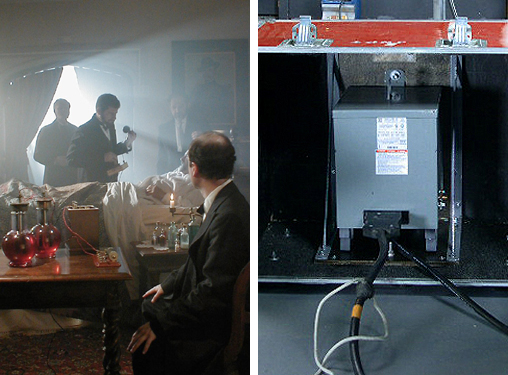
I regularly use transformers to power not only 5ks, but also big HMIs (2.5-4Kw) in situations where a tie-in is not an option and the budget doesn’t permit for a tow generator. For example, I have used this approach repeatedly at a historical mansion in Easton MA called the Ames Estate.

Transformer-Distro_Sam1.jpg

Scene from "Unsolved History" powered from 50A/240V range outlet through step-down transformer/distro at the Ames Estate.​

A popular state fee free location, the Ames Estate, like many historical house/museums, does not permit tie-ins and the electrical wiring in the house is so antiquated that it is unusable. Fortunately, they have a 50A/240 volt circuit in the carriage house for a welder they use to repair the mowers they use at the park. Our standard mode of operation when shooting there is to run 250V extension cable from the welding receptacle to our 60A Full Power Transformer/Distro placed in the entry hall of the house. Using a 60A Siamese at the Transformer/Distro, we then run 60A 6/3 Bates extensions, down to the library, to the second floor, and back to the maid’s pantry. At the end of each run we put another 60A Siamese. A 60A snackbox on one side of the Siamese gives us 20A branch circuits. The other side we leave open for a large HMI or Quartz Light. Now we can safely plug 1200 & 2500W HMIs, or even a 5k Quartz, into our own distribution anywhere in the house.

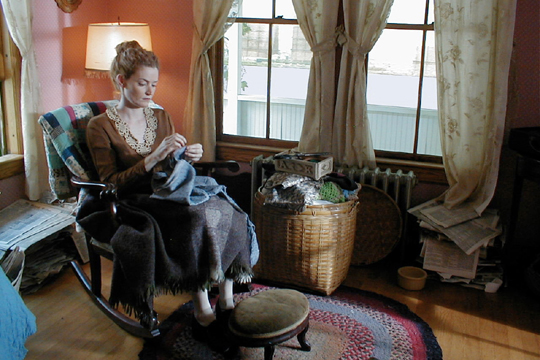
tmfilmstrip1lg.jpeg

Typhoid Mary in quarantine on an island in New York's East River. Note the view out the window of the East River shoreline at the turn of the century.​

To maintain continuity between shots on these dramatic historical recreations, we usually bring a 4kw HMI Par or 5k Tungsten Fresnel (depending on the effect we are after) in a window on one side of the room as a sun source and a 1200 par through a window on the other side as a northern light source. Lights positioned outside, we power off of our modified Honda EU6500is through a Transformer/Distro. We are able to power both lights off our modified EU6500is because our 60A Full Power Transformer/Distro steps down the enhanced 7500W output of the generator to a single 60A/120V circuit (for more details on how this is accomplished I suggest you read my newsletter article on the use of portable generators in motion picture production available on our website. And, since the Honda EU6500is can be placed right on the lawn, we are saved from running hundreds of feet of feeder back to a tow generator in the drive.

tmfilmstrip2lg.jpeg

(The exterior of the actual location used for the quarantine island. A 30' blowup of a picture of the East River at the turn of the century was rigged outside the windows of a house in Arlington MA.)
​

We have been able to use this same basic distribution package (two Transformer Distros, 1- modified EU6500is) at numerous museums and historical houses throughout New England including Sturbridge Village. Fortunately for us, to make ends meet, many historical houses rent themselves out for events and weddings. For that reason, they usually have at least one updated service with 30 or 50 Amp 240 volt circuit for the warming ovens of caterers. I have included in this post several production stills from these shows. For those who would like to see samples of what can be accomplished with this basic package, I have attached these links to production stills of the PBS and History Channel historical documentaries shot entirely, or in part, with just a couple of transformers and a Honda generator.

The History Channel’s “Unsolved History” episode “Presidential Assassins”

American Experienes Typhoid Mary Biography "The Most Dangerous Women in America"

WGBH’s Ben Franklin Biography “Franklin”

Or, use this link for more details about using step-down transformers on set: . By giving you safe and legal plug-in access to more house power through common 240V house outlets, a transformer can quite often eliminate the need for tie-ins or generators.

Guy Holt, Gaffer, ScreenLight & Grip, Lighting rental and sales in Boston
 
A 5k will most likely be a 60amp bates 'stage' pin connection. It's a simple start-up procedure, nothing like an HMI. My only advice is to make sure you don't hot-stab the bates 'stage' pin connection. My concern is more or less for 10k's and 20k's, but if you hot stab a live wire, you can create an arc across the pins, causing them to possibly explode.... and you don't want small metal shrapnel in your face, that's for sure.

So make sure when you connect the lamp head to the end of the 60amp bates cable run, it's not a hot stab... and also try to connect the ground pin in first by allowing it to be the first pin in.

-ryan
 
Last edited:
Back
Top