How to do shallow depth of field with an entire car ?

plainman007

Well-known member
Hi Guys,

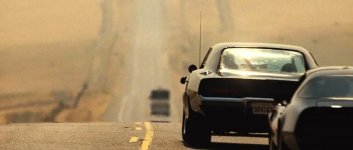
How can i get a car in my video to have this shallow DOF. See the sample image ive attached. In shots like this the car seems pretty far from the lens and yet has such shallow DOF only covering the vehicles.
Is the basis of this shot in the fact that they found a location where the road is a mound and the background is very far from that point ? And does one need to use a 500mm/1000mm lens or something like that to achieve this effect ?

I would want to simulate this look on my Panasonic G7. Can you guys advice which lens i should go for ?
 

Attachments

  • Fast Five 1.jpg
    Fast Five 1.jpg
    34.3 KB · Views: 0
  • Fast Five 2.jpg
    Fast Five 2.jpg
    35.1 KB · Views: 0
Yes, it's a very telephoto lens. You can tell by the perspective and compression of depth. Probably the long end of a zoom? You'd probably be fine with a 200mm at f/2.8. Could maybe achieve it even at shorter focal lengths or smaller apertures. And the road dips behind the car and rises up in the distance, so the background is quite far from the car, rendering it further out of focus.
 
Also the cars are on a hill, so the background behind them is pretty far away. ( that bus might be 500 - 1000 feet from where the cars are )
 
Also see this shot...of a person...

Will a 45-150mm panasonic lens MFT be able to get this look ?
 

Attachments

  • Shallow DOF.jpg
    Shallow DOF.jpg
    23.7 KB · Views: 0
Just remember depth of field is simply the result of lens physics - so narrower, faster shutter speeds and wider apertures reduce it, and wider, slow shutters and tiny apertures increase it. You then do a ballet with the settings, and fiddle the sensitivity and neutral density filters to get the look you want, with the features you need. So if you MUST freeze motion, then your shutter speed has a low limit, meaning you only have the others to fiddle with. Outside, it works for you with bright sunlight and huge spaces - so with a long lens and plenty of light the iris will need wrangling to keep it open - so that's the ND filters, higher speed shutter, and low sensitivity - which usually mean decent results without too much hassle. In the dark, then gain is an enemy, but little to avoid using it. As I said, a ballet - or perhaps synchronised swimming would be a better metaphor - with the thrashing around under the serene surface.
 
Also see this shot...of a person...

Will a 45-150mm panasonic lens MFT be able to get this look ?

MFT needs to shoot at 1 F-stop wider than Super35 to achieve the SAME depth of field. So you will have to see if you can find a fast enough MFT lens ( or an adapted FF lens ) that will give you the same DOF.
 
Just remember depth of field is simply the result of lens physics - so narrower, faster shutter speeds and wider apertures reduce it, and wider, slow shutters and tiny apertures increase it. You then do a ballet with the settings, and fiddle the sensitivity and neutral density filters to get the look you want, with the features you need. So if you MUST freeze motion, then your shutter speed has a low limit, meaning you only have the others to fiddle with. Outside, it works for you with bright sunlight and huge spaces - so with a long lens and plenty of light the iris will need wrangling to keep it open - so that's the ND filters, higher speed shutter, and low sensitivity - which usually mean decent results without too much hassle. In the dark, then gain is an enemy, but little to avoid using it. As I said, a ballet - or perhaps synchronised swimming would be a better metaphor - with the thrashing around under the serene surface.

It is interesting to see shutter spoken of in terms of narrow and wide. My first impulse was to think that is "wrong" but when you think of the shutter in a film camera, shutter angle, it makes sense. ( Did you start your career on film cameras, Paul, and that is why you spoke of shutter in terms of narrow and wide? ) With video cameras there is no physical shutter for there to be narrow or wide openings in that physical shutter, correct? The "shutter" is just the sensor discharging itself in order to replicate the effect of a mechanical shutter.

Its always thrown me off when people speak of f/2.8 being "smaller" than f/8. The reason it throws me off being that the number 2.8 is in fact smaller than 8 but the aperture at f/2.8 is larger than at f/8, not smaller. I think of f/2.8 as being larger than f/8. If I'm at f/4 and you tell me to go to a larger f-stop I'll reflexively take that as meaning a larger aperture. Related to that, when f-stop and t-stop are spoken of in terms of "light" and "heavy" I have to stop and think what they mean. Is a "heavy" 2.8 closer to 4 or is a "heavy 2.8" closer to 2? If memory serves a "heavy T2.8" is towards T4, a "light T2.8" towards T2. I don't hear aperture spoken of in terms of light and heavy as much as I used to. Maybe that's an old-school / film era thing.

Back to the question from the OP and the advice given, does shutter speed impact depth of field in and of itself? Funny, but that advice has me questioning my own knowledge of photography. To my knowledge shutter speed has no impact upon depth of field. The depth of field with a 180-degree shutter is going to be the same with a shutter angle of 300. Or, speaking of shutter in terms of shutter speed ( in still photographer speak ), the DoF is going to be the same at 1/10 of a second as it will at 1/1000th of a second, given that the aperture is the same in both instances.

I rarely alter the shutter angle ( shutter speed ) of my video cameras. I'm at 180 degrees nearly all the time. The primary exception being when I'm hurting for enough light in a low-light situation such as night exterior. Another being when I desire a stroboscopic effect, most often when shooting sports.

I was recently on a shoot, on a 2/3rd " camera, shooting sports news content, and another camera Op came over to me and said "hey, I noticed you have your shutter on. Was that by accident?". His suggestion being that I should have the shutter turned off completely. When he said that to me I second guessed myself and couldn't recall if during all those years I shot on 2/3" cameras we shot with shutter on or off. The Cam OP who brought up the shutter also comes from 2/3" ENG / News background. For the life of me I cannot remember the standard practice from back then. It might have been to keep the shutter off unless you were shooting fast-moving subject such as sports. I have a memory of "shutter OFF" being a common instruction for camera specs. Whereas here in year 2019 I never have a client request shutter be set to OFF. To this day it sounds odd for it to be possible for the shutter to be completely off. That wasn't possible with a mechanical shutter on a film camera.

My Betacam brothers- what was the common practice back in those days in regard to shutter? 180-degree or OFF?
 
Last edited:
plainman- In simplest terms: long lens & large aperture.

f/2.8 or, if you have a lens capable of it, an even larger aperture setting of f/2...f/1.5.

Use ND ( or pola ) to get proper exposure at that large aperture. Avoid using shutter-speed to attain proper exposure at that large aperture. You may want to employ a polarizing filter regardless in order to reduce reflections in the glass of the vehicle(s).
 
JP, generally speaking, shutter was usually OFF, or more correctly 1/60 by default(30 frames/60 fields). I actually did shoot a lot in the beta/sd days at 1/120. It gave it just a little extra ‘pop’, without getting strobey or “flat”, but you did have to watch out around fluorescent lights, because you could see them roll in and out of phase. However I did see the trend with a lot of local guys, mostly those that fancied themselves as the feature/nat-sound piece/art guys, that would shoot all the time at ridiculous shutter speeds(1/500, 1/1000 and higher) and everything looked like a stroboscopic cardboard cut-out. When we transitioned to HD, I carried the 1/120 over when I shot 60 frames real-time, but was asked to stop. And the reason I had been doing it in SD was no longer really necessary in HD, anyway.

So, generally speaking now, when shooting real-time 60fps(news, sports, live, etc.) I do not shoot with the shutter ON(but it’s still 1/60 by default). When shooting 24(23.98), I shoot 180 degree(1/48). I should actually look and see if on my 55, if it keeps the 180 setting when I jump to slow-mo(base 24) or if it turns off and just defaults to the reciprocal of the frame rate. I think it depends on how you have the camera set, meaning if you’re setting shutter in degrees or fractions of a second. Degrees would constantly adjust as the frame rate changes, fractions will stay the same, but will at least be the reciprocal of the frame rate. So if I was shooting 180 degrees and I jumped from 24(1/48) to 60, the shutter would adjust and be equal to 1/120, but if I’m shooting fractions and I jump from 24(1/48) to 60, my shutter speed would only go to 1/60.
 
To clarify- on the 2/3" cameras when shutter was set to "OFF" there was still 1/60th shutter happening. But with the Fs7, when shutter is "OFF" there is no shutter happening?

You were talking about your F55 here or a 2/3" camera?:

"when shooting real-time 60fps(news, sports, live, etc.) I do not shoot with the shutter ON(but it’s still 1/60 by default). "
 
Shutter Off equates to a 360° Shutter Angle.

Or does it? Doesn't it depend upon what camera you are using? As noted, "shutter OFF" on a 2/3" camera isn't actually shutter OFF. Do I have that correct? Or does "shutter OFF" on a 2/3" camera equate to 360-degree shutter even though there is still shutter employed?


EDIT: I found this discussion on the subject of shutter.

https://www.dvinfo.net/forum/sony-xdcam-ex-pro-handhelds/126254-what-do-they-mean-shutter-off.html
 
Hi Guys,

How can i get a car in my video to have this shallow DOF. See the sample image ive attached.

I would want to simulate this look on my Panasonic G7. Can you guys advice which lens i should go for ?

Also see this shot...of a person...

Will a 45-150mm panasonic lens MFT be able to get this look ?

A couple decades ago I would have told you to go learn basic photography. But today's cameras have given us some special tools to visualize this sort of thing, Panasonics, including the G7, especially. So find a person who would like some pictures, in the menus of your G7 find the item CONSTANT PREVIEW and set that to ON. That way, in MANUAL exposure modes ONLY (including in video mode with the dial on top set to the movie cam icon)...

...Easy way: In this video mode touch the red icon on the top left of your LCD. You get 4 options: P, A, S, & M - Touch M and you're there. For stills set the dial on top to M ...

Now, in Manual mode for either stills or video, you can see the actual final result you will get in the EVF as you change settings. Also be sure while setting the CONSTANT PREVIEW to ON you also set EXPO.METER to ON.

With your 45-150 lens set to max zoom and your aperture set to widest open (you'll likely need 4 or 5 stop ND filter here if in daylight) start trying different compositions with your model to find the closest DOF to what you want. The closer you get to your model with the most distance you can manage between model and background elements, the closer you will come to what you want. Your 45-150 can do it if you learn to do your part.

Pretty much everything others posted above is right on. All I've done here is try to put it in practical terms and something specific you can try.
 
To clarify- on the 2/3" cameras when shutter was set to "OFF" there was still 1/60th shutter happening. But with the Fs7, when shutter is "OFF" there is no shutter happening?

You were talking about your F55 here or a 2/3" camera?:

"when shooting real-time 60fps(news, sports, live, etc.) I do not shoot with the shutter ON(but it’s still 1/60 by default). "

Shutter Off equates to a 360° Shutter Angle.

With the exception of some of the "frame accumulation" tricks/modes that some cameras have, even when the shutter is OFF or 360 degrees, it will still equate to the reciprocal of the frame rate, i.e: 60 fps will be 1/60s, 24 fps will be 1/24s, 120 fps will be 1/120s, etc.
 
Thanks to everyone for chiming in. Ill get the 45-150mm and try this out and let you guys know how it went. Panasonic isn't as popular as Canon etc as far as finding sample pics on the internet for a particular lens. I tried seeing samples of pics taken with the above lens and there's literally nothing but for a few family pics posted online. Tried YouTube with more results than google images resulted in. But even there nobody attempted or demonstrated the kind of shot we are talking about.

The panny lens also starts at f4 so i don't think ill need an ND filter even in bright day light. Incidentally can i up the shutter speed instead, since shutter speed doesn't affect shallow DOF does it ?
 
Back
Top