How many see something (technically) egregious in this?

Thanks:-)

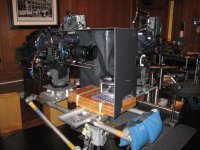
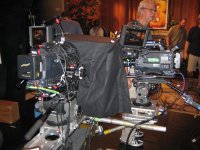
Lighting was 2 4x4ft Kinos for keys and a couple of Arri 300watt Juniors for the back lights, plus a few redheads hitting the BG. Used the same lamps for the interviews. Yes, two cams, side by side.

Ah Kinos.. just can't beat 'em. I have a pair of Divas. The 4 X 4s are fantastic and are next on the list. I hope they mix alright. The Divas spike a little magenta. I like the dimmers on the Divas so I was thinking about the Tegras instead of the Gaffer Kit. It depends on funds. Thanks for the info
 
Last edited:
It's the same basic principle, there's only a couple of degrees difference on the angle, but it's executed with more finesse.


Same basic principle as what? My issue is that there's no change in camera position between a framing and a closer version of the same framing. Even raising the camera height on the Bachmann piece for the tighter framing would help, but more than likely the tighter shot was achieved in post.
 
Same basic principle as what? My issue is that there's no change in camera position between a framing and a closer version of the same framing. Even raising the camera height on the Bachmann piece for the tighter framing would help, but more than likely the tighter shot was achieved in post.
Basic principle being a wide and close from the same angle. OK the one I posted was a couple of degrees out, but I have done single camera punch-ins many, many times and made it work just fine and I don't think I'm being lazy.

You've dissed another crew's work here Chris, I think it's the least you should do, by way of comparison, is show us all an example of your own work so we can see just how obsessively picky you are. Come on man:-)
 
Last edited:
I think it's likely an entirely different reason they did that. granted all the possibilities listed are possibly why they chose to do those punch ins, but my guess is that they did the punch ins to cut between different takes. it's a choice between a jump cut and a punch in cut, if that's the case then i'd have to agree with the choice.

it could be that the talent(or lackthereof) told them she could deliver the message sinatra style (one take....) but when they saw she couldn't they said ok, let's bite size it down and use punch ins in post to make it work.
 
Basic principle being a wide and close from the same angle. OK the one I posted was a couple of degrees out, but I have done single camera punch-ins many, many times and made it work just fine and I don't think I'm being lazy.

Your example is not the example I asked to see. I wanted to see an example that shows the same axial cut technique used in a professional piece. To be fair, she's looking at the camera and in the only political commercials I ever shot, I dollied in on the subject when they delivered their message. This is a long form piece obviously, so they really did need the variety of two framings, but I hate the way they did it.

Everything I shoot has subjects looking off camera. If I were to shoot a long form piece with one subject delivering an uninterrupted message, I'd definitely prefer to use 2 cameras off axis from one another even if only by height.

If you want to see my work, go nuts and just click on my signature.


I do think it is interesting what you zeroed in on as a fault, vs what others came up with. For me the overall look was pretty 'bad', because I personally hate haze, and so that effect used throughout for me was a 'far more egregious error', than the 'jumpy' cuts. Even with that opinion about 'haze', I can accept that someone will do it 'well'... in the present case, I think it was done badly...

The other issue that I saw was the necklace 'changing'... and that may be sort of consistent with your criticism, namely not enough attention to such details, such as 'eye lines' or 'matched cuts', etc.

Thoughts that did occur was that the shoot was done 'gratis', or for minimal money, and so, got 'what was paid for'...
 
I do think it is interesting what you zeroed in on as a fault, vs what others came up with.

As do I.

The other issue that I saw was the necklace 'changing'... and that may be sort of consistent with your criticism, namely not enough attention to such details, such as 'eye lines' or 'matched cuts', etc.

That's not related to cinematography and no, my issue is with the choice to use the axial cuts.

Thoughts that did occur was that the shoot was done 'gratis', or for minimal money, and so, got 'what was paid for'...

I'm guessing there were significant time constraints, and possibly this was low budget, yes. But someone made the decision to (most likely) enlarge the frame in post, more than likely ahead of the shoot day. I'm of the mind that that was a bad decision but in the end, I apparently have a pet peeve about the axial cut style of frame changes. I do think it's entirely possible that the reaction to this style of frame change would have been viewed a lot differently 20 years ago (or so) for THIS style of video.
 
A lot of times the lighting is so complex and so near the edge of frame that moving cam a few degrees could reveal gak and necessitate a relight. And again, no time for any of that.
 
I recently shot some interviews in the manner you are referring to as 'egregrious'. Here are a couple screen grabs from it. I can't actually show you the edit due to contract reasons, but it cuts together nicely without looking too jumpy. Needless to say I would have liked to have changed the angle, but the time constraints didn't allow for me to move and re-tweak the lighting.

https://www.dropbox.com/s/yfdptltxdmt1pmi/Maia 1.tif
https://www.dropbox.com/s/1r2eyy3hwcg7b3k/Maia 3.tif
https://www.dropbox.com/s/10tqbwbq504dwhq/Maia 5.tif
 
Some years ago I was asked to shoot a series of clips that required wraparounds. Said wraparounds were to be shot with two cameras simultaneously, a wide and a tight. On discussion with the director, I asked which one he'd like to be the more off-camera eyeline. He said he wanted both to have an eyeline into the lens. I suggested that was a single camera shoot with two sizes, for obvious reasons (this was pre-RED or any video cameras greater than HD resolution, so digital blowups weren't an option). A few days before the shoot I was told that due to time constraints with talent, we would have to shoot with two cameras delivering two sizes simultaneously, with matching eyelines into camera. And, the cameras needed to be able to dolly in.

After a bit of chewing the inside of my cheek, I secured a dusty 3D mirror rig (this was also pre-current 3D popularity) and instead of fixing two cameras at right angles to the mirror, we mounted the cameras on individual heads so they could pan and tilt independently while still shooting with a common axis via the mirror. The whole thing was mounted to a Fisher 10, with two operators riding. It all came together the morning of the shoot and was an absolute nail-biter for me (what if the mirror or the cameras or both vibrated when we moved the dolly?) but fortunately, 30 minutes before the illustrious Mr. Seinfeld arrived, everything checked out fine and off we went.

So yes, in theory these are axial cuts--but they are greater than 50% difference (the standard rule of thumb for punch-ins) and the camera movement helps. Link to one of the clips: http://charlespapert.com/DP/DPseinfeld.html
 

Attachments

  • IMG_0275.jpg
    IMG_0275.jpg
    113.9 KB · Views: 0
  • IMG_0279.jpg
    IMG_0279.jpg
    121.5 KB · Views: 0
There, that's better :cheesy::

Note; the eyes are not on the same line in this piece or Charles' piece. Both cuts work, so I think we can dismiss the "eye's must be level" rule. Shot size and balance is far more important.

Oh, and I looked at your work Chris. Some great work, no doubt, but I'd like to bring your attention to one job; "Millard Fillmore Hospital". Looks like a punch-in to me, and with a soft-cut - or is a hard dissolve...
 
Last edited:
So yes, in theory these are axial cuts--but they are greater than 50% difference (the standard rule of thumb for punch-ins) and the camera movement helps. Link to one of the clips: http://charlespapert.com/DP/DPseinfeld.html

That doesn't bother me at all and don't nearly look as "axial" as the Bachmann piece. Hmmm...

The old rule is 30 degrees off axis to avoid the jump cut effect from what I remember.

Note; the eyes are not on the same line in this piece or Charles' piece. Both cuts work, so I think we can dismiss the "eye's must be level" rule. Shot size and balance is far more important.

It's probably scale that makes the biggest difference. On the Jackie O. piece, the camera is lower for the wide shot and higher and off axis for the closer shot, by the way.

Oh, and I looked at your work Chris. Some great work, no doubt, but I'd like to bring your attention to one job; "Millard Fillmore Hospital". Looks like a punch-in to me, and with a soft-cut - or is a hard dissolve...

That was done in post. I had nothing to do with that :undecided
 
Whoa whoa whoa bro . .. 50%? I thought it was 20%? Did the rules change while i was away at summer camp?

The rule as I've always known it is: double the focal length gives you a good cut. 20% is definitely jump-cut territory. Did you mean 20 degrees off axis? Two very different concepts. Given that we are talking about punch-ins, i.e. zooming in from the same vantage point, I stand behind the 50% rule. In the Bachman piece, the focal length variation is less than 20% different between the two setups. I'm sure someone could take a ruler to the screen and determine the exact percentage, but point being it's nowhere near enough to keep it from looking jumpy.

As far as the eye lines being different heights on the piece I linked--they are completely identical. The whole point of that cockamamie rig is that Jerry is looking directly into the lens of two cameras at the same time.
 
Last edited:
The scale difference is about 76% as far as I can tell. And on 2nd look, it appears they definitely did reframe (by raising the camera slightly) for the closer shot. I'd say the major issue (to my eye) is the nearly axial framing more than the scale change but really the eye height IS off also so that contributes to the jarring effect I'd say.

Screen shot 2013-05-31 at 11.57.32 AM.jpgScreen shot 2013-05-31 at 11.57.45 AM.jpg
 
Last edited:
I think i had always heard it called the "20% rule": either the focal length or cam angle must change by 20% or more for it not to look like a jump cut.
 
Back
Top