how do i treat a room for sound?

ugafan

Looking for a woman
i know some rooms are better than others for capturing dialogue, but i'm fairly clueless as to what i can do to acoustically treat a room. for example, let's say i am recording a dinner scene. the room is 15x12 and there is a dining room table in the center. what can i place in the room to improve the recording environment? heavy curtains..sound blankets..foam? any tips or product recommendations you have would be helpful.
 
It depends on many factors. You don't need to answer to US, but these are some questions to ponder:
How noisy is the room?
How many actors with speaking parts?
Are you using a boom (or two) or body mics?
How clean does it need to be? (Primary dialog, background, etc.)
Is this for a full suspension-of-disbelief scripted drama, or it is "reality"?
Will there be music under the dialog (to mask the acoustics that you can't tame within your resources)?
How much gear do you have available? (mics, channels of recording, light stands, sound blankets, etc.)
How much time do you have for setup and strike? (And for testing and experimenting)

Yes, you are on the right track. Basically anything that can absorb internal sound or block external sound is your friend.
Note that absorbing internal sound and blocking external sound are different problems with different solutions.
Many materials and techniques have been used. In addition to the obvious "sound blankets" hanging over C-stands,
there are people who prop up mattresses around the walls, or pile up bales of hay to block sound.
Limited only by your imagination.
 
If you look on the net, there are lots of how to articles as well as U-Tube videos. I am just completing the sound treatment of a small studio space where I could do interviews or possibly music video. This space was a horrible box that resembled an echo chamber. I purchased some of the less expensive Auralex foam 2x4 panels in bulk and glued them to foam core. I mounted them on the walls with heavy duty Velcro. I split some of the panels lengthwise and put them in the corners, these are called bass traps. Although I didn do any of this scientifically, the end result was IMHO, very respectable. Certainly a more scientific approach, maybe hiring an consulting engineer would have created a better result, but I don play at that level, yet. An extra benefit is the panels can be quickly removed and transported to a set. They can be easily hung from most anything. The total cost for 12 panels including foam, foamcore, Velcro, and adhesive was less than $400.

Another option is to go with furniture pads. In my space, on one wall, I have a foam green screen curtain. Carpet, curtains, furniture and bookcases all help. Now there is real science involved in true recording studios, and it gets very expensive, but in my case, I made a significant improvement with a modest investment; less than the cost of a quality mic.

Grant
 
There's this fabric called molton or stage molton (bühnenmolton in German). It's usually used on stages. It's a very thick and compact cloth. You could hang it on some cheap foto background kit.

Different materials absorb different frequencies, but the most important thing to get rid of is reflections/echo. The rest you can usually fix with EQ in post. But room boxiness is very hard to get rid of.

Also, don't forget to treat above and below. A thick carpet under the actors or hanging cloth above their heads if possible.
 
I believe in the US that would be Velour, at least that is what what those kinds of theatrical curtains are made of here. Packing blankets are also good.

One thing to keep in mind that new/ low budget filmmakers often over look is that you are shooting the set not the room. Your small intimate meal might be the corner of a huge room. The point is you do not have to shoot the "real" space, because the camera only sees what you let it. So if having the table in the middle is giving you a lot of bounce maybe moving it off center and hanging some blankets in the "extra" space you just created will work?

THe other thing is the closer you can get the mic the less you are going to hear the room. Plant mics or lavs might help. If it's a lock down then shooting a plate and then booming in frame might work well. If you are shooting in a traditional fashion (establishing then reverses), then you don't generally have to worry about the wide shot because you will use the audio from the CU where you can get in close.
 
thanks for all the great suggestions.

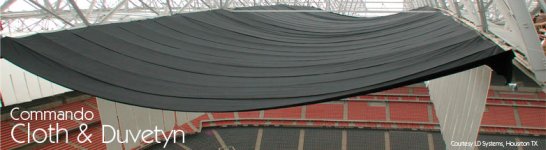
between the auralex foam, the sound blanket, and the commando cloth, which do you think would absorb the best?
 
The foam would absorb more just because there is more enclosed air within the mass of the cells.
The cloth isn't nearly as absorbing for sound, but it has many uses to block and/or absorb light.
 
Actually I had read, so? about the accuracy, that the main function of open cel foam is not absorption since it's open cel and doesn't hinder the sound pressure much is to break up and defuse reflections. Cloth on the other hand offerers a soft surface that doesn't reflect much. When we did the Foley room we put up packing blankets and then covered that with foam. The combo was almost as effective as using fiberglass panels.

For most on set situations you are usually more interested in cutting down on reflections than actual "absorption". You usually want the "space" to sound like a space and not a sound booth. Sound blankets, or just packing blankets, are pretty effective and easy to hang. Foam could get a bit problematic in that how are you going to hang it. They should both work at knocking down the reflectiveness of the space.

I have no idea what "commando" cloth is.
 
A note on fabrics, and foam for that matter, fire retardant products should be used. Hot lights such as tungsten is a bad combo with materials that catch fire easily. I ended up thinking i could have used some kind of packing foam with the same results as the Auralex I purchased, I wanted to make sure the foam had a fire retardant rating. To be sure, any burning foam is really nasty, but at least the fire retardant types probably have a higher flash point.

The panels I built are very very light, and hanging them with Velcro worked great and can be easily taken down and moved. GooGone will remove the velcro tabs on the walls. I used 1" squares and if you soak them for an hour, they just melt away.
 
A lot of pro guys in big feature films (eg. Hollywood) use moving blankets. Go to a place with reverb in your house and experiment. Move some carpets, towels, chairs, and see how better it is. Moving stuff around can make the room sound much better. Im working with low budget or no budget shorts now, and I go to the locations once everything is in place, clap my hands around looking for reverb and then throw what I can, blankets, carpets, etc. Suggest the production to make the actor move a little more to the left or to the right when speaking. My 416 has been sounding great indoors.
 
Back
Top