Horrible flicker noted under LED stage lighting, example video.

David G. Smith

Steak Knife Member
I shot some concert footage at a small venue that uses all LED stage lighting. All of the footage is unusable because of horrible rolling shutter artifact. I used a T2i, at 1080 24P with a 1/60th a second shutter speed. My question, is this an unresolvable rolling shutter issue, or can it be resolved, while shooting, by the use of a different shutter speed? The LED lights were controlled from a central board like a DMX controller and could recreate a huge pallet of color. Does anyone know about LED lighting system design? Does the LED flicker remain constant, or does it change with lighting intensity or other factors? This is a real eye opener for me. I have experienced the extreme rolling shutter artifact from camera flashes and emergency beacon type of lights, but this really hit me from left field. I did a google search and there very little that has been posted about this issue. I am afraid that with the push to be "Green", and the falling prices of LED lighting fixtures making them more prevalent, we are going to run into this issue more and more.


I did a search on this forum and the only post I could find that comes close to addressing this is the one below by Barry from 2008. Are there any other threads that may address this issue?

http://www.dvxuser.com/V6/showthread.php?129221-Rolling-shutter-fluorescents-HMI-and-quot-shutter-off-quot

Anyone shooting concerts, or anywhere else that may be using LED fixtures for their stage lighting, be warned, and check it out before shooting.
 
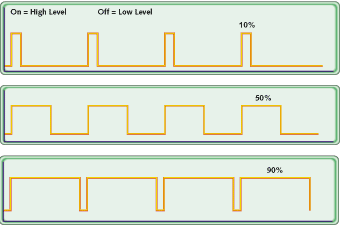
These lights are controlled by Pulse Width Modulation (PWM). Essentially, the LEDs are driven by a square wave which has a constant period. To change the intensity of the light, the ratio between on and off within that period (duty cycle) is changed.

The frequency of the base square wave probably varies depending on the different fixtures although it may be 60 Hz for you in the US. The best idea is probably to test out any lights with the camera system you intend to use before the shoot and adjust the shutter speed within reason to eliminate the effect.

on-off-pwm-duty-cycle.gif
 
Yeah Andrew, I read that article on PWM. However, I am not sure that the base square wave is slaved to the AC mains frequency in North America (60 Hz) or not. The power to the LEDs is DC, so they would not have to be slaved to the mains. I would bet that it has been standardized, but where would that info be available? You are absolutely correct, testing with the lighting system before hand is essential. The problem is, the problem I encountered was with one of those situations where the whole shot was a spur of the moment thing, you know.... "Dude, my nephew's band is playing tonight... wanna come and shoot them?....". It was a fun night out and the venue they played at was a punk club we used to frequent back in the day, but when we got there.... the fu*kers had gone and remodeled... and installed the LED stage lights! While the problem with this "Gig" is really just an embarrassment, and not an issue of money, or repetitional loss, I do frequently make money in gigs that require "Run and gun" shooting in environments where pre-planing or prep is not an option. As I noted above, I think that LED lighting is going to be more broadly adapted, and I think that this is going to be an issue that will crop up more and more frequently.
 
Yeah Andrew, I read that article on PWM. However, I am not sure that the base square wave is slaved to the AC mains frequency in North America (60 Hz) or not. The power to the LEDs is DC, so they would not have to be slaved to the mains. I would bet that it has been standardized, but where would that info be available?


If someone were to ask me to design a cheap PWM circuit... I'd look up the minimalist NE555 timer example, a 'ubiquitous' timer chip, and probably set the frequency at 100 Hz... or so, based on an equally ubiquitous set of application examples.

The example found here:

http://www.dprg.org/tutorials/2005-11a/index.html

Has a base frequency for the PWM of 144 Hz...

The point being, for this sort of thing, there probably is no 'standard'... just whatever some one threw together that worked well enough to avoid human eye 'stuttering'....

Speaking of which... I've noticed this on car tail lights, where if you glance away from some of these cars, you will see a 'strobing' effect... probably due to using LED's and a PWM circuit... That way one could have a low duty cycle for 'night on', but then change the duty cycle up for the 'brekes appliied' indication...

The only way to avoid this would be some sort of in camera 'sync' circuit/detector, that would trigger the shutter on the light pulses detected... all the while maintaining the set frame rate...

Hemm... perhaps I could design a product that would at least indicate what the LED PWM frequency most likely may be... and give a shooter some sort of 'fair warning' about what shutter speeds to use...
 
Last edited:
If someone were to ask me to design a cheap PWM circuit... I'd look up the minimalist NE555 timer example, a 'ubiquitous' timer chip, and probably set the frequency at 100 Hz... or so, based on an equally ubiquitous set of application examples.

My tests show that nothing short of around 18KHZ is good for these kind of LED PWM circuits if you really want to avoid flicker at most dimmer settings. Those 555 type circuits work best at the lower frequencies so its a catch 22. You can make them work at higher frequencies but it takes a lot more to do it than the simple version.
 
So, is it still worth getting LED lights now? How come LITEPANELS never mentioned such issue with their products?
 
I see this often in weddings with cheaper LED systems the dj's bring and LED on camera lights that photographers bring for fill. It is not the best solution but I usually change my shutter speed until it is gone away. I may be losing the filmic 180 but often I am the only one that can tell and it always better then awful flicker. I have seen much much worse. That being said it almost looks like some thing I would do with my visualist gigs when I project onto the band. If it was only on the Amps it would actually look pretty cool.
 
Cool Lights LED panels don't have such issues either.
Is this because of the frequency of Cool Light LED panels is higher than most of the cheap ones? I am unclear on your statements there.
By the way, I am planning to buy a lot of LED lights in the next 2 weeks for expanding my business for rental. Can you PM me on what is your current useful products that I might be interested in?
 
Its important to distinguish between LED stage lighting (or LED commercial lighting for that matter) and LED lighting specifically made for film and television. LED stage or commercial lighting has no particular requirements to not show flickering with video or film cameras. They get it good enough for eyes not to see flickering. You can find all kinds of moving head HMI spots that would show flickering in some circumstances as well. Film and television lighting of course has this requirement to work well with cameras. Can you find some cheap film and television lighting that has flickering issues? Of course, because not all these companies understand all that well how to make a dimming circuit flicker free. Some of them may not even understand how to test for it. I've visited lots of companies like that. Its not all that easy actually to do it right, especially for LEDs.
 
Last edited:
That is the crux of the problem; the eye can adapt out flicker at pretty low frequencies. Remember, silent movies used a frame rate of 16 fps (with variations from 12 to 23 fps through the silent era depending on other factors), and found that flicker was not an issue. Cool lights, I have a question. With a dimming LED, like the ones I ran into, does the frequency change with changes in the lighting intensity or does the frequency remain constant for each fixture without regard to the light intensity? In other words, does dimming change the frequency of the light?
 
No the frequency itself doesn't change just the pulse width. At full intensity, normally with a circuit like this there is no PWM at all. Once you start to dim what happens is the PWM kicks in and the pulse goes from very wide to very narrow. You are therefore just varying the width of the pulse.

So the wide pulses represent time the LED is lit and the narrower ones then are less time the LED is lit. At some point all PWM circuits, even the best will flicker. But, on the best ones, the flicker happens at such a low intensity that the light from the panel isn't usable anyway to light anything of significance.
 
As far as stage lighting goes, we've tested some of the more popular fixtures for live-event and concert lighting in addition to white / TV LED lighting. Professional-quality lights like the Chauvet COLORado do not exhibit rolling or flicker in any mode on the HPX300 we tested against. We continue to test professional fixtures as we gain access to them.
 
Back
Top