Hobbit: Overly detailed 5K and HFR failing to please

OK, you're talking about the '70s and '80s, and I agree, many BBC productions were shot on video at the time. But these days, what's 50i/50p instead of 25p? I've seen a lot of British drama in the last decade and I can't think of one.

But no one's talking about the "quality" of the drama -- writing and production value don't have anything to do with frame rate.
As far as the last sentence goes, the relevance is that in the UK there's been a lot of decent quality drama broadcast with 50 fps motion - as well as much with 25fps. Hence the conditioning of 24fps=good, 50fps=bad has never been as strong as it may have been in the US. Where I believe that in the same period, equivalent (higher quality) shows would always have been shot on film, and probably 35mm?

As far as production today goes, then nothing I've written should be taken as "24/25p is bad" - rather that it's not as "magic" as is sometimes made out. Practically, the choices today are 1080p/25 or 1080i/25 for UK broadcast. It may be true that nowadays - with modern cameras - most TV drama gets shot 25p, but that's as much to do with progressive being preferred for such work - and 50p is not (yet) seen as generally practical. 1080i/25 will give smoother motion - but lower vertical resolution due to the interlace effect. Shooting 25p also has benefits for overseas compatibility over i25 - it can be slowed down and treated as 24p.
Also, no one's trying to convince you that you ought to like 24 fps or 25 fps when you obviously don't. We simply don't agree with the idea that 1) it doesn't matter, 2) the difference is attributable to things other than the frame rate, and 3) people don't notice or care.
If you look back through the thread, you'll find I've never said anything such as "I don't like 24 or 25 fps". What I HAVE said is that I don't believe there is any special "mystical" quality to it, which is a very different thing. I also don't believe that "people don't notice or care". They obviously do - or this thread wouldn't exist. But as has been said earlier, the question is "why"? And personally I think it's down to past experience, people being happy with what they are familiar with. To quote Peter Jackson, from the link someone posted earlier:
Film purists will criticize the lack of blur and strobing artifacts, but all of our crew--many of whom are film purists--are now converts. You get used to this new look very quickly and it becomes a much more lifelike and comfortable viewing experience.
As far as your second point goes ("We simply don't agree with the idea that .... 2) the difference is attributable to things other than the frame rate.....") then no, that I don't agree with.

And it's easily disproven. If the difference (I assume you do mean between film and video "looks"?) was solely down to framerate, then it must follow that by posting just framegrabs you wouldn't be able to tell which was which? And traditionally that just has not been true. Go back to 1970s Dr Who, and if you gave me single frames from the location footage of two episodes - one shot 16mm film, the other electronic OB, your logic would suggest I couldn't tell the difference between them? I'd put a large bet I could, and I think most people on this forum could as well.

So surely there must be factors aside from framerate which distinguish between traditional film and video looks?
 
As far as the last sentence goes, the relevance is that in the UK there's been a lot of decent quality drama broadcast with 50 fps motion - as well as much with 25fps. Hence the conditioning of 24fps=good, 50fps=bad has never been as strong as it may have been in the US. Where I believe that in the same period, equivalent (higher quality) shows would always have been shot on film, and probably 35mm?

I can't speak to the mind of anyone in Britain, so I don't know if they saw a difference/had a preference or not.

As far as production today goes, then nothing I've written should be taken as "24/25p is bad" - rather that it's not as "magic" as is sometimes made out. Practically, the choices today are 1080p/25 or 1080i/25 for UK broadcast. It may be true that nowadays - with modern cameras - most TV drama gets shot 25p, but that's as much to do with progressive being preferred for such work - and 50p is not (yet) seen as generally practical.

Why wouldn't 50p be practical? It's used in "live"-type shows in the UK all the time. News, Pop Idol, Britain's Got Talent, sports, the whole gamut, just like 60p is used for those things in the US. Why couldn't drama be shot with it?


If you look back through the thread, you'll find I've never said anything such as "I don't like 24 or 25 fps". What I HAVE said is that I don't believe there is any special "mystical" quality to it, which is a very different thing. I also don't believe that "people don't notice or care". They obviously do - or this thread wouldn't exist. But as has been said earlier, the question is "why"? And personally I think it's down to past experience, people being happy with what they are familiar with.

Fair enough.


As far as your second point goes ("We simply don't agree with the idea that .... 2) the difference is attributable to things other than the frame rate.....") then no, that I don't agree with.

And it's easily disproven. If the difference (I assume you do mean between film and video "looks"?) was solely down to framerate, then it must follow that by posting just framegrabs you wouldn't be able to tell which was which? And traditionally that just has not been true. Go back to 1970s Dr Who, and if you gave me single frames from the location footage of two episodes - one shot 16mm film, the other electronic OB, your logic would suggest I couldn't tell the difference between them? I'd put a large bet I could, and I think most people on this forum could as well.

One of these characters is in 60p and the other in 24p, and they're being shown, on screen, in their respective frame rates at the same time. Which is which?

2sm.jpg


One of these is 60p. The other 24p. Which is which?

Image2.jpgImage1.jpg

Granted, you have a 50/50 chance of getting it right, but be honest -- which is which?

As for the question about Doctor Who and one being shot on 16mm film and the other being shot on video, sure, you can tell the difference in still shots. But in that case, there are many differences other than frame rate. In the above shots, there aren't.
 
Am I the only one that sees this as ironic? The argument seems to be 24fps was not the best frame rate artistically, didn't look the best, it was just used to sync with sound and save on film stock.

So, there's no need to cling to 24fps, since we don't use film stock so much now, etc.

the idea is let's replace what was supposedly only used for technical reasons and not what looks best artistically with something different, but again for technical reasons not necessarily what would look best?
Welcome to the wonderful world of legacy standards! :)

Firstly, I'm not sure where the sync aspect comes in? On all comopt systems, corresponding sound and vision are separated - they have to be as it's not physically possible to have the film gate and sound head in the same place. (For 35mm, the sound is 21 frames behind the picture. It's why if there's a bit of damaged film you see the damage - then hear it nearly a second later.) In this respect, framerate is irrelevant for any given standard - as long as the separation is the same at recording and playback, there won't be a problem.

The audio aspect to "why 24fps" was solely speed AFAIK, and too low a speed giving an unacceptable frequency response. (Same principle as 7 1/2 ips being preferred to 3 3/4 ips for analogue audio recorders.)

And nearly all engineering matters have to involve a degree of compromise - knowing where to draw the line between absolute quality and cost. I think the engineers of about 90 years ago did pretty well, all things considered.
 
Why wouldn't 50p be practical? It's used in "live"-type shows in the UK all the time. News, Pop Idol, Britain's Got Talent, sports, the whole gamut, just like 60p is used for those things in the US. Why couldn't drama be shot with it?
All you mention there are 1080i/25 - interlace at 50 fields per second. Not the same as 50p. Until recently high quality 1080 standard 50p cameras just weren't available. They may be starting to come - but there is no 1080p/50 transmission standard in the UK at the moment, and I think that's true for the rest of the world.

One of these characters is in 60p and the other in 24p, and they're being shown, on screen, in their respective frame rates at the same time. Which is which?
David, I'm not saying there isn't any difference between the "look" due to different framerates, all else equal. I did start off with "If the difference was solely down to framerate....."

What I'm saying is that it isn't the ONLY difference, and hence that's why it's easily possible to tell the difference between film and video sequences on such as 1970s Dr Who - by framegrabs alone.

And the whole point is that when "video look" and "film look" have been traditionally compared, then what is generally derided often comes down far more to the comparative look of frames, than the differences due to motion. Dynamic range, blown highlights, too much detail enhancement, too little "real" resolution etc etc. All visible on frame comparisons, nothing to do with motion.

Nowadays, electronic cameras are vastly better than they were, to the extent that it's now far, far more difficult to tell individual high quality HD video frames apart from film. So - with all those traditional "video look" flaws gone, does the only difference that's left - motion rendition - matter? Does 24p really constitute enough of the "film look" *by itself* to make everyone go, wow! Shall we agree to differ?
 
All you mention there are 1080i/25 - interlace at 50 fields per second. Not the same as 50p.

No, I specifically said 50p:

Why wouldn't 50p be practical? It's used in "live"-type shows in the UK all the time. News, Pop Idol, Britain's Got Talent, sports, the whole gamut, just like 60p is used for those things in the US. Why couldn't drama be shot with it?


Until recently high quality 1080 standard 50p cameras just weren't available.

The BBC, at least, has been using Panasonic 50p cameras for any number of years now.


They may be starting to come - but there is no 1080p/50 transmission standard in the UK at the moment, and I think that's true for the rest of the world.

There's no 1080p broadcast anywhere, but that doesn't mean 50p or 60p cameras aren't used. They are.


David, I'm not saying there isn't any difference between the "look" due to different framerates, all else equal. I did start off with "If the difference was solely down to framerate....."

I showed you grabs from footage where the only difference, indeed, was the frame rate. One example was cinematic. One example was "newsy." Could you tell the difference?


What I'm saying is that it isn't the ONLY difference, and hence that's why it's easily possible to tell the difference between film and video sequences on such as 1970s Dr Who - by framegrabs alone.

Yeah, and you aren't going to find examples where the only difference in the footage is the frame rate, so that's not a good comparison. You have to remove every other variable.


And the whole point is that when "video look" and "film look" have been traditionally compared, then what is generally derided often comes down far more to the comparative look of frames, than the differences due to motion. Dynamic range, blown highlights, too much detail enhancement, too little "real" resolution etc etc. All visible on frame comparisons, nothing to do with motion.

Nowadays, electronic cameras are vastly better than they were, to the extent that it's now far, far more difficult to tell individual high quality HD video frames apart from film. So - with all those traditional "video look" flaws gone, does the only difference that's left - motion rendition - matter? Does 24p really constitute enough of the "film look" *by itself* to make everyone go, wow! Shall we agree to differ?

All I can tell you, harddrive, is that the frame grabs above are from a program specifically designed to answer all of those questions. The film noir sequence absolutely looks filmlike in 24p, and the portions which are purposely shot at 60p look video-ish, soap-opera ish. That was the whole point of doing it. And then, just to emphasize the point, the 60p portions are shown in 24p and the difference between it and the 24p footage totally dsiappears -- it all looks filmlike.

As for the newsy-looking footage, that, too, was designed for the specific purpose. The 60p footage looks "live," looks "newsy," looks "videoish." The 24p footage looks "filmic." The only difference is the frame rate.

And you could not tell which was which for any of it from the frame grabs, because other than frame rate, they are identical. You have to see it in motion to see the difference.
 
Welcome to the wonderful world of legacy standards! :)

Firstly, I'm not sure where the sync aspect comes in? On all comopt systems, corresponding sound and vision are separated - they have to be as it's not physically possible to have the film gate and sound head in the same place. (For 35mm, the sound is 21 frames behind the picture. It's why if there's a bit of damaged film you see the damage - then hear it nearly a second later.) In this respect, framerate is irrelevant for any given standard - as long as the separation is the same at recording and playback, there won't be a problem.

The audio aspect to "why 24fps" was solely speed AFAIK, and too low a speed giving an unacceptable frequency response. (Same principle as 7 1/2 ips being preferred to 3 3/4 ips for analogue audio recorders.)

And nearly all engineering matters have to involve a degree of compromise - knowing where to draw the line between absolute quality and cost. I think the engineers of about 90 years ago did pretty well, all things considered.

I think that's missing the point.

IMO, the 24 fps stayed that way for so long, and then video emulated it with 24p, because it's pleasing to the eye.

The counter argument is that 24fpswas just a technical convenience, not a frame rate that was picked on purpose and then stood the test of time because it looks so pretty.

Then the argument for HFR is that with digital technology we don't have to settle for a frame rate that isn't optimal. Instead we can use the BEST frame rate for motion.

Ok, so what is that "best" frame rate? Something determined with tests to see what is the most pleasing frame rate to the eye? No, it's based on teh supposedly flawed frame rate, which is just doubled.

To replace a supposedly flawed frame rate, we base the new frame rate on that flaw?

That's ironic.
 
No, I specifically said 50p:

The BBC, at least, has been using Panasonic 50p cameras for any number of years now.
The only Panasonic cameras at all capable of 50p I'm aware of that the BBC has used much have been Varicams for such as the NHU in the past. But the whole point of their usage has been to get Varispeed ramping - so for a base framerate of 25fps. Until quite recently, for all practical purposes, shooting 50p meant the 720 system - and no broadcaster in the UK uses that. (Though some Scandinavian broadcasters do.)

*ALL* UK HD broadcasts are to the 1080 system - no 720. Including all BBC HD transmissions. And because 1080p/50 never got included in the transmission spec that effectively means 1080i/25, and hence 1080p/25 can be coped with via 1080psf/25. I can categorically assure you that the programmes you mention ("News, Pop Idol, Britain's Got Talent, sports, the whole gamut....") are originated and transmitted in 1080i/25 here.

If you get 60p for such as News in the States, I can only assume it's via a 720p/60 station? As I've said - there are no 720 broadcasts here.

You said "why couldn't drama be shot with it?" Well, it could, but at limited resolution of 1280x720 - so why? The decision was taken to go with the 1080 system - hence the sensible options are 1080i/25 and 1080p/25. I can see you don't believe me, but try http://www.bbc.co.uk/guidelines/dq/pdf/tv/TechnicalDeliveryStandardsFileBBCv2.pdf section 2.1. That's from the BBC - other broadcasters have similar guidelines in place. As more 1080p/50 cameras suitable for drama come onto the market, it may well be that the master will increasingly be made 1080p/50, however it's delivered - but that's more likely to be bypassed for 4K/50p. If such happens at all now, believe me, it's very rare.
 
The only Panasonic cameras at all capable of 50p I'm aware of that the BBC has used much have been Varicams for such as the NHU in the past.

There was a press announcement, posted here, some years ago about the BBC's mass purchase of P2 cameras -- the big guys, not just the little 1/3" models. (As well as their adoption of Adobe Creative Suite to edit it, beacuse it had the best P2 integration, but that's another conversation.) I was going by that. If I'm incorrect about the cameras used, then mea culpa.

And now that I think about it, those cameras would be 50i at 1080 anyway, so I was confused on that point. However . . .


But the whole point of their usage has been to get Varispeed ramping - so for a base framerate of 25fps. Until quite recently, for all practical purposes, shooting 50p meant the 720 system - and no broadcaster in the UK uses that. (Though some Scandinavian broadcasters do.)

*ALL* UK HD broadcasts are to the 1080 system - no 720. Including all BBC HD transmissions. And because 1080p/50 never got included in the transmission spec that effectively means 1080i/25, and hence 1080p/25 can be coped with via 1080psf/25. I can categorically assure you that the programmes you mention ("News, Pop Idol, Britain's Got Talent, sports, the whole gamut....") are originated and transmitted in 1080i/25 here.

If you get 60p for such as News in the States, I can only assume it's via a 720p/60 station? As I've said - there are no 720 broadcasts here.

I didn't say you could "get" 1080p over the air. I said specifically that there's no 1080p broadcast anywhere. I'm only saying that the cameras used are (at least in many cases) 60p.

But broadcast isn't acquisition. 50p can be transmitted as 50i with no problem.


You said "why couldn't drama be shot with it?" Well, it could, but at limited resolution of 1280x720 - so why? The decision was taken to go with the 1080 system - hence the sensible options are 1080i/25 and 1080p/25. I can see you don't believe me, but try http://www.bbc.co.uk/guidelines/dq/pdf/tv/TechnicalDeliveryStandardsFileBBCv2.pdf section 2.1. That's from the BBC - other broadcasters have similar guidelines in place. As more 1080p/50 cameras suitable for drama come onto the market, it may well be that the master will increasingly be made 1080p/50, however it's delivered - but that's more likely to be bypassed for 4K/50p. If such happens at all now, believe me, it's very rare.

OK; it's not a question of not believing you; I know full well that all of Europe broadcasts at 1080/50i. I didn't argue with that, at all.

Your link doesn't say which cameras are used, only what the broadcast delivery requirements are. That's independent of acquisition.

But whether the cameras are 50p or 50i, the point is, British TV shoots and broadcasts PLENTY of material at a rate of 50 -- be it shot at 50i or 50p -- which it finds perfectly acceptable.
50i and 50p are not the same, but the motion is the same, and the two appear nearly identical visually, the only differences being in apparent resolution and perhaps some interlace artifacts. Both look "live" and "video"-ish.

But it chooses to shoot dramas at 25p. If it's a matter of practicality and wanting to avoid interlace, then why don't they shoot everything else at 25p, too? Why not sports, news, live events?
 
Yeah, and you aren't going to find examples where the only difference in the footage is the frame rate, so that's not a good comparison. You have to remove every other variable.
You can find that very easily - just go go to the theater and see both versions of "THE HOBBIT." Literally the ONLY difference is framerate. And the difference couldnt possibly be more stark and more obvious.
 
You can find that very easily - just go go to the theater and see both versions of "THE HOBBIT." Literally the ONLY difference is framerate. And the difference couldnt possibly be more stark and more obvious.

I agree with that; I was referring to the examples harddrive mentioned, like Doctor Who in the '70s.
 
There was a press announcement, posted here, some years ago about the BBC's mass purchase of P2 cameras -- the big guys, not just the little 1/3" models. (As well as their adoption of Adobe Creative Suite to edit it, beacuse it had the best P2 integration, but that's another conversation.) I was going by that. If I'm incorrect about the cameras used, then mea culpa.

And now that I think about it, those cameras would be 50i at 1080 anyway, so I was confused on that point. However . . .
What you are thinking about was "Project Starwinder". It got a lot of industry press at the time, and was a big initiative on the part of the BBC for a totally tapeless model - from acquisition through production to archive via transmission. It's not true to say they made a mass purchase of P2 cameras - though for a period Panasonic were closely involved with the initiative and P2 cameras were used in trials (and I seem to recall that's true of Adobe as well). But there were others as well and the best link I can find via googling is - http://www.tvbeurope.com/main-conte...18BE762627A7DFFC1F6A1071BC800825#.UreOLU2YZ9A - remember the Grass Valley Infinity?

I can't pretend to know anything like the full details, but the whole thing seems to have ended in disaster. It came to a head with an announcement by the new Director General a few months ago - http://www.telegraph.co.uk/finance/...ons-from-Digital-Media-Initiative-fiasco.html - is how one UK newspaper reported it. (After it had changed names from "Project Starwinder" to DMI.)
The project was a massively ambitious effort to impose single, all-digital production and archiving infrastructure across the BBC.

The full post-mortem into its failure will now be carried out by the BBC, auditors PricewaterhouseCoopers and the Public Accounts Committee. Shocking errors of judgment are sure to be uncovered. Heads may or, this being the BBC, may not roll.
The only mass purchases of cameras I'm aware of the BBC making in the last few years were several hundred Sony PMW500s as 2/3" shouldermounts, a lot of Canon XF305s as producer "self-shoot" cameras, and the most recent being a lot of JVC HM650s for journalists to use as self-op. I gather they have mostly standardised in-house on XDCAM422 for mainstream work, and XDCAM EX for "journalism" format wise - hence the choice of cameras.
I didn't say you could "get" 1080p over the air. I said specifically that there's no 1080p broadcast anywhere. I'm only saying that the cameras used are (at least in many cases) 60p.

But broadcast isn't acquisition. 50p can be transmitted as 50i with no problem.
Well, we do get 1080p over the air - as long as it's 25p...... The cameras referred to above will do 60p (OK, 50p here).... but only at 720. So OK, they COULD be used for 50p acquisition, the pictures COULD be transmitted interlace to maintain the 50fps look as 1080i/25 via conversion....... but why do that?

If you want to end up with 1080i/25, why not just shoot it directly? And get full 1920 horizontal resolution, not 1280 and without the pain of p>I conversion?

It's highly likely that as new cameras come along, so will 50p acquisition become more possible. But not at 720. More likely to be 4K for fuller future proofing than 1080. The general expectation is that 1080p/50 will get missed out.

But whether the cameras are 50p or 50i, the point is, British TV shoots and broadcasts PLENTY of material at a rate of 50 -- be it shot at 50i or 50p -- which it finds perfectly acceptable.
50i and 50p are not the same, but the motion is the same, and the two appear nearly identical visually, the only differences being in apparent resolution and perhaps some interlace artifacts. Both look "live" and "video"-ish.

But it chooses to shoot dramas at 25p. If it's a matter of practicality and wanting to avoid interlace, then why don't they shoot everything else at 25p, too? Why not sports, news, live events?
I can't answer for the BBC or any other broadcaster as to why they do it - I can only give my own guess. My understanding is that they don't have an edict as such to production companies, only that delivery shall be at 1080i/25 (psf/25). That said, progressive is generally seen as a "good thing", regardless of framerate. Practically, at the time the UK adopted HD standards, the options were either 720p/50 or 1080i/25(1080p/25). The choice was made to go the 1080 option, so if progressive is desired, fine - at 25p framerate. But whilst that may have been seen as OK for some subjects, it wasn't for others, so interlace it had to be for them.

The other option - 720p/50 - may have been preferable for all the news, sport etc, but transmit a feature film and you're effectively down to the lowest common denominator - 720p/25.

What I seem to be failing to get over is that neither I nor anyone I know actively hates 24/25fps. It's fine. We'll watch it happily. I'm not knocking it per se - though nobody seems to think it works for news, sport etc. But equally, I just don't see it in the magical, mystical way that some here do. I'm going to have to see the Hobbit, aren't I? Just to see what all the fuss is about........ :)
 
Last edited:
Honestly, I loved the 48fps in 3D. But probably only because it was in 3D and I didn't want a headache by the end caused by all of the strobing imagery. 2D, I want my 24fps.
 
You can find that very easily - just go go to the theater and see both versions of "THE HOBBIT." Literally the ONLY difference is framerate. And the difference couldnt possibly be more stark and more obvious.

Well, Hobbit in 24fps won't really look like "normal" movies, since the shutter angle isn't 180 degrees but 270, giving a shutter speed of 1/64th instead of 1/48th.
 
Well, we do get 1080p over the air - as long as it's 25p...... The cameras referred to above will do 60p (OK, 50p here).... but only at 720. So OK, they COULD be used for 50p acquisition, the pictures COULD be transmitted interlace to maintain the 50fps look as 1080i/25 via conversion....... but why do that?

If you want to end up with 1080i/25, why not just shoot it directly? And get full 1920 horizontal resolution, not 1280 and without the pain of p>I conversion?

You can shoot 1080/50p and transmit it as 50i the same way you do with 25p, and it would still look like 50p. But 50i and 50p look almost exactly the same, so in that sense it doesn't matter.

Of course, there are many advantages to shooting 50p and editing as 50p before you deliver for 50i broadcast.

But as I said, the point is, British television uses a lot of 50.000, not 25.000, footage on the air. Obviously, 1080/50i (which is what you're referring to as 1080i/25) is good enough for UK broadcast, so dramas could still be shot with it if they wanted to do so.


What I seem to be failing to get over is that neither I nor anyone I know actively hates 24/25fps. It's fine. We'll watch it happily.

No, I got that. I said "fair enough."

I'm not knocking it per se - though nobody seems to think it works for news, sport etc.

And why is that?

But equally, I just don't see it in the magical, mystical way that some here do.

I think you're overstating the "magical, mystical" thing. You say yourself that different frame rates are better for different things, above, when you say 25p isn't good for sports, news, etc.

All we're saying is that 24p/25p is good for drama, and the "live" look of 50/60 doesn't look as good for it. Not magic, not mysticism, simply artistic texture.

I can't answer for the BBC or any other broadcaster as to why they do it - I can only give my own guess. My understanding is that they don't have an edict as such to production companies, only that delivery shall be at 1080i/25 (psf/25). That said, progressive is generally seen as a "good thing", regardless of framerate. Practically, at the time the UK adopted HD standards, the options were either 720p/50 or 1080i/25(1080p/25). The choice was made to go the 1080 option, so if progressive is desired, fine - at 25p framerate. But whilst that may have been seen as OK for some subjects, it wasn't for others, so interlace it had to be for them.

Well, here's what I think. It's speculation, but it's educated speculation.

British and US television work on entirely different business models. It is not to say that one is better or worse than the other, only that they are different. But one of the upshots of the different business models is that US TV shows theoretically don't have limits to their budgets, as long as they can make it back in advertising, while British TV shows have much more of one.

In the '70s and '80s, British television (especially the Beeb) shot a lot more of its TV shows on video because it cost less than film.

US TV shows could far more afford to use to film, especially single-camera weekly dramas. But you also saw video used. Where did you see it used? In three-camera sitcoms and soap operas. Three-camera sitcoms (pioneered by Desi Arnaz, just for a bit of trivia) would otherwise use three times the film, and that was quite expensive. Soap operas, of course, have to deliver an hour of programming per day, not per week, to say nothing of some of them being three-camera as well, so video made sense for those.

But ALL of the video sitcoms and soap operas look/looked like stage plays. TV dramas did not. TV sitcoms which shot single-camera and on film did not.

Examples of sitcoms on video: All in the Family, Family Ties, Night Court, The Cosby Show. Others, too.

Examples of sitcoms shot single-camera on film: Cheers, M*A*S*H.

British dramas of the day shot on video -- ones you mentioned, like Blake's 7, Doctor Who, etc. -- also looked like stage plays.

Of course, in that time, with video, you had only one possible frame rate. 50i in the UK; 60i in the US. If you were forced to use video for budgetary reasons, that's the frame rate you had to shoot. It's not so much that you wanted to shoot in that frame rate; you just had no choice -- the camera shot what it shot. If you shot film, you shot at the cinematic standard (24 or 25 fps). The cameras pretty much made the "frame rate choice" for you.

Today? Film is rarely used anymore, and video cameras can do multiple frame rates. You actually do have an active choice in frame rates now. It costs the same to shoot 25p as it does 50i, so there's no longer an economic limitation to what you shoot. While it was cheaper to shoot 50i back in the '70s and '80s, it doesn't matter anymore. So now, British drama is shot at 25p. And if it wasn't, it would look live, like sports, like news. Given the choice, it's very few people who would want that.

The "magic" or "mysticism" of 24/25 fps is that it looks like fiction, not like live action. No, you don't want to shoot news or sports with it, because it won't look live. But you don't want your dramas to look live. They're fiction. So it's not this magical aura. It's simply effective and appropriate artistic texture.
 
The "magic" or "mysticism" of 24/25 fps is that it looks like fiction, not like live action. No, you don't want to shoot news or sports with it, because it won't look live. But you don't want your dramas to look live. They're fiction. So it's not this magical aura. It's simply effective and appropriate artistic texture.

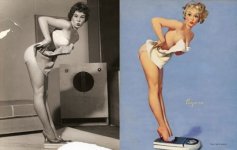
I think it's similar to comparing a painting to a photograph. Neither one is "better" than the other, but the emotional response is different to each medium. Many people have commented that they had very different emotional responses to The Hobbit in 24fps vers The Hobbit in 48 fps. Not everyone has the same sensitivity to motion so some people might not get the different responses to the different mediums but a lot of people do.

There's a lot of these, just google pinup painting versus photography. These are the actual reference photos used by the artist for the painting.

1.jpg

tumblr_lv4tc3RcVs1qzv9v0.jpg
 
Last edited:
I think it's similar to comparing a painting to a photograph. Neither one is "better" than the other, but the emotional response is different to each medium. Many people have commented that they had very different emotional responses to The Hobbit in 24fps vers The Hobbit in 48 fps. Not everyone has the same sensitivity to motion so some people might not get the different responses to the different mediums but a lot of people do.

There's a lot of these, just google pinup painting versus photography. These are the actual reference photos used by the artist for the painting.

View attachment 80286

View attachment 80287

Finally - scientific proof!
 
British and US television work on entirely different business models. It is not to say that one is better or worse than the other, only that they are different. But one of the upshots of the different business models is that US TV shows theoretically don't have limits to their budgets, as long as they can make it back in advertising, while British TV shows have much more of one.

In the '70s and '80s, British television (especially the Beeb) shot a lot more of its TV shows on video because it cost less than film.

US TV shows could far more afford to use to film, especially single-camera weekly dramas. But you also saw video used. Where did you see it used? In three-camera sitcoms and soap operas. Three-camera sitcoms (pioneered by Desi Arnaz, just for a bit of trivia) would otherwise use three times the film, and that was quite expensive. Soap operas, of course, have to deliver an hour of programming per day, not per week, to say nothing of some of them being three-camera as well, so video made sense for those.

But ALL of the video sitcoms and soap operas look/looked like stage plays. TV dramas did not. TV sitcoms which shot single-camera and on film did not.

Examples of sitcoms on video: All in the Family, Family Ties, Night Court, The Cosby Show. Others, too.

Examples of sitcoms shot single-camera on film: Cheers, M*A*S*H.

British dramas of the day shot on video -- ones you mentioned, like Blake's 7, Doctor Who, etc. -- also looked like stage plays.

Of course, in that time, with video, you had only one possible frame rate. 50i in the UK; 60i in the US. If you were forced to use video for budgetary reasons, that's the frame rate you had to shoot. It's not so much that you wanted to shoot in that frame rate; you just had no choice -- the camera shot what it shot. If you shot film, you shot at the cinematic standard (24 or 25 fps). The cameras pretty much made the "frame rate choice" for you.

Today? Film is rarely used anymore, and video cameras can do multiple frame rates. You actually do have an active choice in frame rates now. It costs the same to shoot 25p as it does 50i, so there's no longer an economic limitation to what you shoot. While it was cheaper to shoot 50i back in the '70s and '80s, it doesn't matter anymore. So now, British drama is shot at 25p. And if it wasn't, it would look live, like sports, like news. Given the choice, it's very few people who would want that.

The "magic" or "mysticism" of 24/25 fps is that it looks like fiction, not like live action. No, you don't want to shoot news or sports with it, because it won't look live. But you don't want your dramas to look live. They're fiction. So it's not this magical aura. It's simply effective and appropriate artistic texture.
You may be surprised to know that I agree with most of that.

Certainly about the usage of electronic v film in the 70s being largely down to cost. Even at the time, as a student, it was glaringly obvious that "Star Trek" had much higher production values than "Dr Who" but - I wonder if it would have looked better still if shot 50fps, still on 35mm film? (Hypothetically? :) )

Today, I had to watch some news archive from the late 1970s, and a point struck me which may be relevant here. I grew up with "news look" *NOT* being "video", but rather 16mm film - the UK didn't really switch from 16mm to ENG until somewhere around the early 1980s. I remember being unimpressed when the first ENG came along - much preferring the look of film. But - looking at material from the 70s today, my feelings are very different. You could also make your point about current cameras now being i25/25p switchable about news. Early ENG had to be 50fields/sec interlace - now it doesn't - but there's no desire to return to a 25fps "look" for such.

So - and this doesn't contradict anything you say - are we not now back to the whole area of absolute versus conditioned values?

One point I would pick up on is that in the period I initially referred to (70s and 80s), it wasn't just the likes of Doctor Who and Blake's Seven that were shot video - there was a considerable amount of period drama as well; Jane Austen works such as Mansfield Park were shot exclusively such - all on location. My recollections are that the vision control was handled such as to use low aperture correction etc - so many of the "static frame" attributes of "video" were minimised, given the technology of the time.

One point that hasn't been touched on is that if 24fps has been universal in the cinema for so long - and I'll be the first to say with general satisfaction - then why should anyone one want to rock the boat now? Shooting HFR is costing a lot more (in terms of data handling and post), so why bother? I suspect the answer may be that it's seen as less satisfactory firstly as resolution increases, and secondly with 3D. 24fps 2D may be one thing - 24fps 3D quite another.

Be all this as it may, hopefully I'll get to see the Hobbit over the Christmas period. Until then - Merry Christmas! :)

No, I'm not very surprised. :) Yes, I know many other dramas were shot on video at that time.

As to:

So - and this doesn't contradict anything you say - are we not now back to the whole area of absolute versus conditioned values?

I didn't say anything was "absolute"; I just said a particular artistic texture seems to work better for one purpose than it does for another.

But consider -- dramas, narrative, etc., were shot at 50/60 in the '70s/'80s because of cost. People watched it, sure, 'coz that's what it was -- they watched it or they watched nothing. But now consider -- they aren't anymore. Granted, I am only speaking for US, Canadian, and British TV here, because other TV doesn't seem to make its way here, but no one does narrative at a rate faster than 30p anymore, even though they could (even soap operas have mostly moved away from faster rates). When they do, it's specifically for a special "live" show. If it were a matter of conditioning after a couple of decades, they'd probably still be doing it. I think they changed to a slower frame rate when they could because it works better for the material.

But dramas/narrative being shot at 24/25, even if it started as a function of cost, hasn't changed, and isn't likely to change even though it could, and everyone who's tried to change it has gone down in flames (I'm looking directly at Doug Trumbull). Dramas/narratives have been tried both ways, and in the end when all things became equal, the slower frame rates won.

And yes, Merry Christmas! Christmas Eve is my favorite day of the year, and I plan to enjoy it. Hope you do, too.
 
Finally going to get a chance to see the Hobbit in HFR tomorrow morning. When I get home, I'm going to bust out one of my cameras as the obvious answer occured to me that I could shoot some HFR myself. If you have a camera that can shoot 50/60p, try for yourself. Shoot something at 24/25 and 50/60 and play it back in your editing software of choice at the frame rate you shot it. Use the same lighting. Try adjusting the time on the faster clip so that it plays at 24/25 and drops every other frame. This would give you a pretty good representation of what you are seeing with the HFR hobbit. The shorter crisper motion blur vs the native 24/25. You could also use frame blending or optiflow pixel motion to create new frames. You should see a difference in the looks, and get an idea of what they had to do to create their 24 fps. Going from 50 to 25 will be the closest to what Jackson's crew had to deal with.

The "video look" has one crucial thing that separates it from film other just frame rate and DR, and that is interlacing. The 70's BBC video was all interlaced. TV News, the weather channel, it's all interlaced. Interlacing really messes up motion and just makes a picture look terrible.

A few things here.

Going from 50 to 25 will be the closest to what Jackson's crew had to deal with.

Yes, that will definitely be the closest to what goes on in The Hobbit, as The Hobbit is 48 fps at HFR and 24 fps. It will be the cleanest conversion, too.

Try adjusting the time on the faster clip so that it plays at 24/25 and drops every other frame.

You don't want to mess with the time. It has to play back over the same timespan. If you're changing the time, you're changing the temporal playback speed, not just the frame rate.

Most any NLE will play back faster frame rates on slower timelines with an on-the-fly interpolation, making it seem like the footage was shot at the slower frame rate. So, all you have to do is put the faster (50 or 60) footage on the slower (25 or 24) timeline and play it back. Of course, it's better to actually make the conversion and then play back the new file (some pre-rendering does this).

The shorter crisper motion blur vs the native 24/25.

Motion blur is a function of shutter speed, which is your length of exposure. The blur comes from objects moving over the duration of the exposure, and when you expose a frame for the same period of time, you get the same blur, no matter the frame rate. So, if your shutter speed is 1/60, the exposure is for 1/60th of a second whether you shoot at 60p or 24p. The actual blurring is the same.

This will be different if you're using an angled shutter -- 180 degrees at 24 fps exposes for 1/48th of a second, but it exposes for 1/120th of a second at 60 fps, and there will be less motion blur at 60 fps. But there, you actually have different exposure times, so the actual shutter speed is not the same between the two.

Or, at a slower frame rate, you can also have a slower minimum shutter speed than you can have at a faster frame rate. The slowest shutter speed you can have at 60 fps is 1/60, while the slowest you can have at 24 fps is 1/24, so you can have a lot more blur at 1/24. (Yes, some cameras purport to give you slower shutter speeds than the frame rate should allow, but that's an in-camera interpolation, not a real physical exposure.) But there, too, you have different actual shutter speeds.

Upshot being, different frame rates shot at the same shutter speed (length of exposure) will give you the same motion blur. You can see this if you examine individual frames. The ultimate effect of the motion blur combined with the frame rate may produce different flavors, but the motion blur itself is the same.

You could also use frame blending or optiflow pixel motion to create new frames.

You do not want to use frame blending. If you do, you will get ghosting. You want clean motion samples, so you want to turn frame blending off. That way, frames are simply dropped, not blended. When the 48 fps is converted to 24 fps, they don't blend frames. They simply remove every other frame.

(Not sure what you're referring to by "optiflow pixel motion." A search says this is an option in 3D software?)

The "video look" has one crucial thing that separates it from film other just frame rate and DR, and that is interlacing. The 70's BBC video was all interlaced. TV News, the weather channel, it's all interlaced. Interlacing really messes up motion and just makes a picture look terrible.

No, the interlacing itself doesn't mess up the motion. If it did, it would mess up the motion of anything shot on film and shown on TV, too. When something shot on film is shown on an interlaced TV, the picture is still interlaced, but you don't see the motion "messed up," right?

The motion of 60i and 60p (or 50i and 50p) is exactly the same. The problems of interlacing are other than motion. You really don't see the problems of interlacing on an interlaced TV screen. You see the problems on a progressive screen.
 
Back
Top