

Navigation
Install the app
How to install the app on iOS
Follow along with the video below to see how to install our site as a web app on your home screen.
Note: This feature may not be available in some browsers.
More options
You are using an out of date browser. It may not display this or other websites correctly.
You should upgrade or use an alternative browser.
You should upgrade or use an alternative browser.
High-Speed Camera Records Video of Light Beam Bouncing Off Mirrors
- Thread starter ahalpert
- Start date
Mitch Gross
Veteran
It's pretty amazing technology, but the description is highly inaccurate. What yu see in each frame is a tiny exposure window so short that it captures a brief pulse of light. The device pulsing this light does so many hundreds of thousands if not millions of times per second. The speed of the camera is just slightly off the speed of the pulse, which means that each successive frame is showing a different pulse at a slightly different place in space. They are different pulses but with the frames stacked together and played out the appear to be a single pulse moving through space. Still pretty impressive but not what you would think based on the headline and article.

puredrifting
Major Contributor
Wow! We're seeing things that no human has ever seen.

paulears
Veteran
Bollocks! If we are seeing a single bit of light traveling at such an amazing speed, how come we can see the background? There are other photons travelling that are illuminating the background, where are they? Surely we should see a black frame with a single dot of light moving? I could do better in AE and be more realistic. That's a composite image, so it's reality is wiped out if it's been enhanced and treated.
ahalpert
Major Contributor
It's pretty amazing technology, but the description is highly inaccurate. What yu see in each frame is a tiny exposure window so short that it captures a brief pulse of light. The device pulsing this light does so many hundreds of thousands if not millions of times per second. The speed of the camera is just slightly off the speed of the pulse, which means that each successive frame is showing a different pulse at a slightly different place in space. They are different pulses but with the frames stacked together and played out the appear to be a single pulse moving through space. Still pretty impressive but not what you would think based on the headline and article.
So you're saying the video is not one pulse of light but many different pulses, each shown at a successive step in the journey?
Eh. I'll take it. The key thing is that we get to see what the path of a single pulse looks like. And each pulse probably takes the same path (within a narrow range of quantum probabilities).
In any case, it's fun to visualize and objectify something so ethereal yet ubiquitous.
And it sounds like - based on what you wrote and what they wrote - the key ingredient for success here was to expose the camera at just the moment that the pulse, after being deflected by air particles, hit the camera sensor.
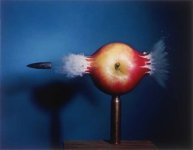
Reminds me of Harold Edgerton's bullet through the apple: "To trigger the flash at the right moment, a microphone, placed a little before the apple, pickes up the sound from the rifle shot, relays it through an electronic delay circuit, and then fires the microflash"
ahalpert
Major Contributor
Bollocks! If we are seeing a single bit of light traveling at such an amazing speed, how come we can see the background? There are other photons travelling that are illuminating the background, where are they? Surely we should see a black frame with a single dot of light moving? I could do better in AE and be more realistic. That's a composite image, so it's reality is wiped out if it's been enhanced and treated.
I disagree with you. I think the key element is that the pulse of light we're seeing was incredibly brief (however long it takes light to travel a few inches). So, what we're looking at would look like an ordinary laser beam if it were being continuously emitted. But it's being pulsed so that we can see the start and stop of the beam and how it looks as it bounces.
And we're not seeing the beam on its path - we're seeing the part of the beam that has been deflected in our direction by air particles.
So what we're seeing is not that special, except that the exposures have been timed to capture the pulses at each subsequent step along their journey and then played back in sequence (of snapshots of many different pulses, not an actual video of a single pulse).
As for seeing the background - that's just a relative brightness/exposure issue
Mitch Gross
Veteran
The thing is, it's been done before. I had to explain this about five years ago. This one is a bit more refined, but it's nothing revolutionary or new.
I used to work directly with Vision Research on the Phantom cameras. Some of them are so ridiculously fast that the US Government considers them proprietary technology of the United States, so those models cannot be sold or shipped outside of the US and are offered in two versions (crippled for general use and full data rate for military and select scientific use).
As to what "Ludicrous Speed" (thank you Spaceballs) actually looks like, once you get up to a million or so fps, it really isn't particularly useful fr most nor is it really photography anymore. It's not the shutter effect that you see in the clip above (because yeah, that's really just a super fast shutter and the photography could have taken a day, a week or a month to capture in completion). And at that speed the only way a sensor or a HIGE data pipe can handle it is to drop the resolution to nearly nothing, like 128 x 8 pixels (so nothing like what that clip above appear to be).
So instead of photography it's more like an on/off switch, which is why these cameras are really mostly used for technical and scientific purposes. A technical use might be a high speed production line where machine vision looks for faults in an endless row of parts. A scientific use might be a particle accelerator searching for quarks and other origins of the universe. Then there are the military uses, which frankly I can't talk about. :lipsrseal
I recall testing a 1.6M fps camera and it was actually kinda difficult to do. First off you need a stupid amount of light. Second it's truly a needle in a haystack situation (times a few thousand). I used a BIC lighter to try to grab sparks, and I set the camera to post trigger, meaning that I was filing a buffer all the time and hitting the trigger meant stop. I flicked the lighter and hit the post trigger at the same time, or at least to the best of my ability. The "image" was so low resolution and monochrome at that speed so the memory buffer could hold about a second and a half of data. So that was around three million frames, or around 35 hours played back at 24fps. I could scrub through the buffer pretty fast, but it was a HUGE amount of time staring at what was essentially a black bar, just 128x8, trying to find those sparks. Really intense stuff. I mean, imagine blinking your eyes and having that action play out over the course of 15-20 hours. That's what we're talking about here.
Mitch Gross
Veteran
Not 70 trillion fps, but then again that other clip isn't really that either (its more like a camera with a 1/70th trillionth of a second shutter, which is an insane feat unto itself). If you want to see what 1M fps footage looks like, this is probably the highest resolution footage at the best quality available. It's also fascinating in it's own way, but I suggest muting the trashy House music. Also, note that it's from 2009, so a lot has happened since then.
https://youtu.be/QfDoQwIAaXg
https://youtu.be/QfDoQwIAaXg
paulears
Veteran
Surely though this is like trying to see radio waves. In a Faraday cage you could produce a single emission, but in free space, there are infinite numbers of them, so tracking individual journeys is a problem. How is the background different from the laser source? We can see it. Those photons also travel but are not visible as descrete paths? Confusing science, dumbed down and ruined.
ahalpert
Major Contributor
The thing is, it's been done before. I had to explain this about five years ago. This one is a bit more refined, but it's nothing revolutionary or new.
Then I guess I took the click-bait
Then there are the military uses, which frankly I can't talk about. :lipsrseal
Oh, the frustration of being left in the dark.
I mean, imagine blinking your eyes and having that action play out over the course of 15-20 hours.
That reminds me of a line from Star Trek First Contact when captain Picard asks the android Data how long he was swayed by the enemy's attempt to recruit him. He responds, "Zero-point-six-eight seconds, sir. For an android, that is nearly an eternity."
ahalpert
Major Contributor
Surely though this is like trying to see radio waves. In a Faraday cage you could produce a single emission, but in free space, there are infinite numbers of them, so tracking individual journeys is a problem. How is the background different from the laser source? We can see it. Those photons also travel but are not visible as descrete paths? Confusing science, dumbed down and ruined.
I dont follow about the radio waves. But re: background vs laser source - I dont think we're seeing individual photons or discrete paths. I think that if the laser were continuously emitting, the shot would probably look normal even though it had a ridiculously high shutter speed. I think the key element is how brief the laser pulse was. I think if they took the same shot of a tungsten filament that was pulsed just as briefly, then assuming that there were atmospheric particles surrounding it to deflect the light, the first frame would show a bright filament and a small sphere of brightness around it. In the next frame, the filament is dark and the sphere has expanded, but only the edge of the sphere is illuminated and the interior is dark again. And in each subsequent frame the sphere expands and the edge gets darker with the inverse square law. We could see the light slowly bounce off a mirror but it would be a broader more diffuse beam. Am I wrong?

Run&Gun
Veteran
Not 70 trillion fps, but then again that other clip isn't really that either (its more like a camera with a 1/70th trillionth of a second shutter, which is an insane feat unto itself). If you want to see what 1M fps footage looks like, this is probably the highest resolution footage at the best quality available. It's also fascinating in it's own way, but I suggest muting the trashy House music. Also, note that it's from 2009, so a lot has happened since then.
https://youtu.be/QfDoQwIAaXg
I watched the whole damn thing. Actually kind of mesmerizing and hypnotic... Yeah, I partially turned up the music.
Then I watched the next video that played. Some guys shooting different armour-piercing 50 cal rounds at a 1.75” plate of titanium. Winner: 50 cal slap round. That would have been cool to see at a few million fps. Their slow-mo may have been 60fps, max.