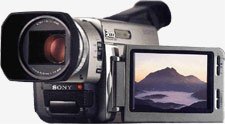
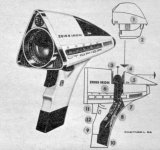
Here's a thing. . .form factor ?

While it's hot, what is more attractive and functional, the D800 or 5DmkIII?
 
good question.

i'm not a fan of dlsr shooting, but used two 5dii's for a shoot yesterday. interview, and some verité and beauty shots. while i'm always impressed with the picture, i'm also constantly amazed at how unwieldy and... not confidence-inspiring these cameras are for video. to me, proper monitoring would be a deciding factor.
Unwieldy is relative depending on the shooting style. Could you go into more detail about that?
 
focus, mostly. even with a loupe it frequently feels like a best guess. because it's a stills lens, the frequent adjustments to focus can be a little more intrusive during an interview. not much leeway on exposure, blah blah blah.

i don't want to open the flood gates, i'm just referring to the known issues when shooting video with a camera designed for stills. yes, i know there are work-arounds.

having said that, while i have a d7000 that doesn't interest me for video work at all, i may well take the plunge on a d800. that is, unless sony does something at NAB.

This is just a matter of using your equipment long enough to know it without thinking about it. Granted, still lenses will never focus as easy as a cine lens, I've seen that first hand, but, at the same time, I can focus my lens I have been shooting on for over a year without even having to zoom in as much, because that focus range, I just know it. I used these same lenses on a 7D, AF100, GH2 and FS100.

It's not different than when I got my Tokina 11-16, where the zoom and focus are in different spots compared to my other lenses, it took me awhile to instinctively know where they are. I'd fumble around on shoots doing the wrong one (and so did the other cameraman who was also using my camera doing the same thing as me). Haha, at first he was like, wow, this lens really breathes! (because he was zooming instead of focusing) :)

If I were to make 2 changes on the form factor of a DSLR like the 5Dm3, it would be this:

1) articulating display.

2) articulating handle.

Those two things would make shooting with the camera much easier to me for video purposes. For a still person, speaking traditionally, you'd have your eye on the eyecup shooting. But, for video, that is not the case. Most of the time, the camera is actually lower than my eyes (I am 6'4").
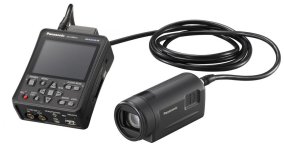
Many DSLR do have the articulating display and having used them, they are DEFINITELY better for video. But, I can see that if you put that display in the 5Dm3, you'd lose those buttons on the left and from a quick use point of view, I can see that slowing down aspects if you use that stuff.

What really is going to be interesting is the Canon cDSLR whenever that gets finished. I think that is the camera a lot of people will be interested in.
 
focus, mostly. even with a loupe it frequently feels like a best guess. because it's a stills lens, the frequent adjustments to focus can be a little more intrusive during an interview. not much leeway on exposure, blah blah blah.

i don't want to open the flood gates, i'm just referring to the known issues when shooting video with a camera designed for stills.
Well, I have to agree with you there. Although, compared to an HMC40, I feel dslr's have better feedback. I hadn't used an entry level prosumer video camera in a while. Some great things on there, but overall lacking. Even the audio solution is a breakout box, making it similar to a beachtek, rather than built-in. (just the feel. I actually don't mind some breakout boxes.)

The 5D2 is one of my least favorite DSLR video experiences. The LCD is awful (not as awful as the HMC40), just low-res enough onto be good for focusing. The newer LCD's perform admirably. And the ergonomics seem oddly less comfortable than is possible with a few others. (i would think bigger better, but the 5D2 doesn't do it for me.)

The modern stills lenses have an awful feel for focus. They work, but at critical times, they can play tricks. I was using the Tokina 11-16 (v1), and when I tilted the camera down, the elements shifted (or something) and actually changed the focus marks!!! So sometimes infinity meant infinity, and sometimes it went past that.
 
Most of the time, the camera is actually lower than my eyes (I am 6'4").
Ouch. I feel your pain. I like to keep the camera at the hero's chest height, but I am 6'2" and shooting a guy who is 5'something gets laborious at times. Some shooters talk about how great shoulder mount is, but the reality is, that a camera shouldn't always be on the shoulder. Depending on the operator's height, and the desired angle, the shoulder might not be the place to shoot from.
 
I tried shoulder shooting and it just doesn't work for me, and it is because of my height. I shot B camera for a production where the main camera operator was about 5ft 3 or somewhere around there and he could use a shoulder mount NO problem.

I like the idea of using the shoulder to take the weight off, but for taller people, there needs to be another type of system. One that you can get the camera lower than your shoulder but still use your shoulder. I've also seen the rigs that hang your camera from a wire, the problem being, reports from those as tall as me say the bar does touch your head, and it still seems like a bulky system for narrative.

The BIGGEST issue is people just shoot in different ways. I see people who shoot EVERY shot on a tripod. I just cannot do this. I am shooting fight scenes where I am up close at times, or in strange positions to get specific angles and having a large camera is just VERY difficult in these situations. There is a scene where we are filming someone falling down a set of stairs, and the camera is against the wall shooting up the stairs. We would not have been able to do this with too large of a camera, good thing we weren't shooting film!

I say this for one big reason, there is no be all end all camera size. Large and small cameras have their places. The problem is, manufactures just seem to do one or the other. It's not like computers where you can get a desktop or a laptop so you can do the same thing with a machine designed for two different needs. It would be nice to see camera companies do this as well.

If I recall correctly, James Cameron was working with Arri to make a smaller version of the Alexa for situations where a smaller camera is needed. To me, if done right, it's the best approach.
 
Here is my new concept for a camera!

newconcept.jpg


You can place it wherever you want, in the most bizarre or wrapped around comfy positions.

Uuh, and the sensor is at the lens end of the tube or something... ;)
 
Perfect Lammy. I think Panny has something like that (but not aps-c sized). But yours looks way cooler.
 
Not quite... but you could modify it to test out your concept.
AG-HCK10G-display_cord_angle_left.jpg
Panasonic: AG-HMR10/HCK10
 
The non-shoulder-mount, handycam-size cameras are comfortable to hold, I think, if you forget the viewfinder and use the flip-out LCD instead. I used to put mine on a monopod. Or, like I said, you can press it against your chest. If you're not holding it at eye level (viewfinder) but just dropping elbows and looking down at the LCD at about chest-level, it's not too shabby.

That's if the camera is not too big or too small. The AF100, for example, is too big. To me, it should be just large enough to have XLR jacks somewhere, about a 4" LCD flip-out screen (940x540 or sharper, to focus with (probably need that false-color focus assist anyway)). Something around the size of the Sony VG20.
 
Last edited:
The non-shoulder-mount, handycam-size cameras are comfortable to hold, I think, if you forget the viewfinder and use the flip-out LCD instead. I used to put mine on a monopod. Or, like I said, you can press it against your chest. If you're not holding it at eye level (viewfinder) but just dropping elbows and looking down at the LCD at about chest-level, it's not too shabby.

That's if the camera is not too big or too small. The AF100, for example, is too big. To me, it should be just large enough to have XLR jacks somewhere, about a 4" LCD flip-out screen (940x540 or sharper, to focus with (probably need that false-color focus assist anyway)). Something around the size of the Sony VG20.


I'm a die-hard shoulder mount shooter for the most part, but I actually find the AF100 to be an excellent size for hand holding -- in every configuration except at the traditional eye level using the back viewfinder. I can tuck it under my arm, press it against my chest, put it on my lap when I'm sitting, lean it against my hip while standing -- and all work pretty well since it's small and light enough. What's not so great is suspending it out in front of my face so I can use the eyecup on the back -- I really don't use the rear viewfinder at all except when working on a tripod and the sun is too bright to see the LCD screen well.

(Note to the AF200 designers -- if the viewfinder could be unplugged and removed, it would save some bulk, weight and power consumption when it wasn't needed, and would allow mounting it in various more useful ways using an extension cable. The camera would be noticeably more versatile.)

Only problem is that I'm too far away from the LCD to use it for focusing when holding in these unconventional ways. The focus in red comes in handy in many of those situations, though.

- Greg
 
Note to the AF200 designers -- if the viewfinder could be unplugged and removed, it would save some bulk, weight and power consumption when it wasn't needed, and would allow mounting it in various more useful ways using an extension cable. The camera would be noticeably more versatile.
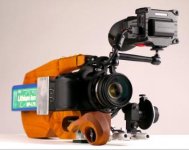
+1000
 
I have to say, the viewfinder was my #1 complaint of the AF100 design. It made it too tall for some of my applications.
 
Hmmmm, I don´t know...

I´m aware that a lot of folks like wooden hand grips, like the Aton or the one that a forum member here makes, but for some reason,
I don´t feel comfortable with the wood - camera combination.

Personally I prefer that more tactical looking black anodized aluminum design of my Tilta gear or the similar stuff RED makes.
There is a reason why we say shooting ;-)

But I think it comes down to personal taste.

Frank
 
My first camera was shoulder mount. (It was cool, the JVC GR-S707U. It was S-VHS-C --- yes, Super-VHS onto the compact VHS tapes. It also recorded Hi-Fi, so I could overdub music onto the monaural track without erasing the dialog. We're talking about the days of deck-to-deck editing, folks!). Here's a picture of the camera, although that's not me (although it kind of looks like me):

Filming by Matt Bigwood, on Flickr

I shot with that camera for 10 years. So, when the VX1000 came out, I scoffed. How can anyone hold that steady? In 2000, I started working with a Hungarian wedding videographer who used the Sony TRV-900.

SONY_DCR_TRV900.jpg

He was very artistic and talented. His videos blew me away, with tons of moving camera work. With a camera so small but with a large, swiveling LCD screen, he raised it way above his head, or lowered it near his toes, or gently glided by table settings, flowers, or some other still life. You can do the same shots with a larger camera, but it's much harder.

Then I was reading another book on wedding videography, where the author mentioned that panning with some poor guest walking by looked eerily similar to following them with a rifle and scope. For professional actors, this is not a problem. But in my world of wedding documentaries, I constantly felt out of place, sticking out like a sore thumb and making the guests uncomfortable. (Most of the time they didn't pay much attention to me, but I hated the idea that I was influencing the guests at all. I wanted to capture them as naturally as possible).

The final blow came when I was reading an article about a wedding videographer shooting some kind of street scene. He backed into the street as the couple walked toward him, and a car hit him, killing him. You have no right-hand peripheral vision when looking through a viewfinder on a shoulder-mount cam. Yes, I know, the chances of that happening to me are small, but it freaked me out. Anyway, I can be such a klutz that I may not get hit by a car but I may knock into something and break it.

There's something to be said for being able to toss your camera in a backpack, as a forum poster once said here. And many times in my car, I have wished that I had a video camera to catch a sunset or some other spontaneous thing (parked or at a stoplight of course ;). That ain't gonna happen with a big ol' shoulder rig.

The tripod is bigger and more expensive. The steadicam rig, rails, bags, batteries --- everything is bigger and pricier. And you stick out like a freak. For some of you, it's no big deal --- you are shooting on sets all the time. Some of you will continue to have hard drives and monitors and other stuff that turns your camera into a mini fort. I'm not saying that no one should use the shoulder cam, I'm just saying that over 15 years, and 150 videos, I've moved on. I want something small and light, inconspicuous and easily packed. (Still need XLRs, though)

P.S. I don't shoot weddings anymore, but I've realized after shooting just about every kind of video there is --- fiction, commercials, weddings --- that weddings are the hardest kind to make. If you have a good wedding video camera, it will probably suffice for shooting just about anythings else.
 
Last edited:
Back
Top