Help: one coollights LED600 is different to the other

J Davis

Veteran
I've got two spot 5600k LED600 from coollights.biz, they were bought 15 months apart and the light output is totally
different between these lights - color and shape and brightness.

Right now I need two matched lights minimum and I'm looking to have four matched lights very soon
but I'm now scared to buy from coollights.biz because of these issues. If anyone has been in the same
situation as me please post your thoughts.

With tax and shipping these lights cost $476 per unit.
For me thats not cheap and my $1000 pair can't be used as key and fill because of the color differences.

I need information, so I'm turning to the dvxuser community. Has anyone ...

• ordered two coollights LED's at the same time and find their light output is different? If so how different?

• ordered two coollights LED's at different dates and found they were different? What were the dates?

• does anyone have three units where all three units create different light?
I'm wondering how many different types (within the same model) are out there

• has anyone noticed if the light output from the LED600 changes over time?
(because we can't replace bulbs in these units)
 
Last edited:
Jhoe,

We wrote to you already and explained also that we have the prerogative (as does anyone manufacturing any kind of hardware) to change units over time as we see fit and there may be changes in output over time with improvements or if we decide to change LED types or beam angles as well if we deem it to be advantageous for one reason or another. 15 months in the fast advancing LED world is nothing in terms of the advancements we've seen as well as ones to come in terms of CRI and output. There is absolutely no reason to hobble a product. I saw your picture you sent us comparing the two outputs and really all I see is indicative of a change in beam angle to be sharper (and therefore brighter) and also the advancements in green/magenta tint over that time but that has nothing to do with color temperature and there will be further advancements coming as well.

There are LED products costing less than ours and also 4 times as much as ours which have shown changes over their lifetime as well (and no they didn't change their model numbers either). Perfect (or stagnant for that matter) doesn't exist at any price.
 
If it was just brightness and beam angle I would have just corrected with diffusion and never written or posted as the new one is brighter and has a narrower spot. The new ones are waaay more magenta, with 1/4 minus green on the older one and there's still a visible difference to the naked eye. As I said in my email, this is the kind of stuff we need to know before walking into a job, or before ordering and I made suggestions that you alter the model the model number so it clear to us the consumer! My moset recent email didn't get answered. As you can see from my orignal post, I'm looking for information. Can you tell me - are there only two variations within the specified model? If I order one in the next few months will it be the same as the one I ordered a month ago or will I end up with three different types of 5600k spot? Do the lights from these units alter over time or with use?

edit: purchase dates on my LED600 5600k spots are Oct 21, 2010 and Jan 23, 2012
 
Last edited:
The last email I got from you said that found a way out of the issue by using a 1/4 frost and no minus green on the newer LED unit so we didn't see any reason to respond. Even if we did change model number by adding a "a", "b", "c", etc. I'm not sure how that would alleviate the issue of evolution or adequately communicate whatever differences there are. We've had at least two or three changes in the LEDs over the 3 years the LED 600 has been out. Brightness, beam angle and magenta/green tint are the changes we work with to find what we think is optimum.

I haven't had one email from any customer telling me their unit changed over time other than if they had some other component that went out and needed to be replaced such as a dimmer.

In regards to what's coming in the future, I am not at liberty to say at this time but evolution will go on and there will be dramatic changes in CRI in the near future. Its fair to say therefore that things will not stay static.

As far as walking into a job without prior testing or familiarity with tools, I guess we all have our different methods. Personally I would test everything and get to know it before I walked into a job with it for the first time, but that's just my opinion and I'm sure many have other opinions.

As I told you in my email response I see upgrades to LED boards in existing units as not only possible but the best solution to this kind of issue over time and no one else is even talking about doing that but us. But I probably wouldn't offer the upgrade path until that dramatic point comes though.
 
Last edited:
It was my fault for not testing the two units together before the shoot.

But to be fair they both have the same model number and my faith in your product led me to believe they would be the same so the thought of testing them against each other never even entered my mind.

The 1/4 minus green was my on set last ditch solution for that setup which was background and not directly onto skin, but by no means made the two lights match.

I'm not looking for upgrade paths or handouts ... but I do want to know if my lights are going to match if I spend more money on ordering another one next month !!

C'mon you must be able to see it from our point of view.
The shipping charges on buying these lights make it even more important that we know what we are doing before ordering.
 
Last edited:
This sadly is extremely common. LEDs colour rendition between batches is pretty hopeless. I've had the same problem with under guarantee replacements, the new ones are so obviously different. Arri, were explaining to me how they actually test each batch of LEDs to ensure that the spectrum output is always the same - it also means using more expensive and higher tolerance LEDs, and the price goes up. As LEDs last a long time, everyone assumes this means a trouble free lifespan, but the colour output does change with age, usually because the plastic used for the encapsulation changes colour. I'm still not convinced LEDs are quite there yet.
 
Paul, thanks for this posting, as weird as this may sound its strangely comforting to know that Arri LED's also suffer from this problem. It means that I don;t need to waste energy testing other manufacturer and I will stick with Richard.

Richard. I want to fix this problem fast and I don't want to be caught out later with a third order of mismatching LED's.
If that means biting the bullet and coughing up another $1500 then so be it.

If I order one spot and two floods right now with they all match the one I bought a month ago on Jan 23?
 
Last edited:
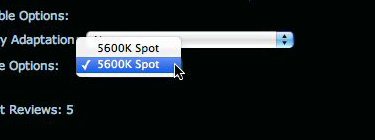
Issue with filling my shopping cart. Your site shows no flood and two different options for 5600k spot.
(tested on Firefox and chrome browsers)
website-ordering-spot.jpg
 
Last edited:
That's because we are out of floods at the moment. Just call our customer service at 855-800-5444 and see if they have some as we sometimes have extras that we keep.
 
I just called and spoke to Pat, he's going to check and call me back.

If he has floods will they be closer in color to the spot that I bought 4 weeks ago or will the flood be more like my spot from Oct 2010?
 
Pat just called me to say he's out of floods and does not have enough spots to fill an order of 3 so I put in an order for just one spot this way I will have at least one matched pair. He said once the new batch of floods come in he will give me a call.
 
I've now got a matched pair of LED600's but I have to say I preferred the older one even though it was not as bright and I have now sold it.

The older ones were around 5000 kelvin these new ones are around 4600 kelvin.
 
You can't measure LED color temp with color meters or with cameras that have color meters in them. LEDs don't have a color temperature, they have a correlated color temperature and there is no such thing as a correlated color temperature meter. We've talked about this many times before. We don't make any LED fixtures in the 4600K range.
 
I thought they were way hotter than my older led600 and it was reaffirmed when I tried to get a white balance on the next shoot when I used them as a key and fill.

Later that week when I had time I ran some tests by taking shots of the light hitting white, then taking the raw file into photoshop. When you first open the raw file in photoshop you have the option to choose adobe's auto white balance and it selects the kelvin – I thought it did a pretty decent job as I used a tungsten lowell pro light as a control

The lowell came in at 3350

6981328171_949501ec59_b.jpg


my coollights cl-255p flo came in at 5700 kelvin (same lens, iso, shutter and aperture on everything)

6835201262_52d5ddd33b_b.jpg


and the two new led600's both coming in around 4500 - 4600k kelvin

6835201096_8705db0da3_b.jpg


6835201010_fb67357de7_b.jpg


I know these are pretty low res jpegs and cropped so
I've made the raw files available temporarily from this LINK
 
Last edited:
I'll say it again. You can't read LED correlated color temperature accurately with a camera or light meter. We said it in our blog in 2009 when the LED 600 came out. Lots of people have written about it. LEDs haven't been full spectrum up to this point. They will be at some point and the price will be higher too for LEDs like that. There aren't many like that yet either at any price point.

The closer to full spectrum something is, the more accurately you can read it with a sensor designed to read color temperature in a camera or a hand color meter. In addition, some sensors are better than others and have ranges they are good in and other ranges they aren't so good. I could easily show you another meter which will read the same fixtures at least 1000K higher and will show the tungsten at 3200K and the flo at about 5600K as well.

A color meter reads things with a color temperature like real daylight and tungsten reasonably reliably. It does not necessarily read anything consistently with a non-full spectrum--those things do not have a color temperature. Those types have an approximation called correlated color temperature or CCT. Technically a flo is measured with CCT. If a flo reads consistently among several types of sensors or meters, and some can, it means the spectrum is close enough to being full that the meter or camera will read it well. Or it could simply mean that that particular sensor is good at reading some kinds of light.

Seems like every 2nd post here is someone talking about LEDs aren't full spectrum, so I don't know how someone could miss it. There are thousands using the LED 600 and other fixtures like it. The ones that really like them and keep coming back to buy more aren't spending all their time analyzing them or belaboring what they can't do or overanalyzing. They are more focused on what they can do or using them to their strengths. Lastly, you will not find any of the major technologies that is perfect for everything. LEDs excel for portability and battery use. Because of their spectrum issues, you don't use them for everything and you don't try to mix them with lots of other sources necessarily. Tungsten, Flos, and HMI are better for color rendering / spectrum in about that order.
 
Tungsten, Flos, and HMI are better for color rendering / spectrum in about that order.

- yes, I've come to this, I've now pretty much given up on LED's except for background or hair light. You've probably noticed I just ordered a 4 bank flo from you because the I won one of your 2 bank flos and I use all the time - I like it on skin and with the DIY mount I made its a work horse. I hope the 4bank matches the 2 bank in color.
- I love the cri off tungsten but hate seeing the droplets of sweat appear on talent.
 
Wow, based on this thread looks like I'll avoid Cool Lights, and it won't be because of technology.

buy their flo's - great skin tones and a price that can't be beat. The last batch of LED's (bought in 2010) were a great match for their flo's. Judge skin tones for yourself - this was only lit with 2010 coolights led's and coolights flo's and even won me a little award for cinematography LINK

edit:
the 2012 led600 pair I now own have decent cri and are brighter than the older ones, just they need to be used on their own and with a custom white balance, I couldn't match them to my older 2010 led256's or my current flo's
 
Last edited:
Back
Top