Help needed with adapters for sennheiser 415t t-power

francis90

New member
Hello,


I have a sennheiser mkh 415t and I want to convert 48v phantom power to 12v t power to run it. I will just be running into a marantz pmd 661.

I've read as much as I could find about this but I'm a little confused. I realise that whilst there are adapters available there might be some issues.

I'm thinking of the PSC 48p-12t adapter barrel in particular because its inexpensive and I'm on a budget, but there are others similar.

I have read that this does not in fact step down voltage but just turns 48v phantom to 48v T-power. Is this true?

I've read elsewhere that it does step voltage down, but to avoid a spike before it drops to 12v the mic should be connected with phantom power off. Is this true?

If the answer to the first question is 'yes' then I understand I could still use the adapter but use a 12v phantom power supply before it so it will just change 12v phantom to 12v t-power. Would this work and would both a battery phantom power box + an adapter significantly degrade sound quality?

I know I could run from a T-power box, but those are too expensive unfortunately.

I'm mainly worried about the safety of my mic, but it would be useful to other people with T-power mics to get a definitive answer to this, as there is a lot of conflicting opinion about.

Cheers,

Francis
 
The PSC is a very very cheap device.

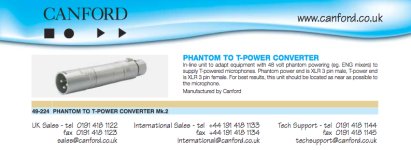
The one I would use is the Canford Audio one - info HERE.

This is more expensive but *does* do the job very well.

This is the Mk.II version, the Mk.I was not so good (the Mk.I was discontinued many years ago).

These things *do* need to be well made, or they can degrade the quality (as Canford found out with the original version).

.
 

Attachments

  • Canford Phantom to T adaptor.jpg
    Canford Phantom to T adaptor.jpg
    258 KB · Views: 0
I have read that this does not in fact step down voltage but just turns 48v phantom to 48v T-power. Is this true?
T-power is 12 volts by definition. There is no such thing as T-48. Where did you read this? Did it seem like a credible source?

I've read elsewhere that it does step voltage down, but to avoid a spike before it drops to 12v the mic should be connected with phantom power off. Is this true?
It is always safer to connect/disconnect microphones with power turned off. Whether you are using adapters or not.

If the answer to the first question is 'yes' then I understand I could still use the adapter but use a 12v phantom power supply before it so it will just change 12v phantom to 12v t-power. Would this work
You don't need a separate power supply if you are using a proper P48 to T12 adapter.

and would both a battery phantom power box + an adapter significantly degrade sound quality?
That can not be answered as a generic question.

I'm mainly worried about the safety of my mic, but it would be useful to other people with T-power mics to get a definitive answer to this, as there is a lot of conflicting opinion about.

There are virtually all glowing reports from users here: http://www.bhphotovideo.com/c/product/275819-REG/PSC_FPSC0010A_A4812_48V_to_12T.html (Customer Reviews tab)
The only negative feedback was apparently an "infant mortality" (or perhaps user error). There were no reports of microphone damage. PSC couldn't sell those things if they were putting out 48V.

I must say that I'm not a strong believer in the theory that "if it is more expensive, it must be better".

Converting P48 to T12 is not rocket science. It is a pretty basic and simple circuit. There is a lot of valuable information here: http://www.uneeda-audio.com/phantom/
Including the circuit if you want to make your own. I typically make these kinds of things for myself, but if I were to buy one, I would have no reservations with the PSC unit.
 
Last edited:
Well, when in UK, you can purchase UK products.
When In USA, you can purchase USA products.
Don't start with the UK products are better.. OK John?
 
Sounds like Canford tried to cheap-out the design with undersize coupling capacitors.
Selling a bunch of sub-par products and then getting it right the second time around isn't a particularly glowing recommendation.
YMMV. Sometimes you don't get what you pay for.
 
Hello again,

Thanks for the replies.

I've been looking back through my history trying to find the relevant information. One example is from a lone reviewer on Amazon US:

http://www.amazon.com/Sennheiser-12T-P48-Phantom-Power-Adapter/dp/B000RV2104

Here is another example, but perhaps because I am very new to the audio world I can't make out what the conclusion to this particular discussion was:

http://repforums.prosoundweb.com/index.php/topic,35260.0/prev_next,prev.html#new

I read about the spike in voltage here:

http://tech.groups.yahoo.com/group/naturerecordists/message/38337

There were another couple of relevant comments, particularly explaining how 48v would harm an old Sennheiser T-power mic, but I can't find them at the moment.

I am in the UK, but I did see the PSC for sale here also. With tax the Canford comes to about £85 or $131.5, this is not kind to my student budget so I was hoping that the prevailing opinion would suggest that the PSC is quite sufficient. At that price the canford seems like it should be perfect, though I have read, as Richard suggested, that the circuitry is simple, so I don't really understand how even a cheaper device could fail in this regard. It's not like even the PSC is pocket money.

There is also a gentleman in Germany who makes these things with the Tuchel connecter, this is helpful to me since I can just put it on the mic, also apparently these adapters need to be as close as possible to the mic and you can't get closer than that. Here is an example:

http://cgi.ebay.de/ws/eBayISAPI.dll...akeTrack=true&ssPageName=VIP:watchlink:top:de


Well anyway, I certainly appreciate any advice you've given and/or can give,


Francis
 
I've been looking back through my history trying to find the relevant information. One example is from a lone reviewer on Amazon US:

http://www.amazon.com/Sennheiser-12T-P48-Phantom-Power-Adapter/dp/B000RV2104

I buy lots of stuff on Amazon. I even buy a significant amount of audio and video gear on Amazon. But my observation is that the "reviews" on Amazon, particularly about technical things, are almost completely unreliable and written by people who are mostly clueless what they are talking about.

IMHO, the reviews on B&H are far more reliable. Since B&H is a specialty shop (vs Amazon who sell everything), they attract a more technical knowledgeable clientele (and reviewers).

Here is another example, but perhaps because I am very new to the audio world I can't make out what the conclusion to this particular discussion was:

http://repforums.prosoundweb.com/index.php/topic,35260.0/prev_next,prev.html#new

If you look at the message at the top of that same page, you will read a response from the president of PSC where he explains that it is not a valid test to measure the OPEN CIRCUIT voltage. The circuit can only operate properly with a ~low impedance microphone attached. None of the "reviewers" even understand this and spew their ignorance on public forums. Which is why I don't even bother to read reviews on Amazon, at least about technical products. Maybe about books or movies, but not any kind of gear.

Repeating: Voltage spikes will occur whether you are using a P48 to T12 adapter or not, so that is a specious "argument" not worth further discussion. IMHO.

There is also a gentleman in Germany who makes these things with the Tuchel connecter, this is helpful to me since I can just put it on the mic, also apparently these adapters need to be as close as possible to the mic and you can't get closer than that. Here is an example:

http://cgi.ebay.de/ws/eBayISAPI.dll...akeTrack=true&ssPageName=VIP:watchlink:top:de
That sounds like a very convenient thing if you have an old microphone with a Tuchel connector. Brilliant!
 
Last edited:
Don't start with the UK products are better.. OK John?

I never suggested any such thing - that suggestion is only in your post. :Drogar-Angry(DBG):


Sounds like Canford tried to cheap-out the design with undersize coupling capacitors.
Selling a bunch of sub-par products and then getting it right the second time around isn't a particularly glowing recommendation.
YMMV. Sometimes you don't get what you pay for.

This was about 20 years ago with the first batch - they worked OK but some people complained and the version by Audio Ant was better - so Canford re-designed and improved the design - just like any good manufacturer will do with customer feedback. What you suggest is conjecture only, without any evidence at all.

So you are suggesting that Sennheiser is a no good company because the first batch of the MKH 60 suffered heavily from RF interference and they re-designed and got it right for the second batch? Rubbish - the sign of a good company is how they react to customer feedback - and as a major broadcast supplier I have never know Canford Audio to "cheap-out" anything that affects quality or reliability. And I say this from personal experience as the MS microphone pre-amplifier they do was my idea and I worked with Canford on the design as regards to the facilitoes and what it should do.
 
I suspect those abroad may assume Canford is just another retailer. Far from it. In fact, Canford products are often more expensive than other similar devices you can find, but here in the UK, broadcast, live sound, radio and studio people trust Canford. In fact, many of their products are made almost exclusively for these people to service specific requests. Somebody wants a certain weight, size or technical specification for something - very often Canford will make it. Their cables, as an example are often the result of a requirement from people like the BBC, or other similar organisations. It's quite common for technical specs to point to a Canford product as the only one acceptable. Lots of their products are get out of trouble devices, and some can be a little rough at the edges, but that's what sets them apart. In their history, they have often produced a problem solver, and then gone onto improvements in the Mk2, then mk3 versions.

They may well have used inappropriate components - but as their products are never cheap, it's fairer to say that maybe some of the products are almost prototypes that can be purchased. In the States, Clearcom have been the 'name' in comms for many years, but here in the UK, Canford's own Tecpro range are far more popular. Just a territory thing really. As far as I'm aware there isn't really a US version of Canford - probably the Country and the user diversity is too wide to have enabled such a company to exist over the water. British people are quite supportive/protective of Canford, hence why we cringe a bit at phrases like 'cheap-out' - just not something we'd agree with I guess.
 
Back
Top