help me light indoors better

FiddlerMD

Well-known member
Ok so i've assembled a basic kit over the last few months from ebay and such.. currently i have:

600W ltm pepper fresnel
lowel tota
lowel omni
1 white transluscent umbrella
a few random scrims / gels
a pop-up reflector
and i have a few light stands and clamps and such...
whenever I try to do a 3 point lighting setup indoors i always get shadows I don't like. I also cant seem to make my fill light dim enough to not cast a second shadow and bright enough to knock out the main shadow (i havent tried the reflector as fill yet due to the framing of the shots i needed)
Are these issues mostly because i am forced to run these lights so close to the talent indoors (regular apartments and such)?
short of a softbox, what are some other options i can utilize without just bouncing the light all over the place?
What am i doing wrong?
 
Softer shadows

Softer shadows

I won't claim to be a lighting genius but since you asked...:)

The first thing that comes to my mind (based on the lights you list) is that the light you are throwing is "hard" and is causing your shadows to be more pronounced. Softening the light and moving it even closer to the subject will "wrap" the light around the subject more and lead to less pronounced shadows. At the same time, doing your best to get a good lighting ratio will also help. Reflectors and diffusion material might be your best friends in this situation.

Good luck.
 
Hey Mike
You mentioned not getting your fill light 'dim' enough. Dimming the light is good, but if you are looking to get rid of shadow from the fill light, diffusing the light will do more. I was actually just using a 600W open face as fill light today, and I aimed it away from the subject, but bounced it into an umbrella, so it came back as a softer, more diffuse light, and worked nicely as a fill. Granted yours is a fresnel which is much harder, but you can still achieve the same effect w/ some tweaking.
For a back light, get your light higher. I like a 45 degree angle down across the back of my subject.
Lighting can be really tricky, I always have my share of issues, it just comes down to being trying all sorts of things, and finding what works. Be creative, and practice with all sorts of setups, you'll find what works.

Good luck
 
If the shadows you're talking about are on the back wall or whatever is behind the subject, it's just a question of adding another light behind the subject that's washing the background enough to eliminate the shadows one way or another. Even a soft, diffused light can cast an annoying shadow behind a subject when the light is coming in at the same level they are at. Simply cranking up some light behind them and focused on the background can help enormously. This can even be a light with a cucaloris (cookie) on it which is projecting a pattern--that will help eliminate any shadows from the subject casting on the wall. Separation of subject from wall can help too to the point that the key and fill lights being aimed at a higher angle don't even hit the background at all but fall onto a point lower than the subject and are never caught by the camera.

Remember, 3 point lighting only really covers the subject(s) and how they are lit with key, fill and backlight. It doesn't talk much about the other aspects of what's going on with the scene and background which is more work.
 
Last edited:
Hey! I've lit plenty of interiors. In fact, I just lit a 50 foot deep hallway with 10,000 watts of light, so I think I might have some good advice.....:) It sounds like you are chaining yourself down to light stands. The first thing I do when lighting an interior is ask myself where the light is coming from. If its supposed to be from an overhead light, then mount the key light overhead. Don't be afraid! For some reason, lots of people think they must stay chained to light stands.

As for 3 point lighting..... Why???

3 Point lighting is only an instructional demonstration. It's the principals that are important.


As for dimming, be careful, that changes your lights color temperature, which might backfire on you.

For fill light, use diffusion, but don't put it right on top of the light, put it a few feet away and make sure your light source fills the entire surface area.

Hope that helps!
 
thanks for the tips guys. i think for my purposes, Cool Light's advice on adding some light to the background may work best.
as far as being chained to light stand - i'm not, but i have limited grip stuff available to attach lights to other objects (i have don that though).
 
Yes I know what you're talking about. This is where having a couple of your light stands that are tall enough to get the lights higher will help immensely on the shadow issue behind the person(s). I'm not really sure where you could mount lights on the ceiling in many places you go to very effectively so a tall light stand is a must for the portable kit.

Get that angle just right from above and you'll never even see the shadow. Just make sure they don't get too much shadow underneath the chin on the neck though either.

Or add the light behind. Or both! A creative pattern on the wall looks great and is a classic lighting technique for video, film and stage. Even just a color swatch with a gelled open face or small fresnel behind the subject would be great and get you what you're looking for.
 
More advice:
Try to keep the subject as far away as the backround as possible. That way, with your lights in the correct place, you won't pollute your BR with the foreground light. Think of them as seperate subjects to light.

Then, try to soften your lights and controll there spill as much as possible. Instead of using another light as a fill, try a white card (or bead board) to bounce back the light from your key. Think of your rim light only when your subject blends into the backround. When the BR is brighter than the subject, you don't need a rim for the contrast between the two is creating the seperation that you want to have.

One last thing - most of your lights are flood lights. For most cases, we in the film/video business don't like these because they take a lot of work to controll (or flag) the light off of parts of the frame that shoudn't be lit. Many times, flagging, shaping, and controlling are as important as is the light itself.

Good Luck!
 
I agree with what everbody's said so here's some more last resort ideas.
Many times you can just angle the person or the light (or the camera) so that the shadow is off camera. Cheat the actor over, around, or back until you move the shadow out of the view of the camera.

Diffusion is your friend but what's behind the actor? putting something in the room like a plant or a divider or even putting a dark color drape on the wall can hide shadows as well as give you a backdrop that's "kinder" that a stark wall.
 
What are you using each of your lights for? I'd say the omni should be used as the backlight, the fresnel as the keylight, and the tota w/ the umbrella as the fill light. You can also use the tota w/ the umbrella as a soft keylight, which would create less pronounced shadows.

Using your fresnel as key light, you want it aiming down at the subject's face so that it creates what's called the "rembrandt triangle," which is a triangle of light under the eye on the dark side of the subject's face.

Using the tota w/ umbrella as fill should lift the dark areas of the face without causing many shadows of it's own, as long as you don't have it too close to the subject. It should be more level w/ the subject's face than the key, and more from the side.

With the backlight you want it aimed at a 45 degree angle down onto the subject's shoulders. You should hang it from the ceiling if you can, so that you can have it directly behind the subject, but considering how most of us don't have access to studios and grid lighting, you'll probably have to put it on a stand somewhere out of frame to the side.


You should try to keep the subject as far from the background as possible, so that you can put the bg out of focus, and you should try and get the backlight and key as high as possible so that you won't see shadows on the walls of the room.

Of course this is most relevant for interview lighting.
 
Last edited:
thanks for the comments guys... speaking of an actual scenario i need to light soon ... i need to recreate the look of a restaurant or cafe. I have a nice brick wall indoors to put the table against which will make it look kinda nice (it's got some copper pots on it and whatnot .. definitely can pass for a rustic looking restaurant setting).. but whenever i shoot it with regular light it looks like a kitchen (cause it is :))
i'm guessing for a restaurant scene it should be fairly dark with maybe just a light directly on top shining into the middle of the table and mabye a couple smaller lights off to the bottom to cast some light onto the 2 people sitting at the table (perhaps a candle on the table to motivate those lights)
any ideas ? solutions ?
have any of you dont this and can you post stills from how it came out?
Thanks!
 
A PVC pipe frame and a bedsheet will provide diffusion and will even spread light very widely. It will also reflect light...especially the shiny satin sheets avail from Walmart for less than $25.
 
light from outside the windows through silk curtains.

it can't be done with your lighting kit, if you want to lit for a movie, better get some big units from some rental facilty...

that's the best looking light... really soft and ambient
 
yep i have a few china balls.. i do like the lighting but indoors it's hard to keep them out of frame (on wider shots)
 
FiddlerMD said:
thanks for the comments guys... speaking of an actual scenario i need to light soon ... i need to recreate the look of a restaurant or cafe. I have a nice brick wall indoors to put the table against which will make it look kinda nice (it's got some copper pots on it and whatnot .. definitely can pass for a rustic looking restaurant setting).. but whenever i shoot it with regular light it looks like a kitchen (cause it is :))
i'm guessing for a restaurant scene it should be fairly dark with maybe just a light directly on top shining into the middle of the table and mabye a couple smaller lights off to the bottom to cast some light onto the 2 people sitting at the table (perhaps a candle on the table to motivate those lights)
any ideas ? solutions ?
have any of you dont this and can you post stills from how it came out?
Thanks!
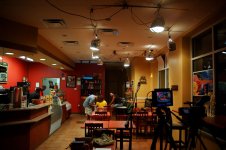
Here you go........

Just a few notes, I color corrected this picture to match the end result I shot with an HVX as close as I could, it's not spot on, but pretty close. This is from my first TV pilot show, so your getting a sneak peek at some articles I'm gonna write soon :thumbsup:. This restaurant was a challenge, you can't really see it, but two whole walls are actually covered in trash bags, this shot was done during late afternoon, so they needed to be covered. The scoops are just typical home depot clamp lights, modified with foil snoots to become more directional and cut light off the tops of the walls. All the scoops had 200 watt bulbs inside them. Use longer snoots for more isolated light.

Hope that helps!
 

Attachments

  • restaurant_set.jpg
    restaurant_set.jpg
    125.7 KB · Views: 0
Last edited:
Thanks, I've had those clamp lights since I got started, I now own mole richard and arri, but I'm too smart to throw away my clamp lights, no matter how annoying they are to work with, or how amature they may look. I always run into situations where they are just right light. Plain and simple. I'm searching for the pro equivilant, but can't ever seem to find one.
 
Back
Top