
Navigation
Install the app
How to install the app on iOS
Follow along with the video below to see how to install our site as a web app on your home screen.
Note: This feature may not be available in some browsers.
More options
You are using an out of date browser. It may not display this or other websites correctly.
You should upgrade or use an alternative browser.
You should upgrade or use an alternative browser.
Help me build this?
- Thread starter jamani
- Start date


paulears
Veteran
If you know electrics and can deal with sheet materials and paint, it's not hard, as it's all straight edges and butt joints. A trip to the local electrical wholesaler will provide all the bits, and most even come with instructions. I don't know the law in your area, but here in the UK, anyone can do electrics with no formal qualifications apart from just a few processes, and a couple of locations where a special permit is required. If you are allowed to do it, it isn't hard - you wire mains voltage lamps in parallel, or you can wire 12C lamps in series, in groups of 10 or 20 depending on your territory. If you are happy with electrics, great - if not, get somebody to do the wiring after you have fitted the lamp holders.
danjenkins
Active member
You could also do this without having to do any wiring at all. Just build a trough out of plywood, drill holes for each lamp and use standard med screw bases that you would use for a china ball (they've already got a plug so make use of it). Mount a cheap power strip inside the trough and plug them all in. If you choose the right size hole saw for the holes you can pressure fit the bases and they'll be fine for a day of shooting. No need to over complicate it.
For the trough use some 3/4 plywood so it's sturdy and you have enough meat to mount to. Finish the edges with spackle, sand it down and paint.
Keep it simple.
For the trough use some 3/4 plywood so it's sturdy and you have enough meat to mount to. Finish the edges with spackle, sand it down and paint.
Keep it simple.
They covered the physical set pretty well. The lighting will further the effect. The light that looks like its hitting her hair is not. You will want to be able to control the level of the bulbs with dimmers or appropriate wattage units. When dimmed down, so they can be photographed, they will no longer throw enough light to rim the actors head properly. You will want to have some tungsten fresnels above the set walls to do this. Just a note if you get enough bulbs and have to dim them significantly they can hum. A few would be ok. Get enough and it can become a problem if recording sound is necessary. This is where DC becomes handy. The blue touches of light that are seen is more then likely just reflections of a unit itslef in the walls rather then lights hitting the wall. That would be a kino with blue tubes far enough from the actual set so it doesnt actually light it but close enough so that the reflection of the unit itself can be seen. Kind of mimicking a window off set. Notice how there is no blue light hitting her. The unit providing her light is probably a 3200/2900 Kino. You can just see its sheen on the panel behind her. There is some depth of field to be seen so there is a good level of light being used.

ilauzirika
Boring Senior Member
Last year I created something similar for a theatre play. It was smaller and wasn't integrated in the set, but the idea is the same. if you are comfortable with basic wiring techniques this is a really simple project. You can see the light strip that I built. It is just wiring various bulb sockets in parallel and then connecting the end to a plug. Just keep in mind the amount of bulbs you want to install not to go over the maximum wattage of your line. If you don't feel comfortable with anything electrical (or your local regulations demand require a licensed electrician) I am sure that you can prepare the holes, install the bullb sockets and let someone do the electrical part. For the black cover I used some black fabric I had laying around.
Hope this helps you! here you have a photo of the finished project.
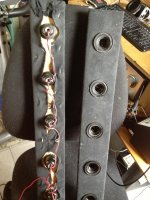
ps: this involves mains voltage, please proceed at your own risk and be cautious!
Hope this helps you! here you have a photo of the finished project.
ps: this involves mains voltage, please proceed at your own risk and be cautious!
Last edited:
Very helpful responses. Thank you all!
I will need to use a dimmer so I will definitely need to do some wiring. What do you guys think about painting the plywood blue instead of using gelled light to create the blue effect like in the picture? I just feel like it would be easier.
I will need to use a dimmer so I will definitely need to do some wiring. What do you guys think about painting the plywood blue instead of using gelled light to create the blue effect like in the picture? I just feel like it would be easier.