HELP! HMI striking trouble

Okay, so I bought a 2.5kw LTM HMI Par off of eBay from Pyramid films and have always had working stuff from them, so I don't doubt the gear. I doubt me, who's never struck an HMI before.

I followed the 'Set Lighting Technicians Book' and first installed my new bulb, then plugged in the header cable, then plugged in the ballast power then turned on both breakers. Now what? I press the green button and nothing happens, at all.

Am I supposed to turn both breakers on or just one? I get power lights over the red button and on the orange light. Here is a picture of my ballast. What am I doing wrong?

And yes, I am feeding it 110v 30amps of power and it is a magnetic ballast.
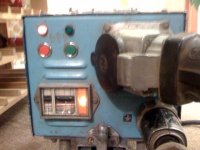
 

Attachments

  • 2500w_HMI_ballast.jpg
    2500w_HMI_ballast.jpg
    44.2 KB · Views: 0
Wait a sec, is it normal for an HMI to slightly strobe when on a brand new bulb? I don't mean to the naked eye, but when observing the footage
 
If I'm correct a magnetic ballast will cause the light to slightly flicker in some shutter speeds.
Hopefully some that knows will chime in.
 
What did you do to get it working?

The UV switch had become recessed, once I made sure that was indeed closed, the head activated and allowed striking.

http://www.cinematographyelectronics.com/index_flickerfree.html

Refer to this chart for flicker free shooting. You shouldn't be getting flicker at 24FPS/180 deg.

Yeah I had my fps at 24 and shutter at both 1/48 and 1/60 (180 and 144). It may have been my screen's LCD.

So HMIs shouldn't strobe at all on new bulbs? I've heard you need a couple hours to "burn in" a new bulb, or is that just for a stable color temp?
 
I saw those lights on ebay, you got a great deal. I have 2 of the exact same systems and I have 1 LTM mag ballast and 2 electronic ballasts between the pair. I would burn the new bulb for at least and hour and that should take care of any visible flicker (to the naked eye). If it ia a power issue like everyone freaks out about with mag ballasts the flicker will not be visible to the naked eye, only on your camera at certain frame rates.

Hope this helps.

-Travis
 
no, household 30amp 110

Hi Shawn:

I rented your same light for a shoot last weekend, except they included an electronic ballast. Great light. Did not notice any flicker at all to my eye or on camera.

How are you getting 110V 30amp on a household circuit? Does your house have custom wiring? Most household circuits are 15 amp although some are 20 amp as are almost all new corporate buildings in North America. I have never seen a 110V 30 amp circuit in a house unless it was custom wired. All of the common wiring, outlets, etc are 20 amp.

Just curious.

Enjoy your new sunshine!

Dan
 
Dryer drop! I worked with a former electrician and designed out this really trick system. It converts the 220v 30amp dryer into two separate 110v 30amp three-prong twist lock sockets. Then I converted my LTM ballast cable from a 60-amp bates to a 30-amp twist lock to plug into my adaptor. I also made a 30-amp twist lock to edison adaptor for running my 2ks. I used heavy duty 10/3 and 10/4 cable for the dryer drop, so its all quite safe. Now I can test 2500w in my apartment!
 
Aha, I recall you were posting about this a while ago.

But what are you going to do when you go on location, rent a genny?

Dan
 
Dryer drop! I worked with a former electrician and designed out this really trick system. It converts the 220v 30amp dryer into two separate 110v 30amp three-prong twist lock sockets. Then I converted my LTM ballast cable from a 60-amp bates to a 30-amp twist lock to plug into my adaptor. I also made a 30-amp twist lock to edison adaptor for running my 2ks. I used heavy duty 10/3 and 10/4 cable for the dryer drop, so its all quite safe.

You have to be really careful when using dryer plugs as you have described. Yes, under certain conditions you can use them to power lights. If you look at the breaker of these circuits on the house distro panel you will notice that they use two pole breakers. Each pole of the breaker is in a sense an independent 30A/120 volt circuit. That is, if you measure the voltage from each pole of the breaker to ground it will be 120 volts, and if you measure the voltage between the two poles of the breaker you will notice that it is 240 volts. The 120 volts of the two poles adds up to 240V because the 120V circuits are on opposing legs of the single phase electrical service of the house and are therefore additive. In residential settings, this is how higher voltages are supplied to household appliances like Dryers, Electric Ranges, Air Conditioners, Motors, etc. that require more power than can be reasonably supplied by a single 120V circuit. Where each pole of the breaker is in a sense an independent 30A/120 volt circuit, you can split them out in a distro system but only under limited situations.

The one situation where it is possible to use dryer plugs to power lights is when the dryer circuit is a four wire system (the receptacle has for slots: one for ground, one for neutral, and two for hot) and it is a single phase service. Where you can run into trouble is when the dryer circuit uses a three wire system (the receptacle has three slots: one for ground, and two for hot, and no neutral), or it is a three phase service. Many household and industrial 240V receptacles use a three wire system (no neutral) because they are meant to power single phase motors or heating elements that draw a perfectly balanced load and return no current because the single phase service legs are 180 degrees out of phase and cancel each other out – hence there is no need for a neutral return.

You run into trouble with this kind of circuit when you start to pull an unbalanced load on your distro system. And, where under most production situations you can never perfectly balance your lighting load, the two 120V circuits that make up this 240V circuit (as described above) will not have 100% phase cancellation and the extra current of the high leg will not have a safe return path. What happens on a film set when the neutral is mistakenly disconnected under load it is an analogous situation – it is not a pretty sight.

The only full proof way to pull power from 240V 30A Dryer and 50A Range Plug circuits is to run your lighting load through a 240v-to-120v step down transformer like the 60A Full Power Transformer/Distro we make for the Honda EU6500is generators. Like it does with the 240V output of the Honda EU6500is Generator, our 60A Transformer/Distro can convert the 240 volts supplied by these industrial and household 240V receptacles back to 120 volts in a single circuit that is the sum of the two individual poles (120v circuits) of 30/50 amps each. That is how our 60A Transformer/Distro makes a 60A/120v circuit out of a “30A/240v” or a “50A/240v” circuit and is capable of powering bigger lights, like a 4k HMI Par, a 5k, or even a 6000W Six Light Mole Par off a 6500W generator. It can also be used with three or four wire dryer/range/motor circuits because our Transformer/Distro automatically splits the load of whatever you plug into it evenly over the two legs of the 240V circuit so there is no need for a neutral return.

When used with a portable generator, our 60A Full Power Transformer/Distro also greatly simplifies set electrics and enables you to run larger lights, as well as more smaller lights, than you could without it. Used with our modified Honda EU6500is, our 60A Full Power Transformer/Distro provides 7500 Watts in a single 120V circuit. But our 60A Full Power Transformer/Distro will enable any generator to run more lights than it could without it by splitting the load of whatever you plug into it evenly over the two legs of the generator. Part of the reason, that our modified Honda EU6500i is capable of handling an additional load is because it is a perfectly balanced load. Likewise, any generator will be capable of handling a greater load when it is perfectly balanced by a transformer.

Our 60A Full Power Transformer/Distro also enables you to more fully utilize the continuous rated power capacity of any generator by enabling you to load it more fully. Without our 60A Transformer/Distro you can never fully utilize the available power of a portable generator because the load of a light has to go on one circuit/leg of the generator or the other. For example, when plugging lights into the power outlet panel of a Honda EU6500i Generator, you reach a point where you can't power an additional 1kw light because there is not 8.4 amps available on either one of the factory installed 20A outlets/leg of the generator. With our 60A Full Power Transformer/Distro you can still add that 1kw light because our 60A Full Power Transformer/Distro splits the load evenly over the two legs (4.2A/leg) of a higher rated circuit of the generator.

Finally, our 60A Full Power Transformer/Distro greatly simplifies your set electrics regardless what generator it is used with. As long as you plug in through our 60A Full Power Transformer/Distro you no longer have to carefully balance the load over the generator's two 120V circuit/legs. Now that you are able to fully load the generator in a perfectly balanced fashion with the help of our 60A Full Power Transformer/Distro, you are able to power larger lights, or more smaller lights, than you could without it.

By giving you access to more house power through common 240V house outlets, our Full Power Transformer/Distros can eliminate the need for tie-ins or generators. Or to simply supplement house power, our Full Power Transformer/ Distros can be used to step down the 240V output from Portable Generators to a single 120V circuit that is capable of powering a big light like the new Mole 5k Quartz Par or the brighter Mole 4kw HMI Day Lite Par - thus eliminating the need for the large expensive diesel generators required to power these lights before. And, where our Full Power Transformer/Distro provides access to the full continuous rated power capacity of a generator in a single circuit, it enables you to power more smaller lights off of a generator than you can without it (use this link for more details about using step-down transformers to access the full power capacity of a portable generator: http://www.screenlightandgrip.com/html/hdfilmstrip4lg.html.)

This is probably more information than you need, but I hope you found some of it helpful.

- Guy Holt, New England Gaffer and Lighting & Grip Rental House Owner.
 
NE Juicier, I have read your threads on the products you sell and rent , and would like to know if you could share the price of your Transformer/distro and modified Honda EU6500 genny.
I have been saving my money for this generator, and found a company in Texas(I believe) that modifies the stock genny, and adds a 60 amp bates plug-in.
I believe they were asking about $ 200 more for this genny, then I have seen on the net at it's lowest price.
I can't tell by the photos, but I don't recall a window to display the running hertz / load being drawn, on the unit I mentioned.
Can you tell me/us the cost of your unit(s) with and without a matched transformer distro "Full Power" unit ?
Thanks, Jon in Iowa
 
Filmat11,

It would probably not be appropriate for me to get into sales details on this forum. Shoot me an email at lightsne@aol.com and I will be happy to give you the information you are looking for.

- Guy Holt, NE Juicer
 
Back
Top