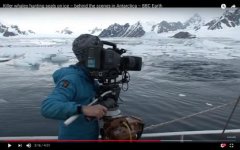
Handheld Gimbal + Engine Vibration

markoconnell

Well-known member
I'm shooting from the deck of a hundred foot boat with a GH5S and 400mm lens on a tripod. This can work EXCEPT for the vibration from the engine coming through the hull and the deck and screwing up the image. I'm wondering if putting a handheld gimbal between the tripod and camera would help? Killing the engine is not an option. The long lens is necessary. Thanks-
 
I think you won't know until you try it, too many variables. How fast is your boat going? How fast are the subjects moving? How rough is the ocean that day? Tons of factors. We shot lots of footage off of various size boats last year for a documentary I am producing and the amount of engine vibration transmitted varies radically from boat to boat. But I do know from experience that expecting to hand hold a gimbal with a 400mm FOV is "optimistic" Most handheld gimbals max out at about 85mm to 120mm FOV and after that, you are magnifying every little jitter and movement exponentially. Usually long lenses require a gimbal head and or stabilization on a boat, it's just a matter of figuring out which solution will get the job done. Unfortunately none of them are cheap to even rent, much less own.

If you want get down to it, this is what you really need but it's $2,500.00 per day to rent http://www.perfect-horizon.com/ It's what we need for our project, but we have to shoot 7-9 races this year and besides the system, you have to hire a DP who is certified to setup and balance their system at about $1,500.00 per day. So at $4,200.00 x 9 races = $37,800.00 that's probably not happening for us.

That's why I suggested the Tylermount MiniGyro, it's probably 70% as good as the Perfect Horizon but at only $400.00 a day, might be do-able for us and for you. The Canon C200 demo film "From Dock to Dish" they used a handheld gimbal mounted to an EasyRig to shoot boat to boat on the open sea, but as others have pointed out, if you are wearing that setup, there lots of other problems that could potentially happen, especially if you fall overboard, good chance of drowning while wearing it. And to rent a fill sized gimbal and EasyRig, costs more than renting the Tylermount. And like I said, I don't believe a handheld gimbal is going to handle 400mm FOV.
 
Last edited:
"But I do know from experience that expecting to hand hold a gimbal with a 400mm FOV is "optimistic""

Perhaps I was unclear, the gimbal would be attached to a tripod, basically exactly the setup I use now, but with a gimbal under the camera. The perfect horizon system is massive overkill for what I'm doing, and even if it were affordable would be logistically impossible. The gyro based systems, because of their power requirements, spin-up time and weight are just not a good solution. My situation isn't nearly as demanding as shooting races, I'm shooting orcas. The average speed they travel at is 4-6 mph. Very slow.

Keep in mind, the boats we are shooting are 44' long, your Orcas are going to be more in the 8'-18' range, aren't they? Here's a video cap at 135mm from about 80'-100' away from the subject. I'd like to be able to zoom in even farther to pick up groups of 1-2 paddlers and see some facial expressions but that may or may not be possible.

Yesterday I was looking at footage we shot for a Newport to Catalina crossing last September, it was the smoothest and glassiest day that we had seen on the ocean in years, it was basically almost as smooth as a lake, no whitecaps, just barely visible gentle 12" waves. The ocean off of Southern California is like that perhaps 1-2% of the time. Even with that and shooting our paddlers, I'd say our keeper ratio went from about 8% on medium rough water to maybe 20% on this smooth as glass sea. That was with an IS lens with the camera mounted on a monopod. It's not really the waves all of the time, it is the swells and the boat rocking from port to starboard and back coupled with long focal lengths and that highly reduced FOV that do you in.

The longest we have shot with, on an S35 imager, is the Canon 18-135mm STM IS, a stabilized lens. Personally, I think any footage you shoot at focal lengths greater than 135mm will yield you a much lower percentage of keeper/usable footage than you think. Usable footage from a 400mm FOV on an M43 imager sounds wildly optimistic to me. But we can discuss and perseverate until the Cows come home about will or won't a given setup work but the only really practical way to determine is to go out and shoot some tests, that's what we plan on doing. We'll rent and test the Tylermount MiniGyro, Kenyon Gyros mounted to the bottom of our camera with a Cinesaddle, a handheld gimbal, but I will be thrilled if with any of these solutions we can use our 70-200 2.8 IS II Canon lens and get usable shots, even at 50-75% keeper ratio would be fine for our needs. I think the only thing working in your favor is that you are shooting off of a small ship, we were shooting off of small chase boats. The larger a boat, the slower they are to respond to the surge and swell and they won't even feel many of the waves that we totally feel on a 22' chase boat. So you have that in your favor, maybe it will be enough to make your VERY long lens FOV usable? Test it.
 

Attachments

  • Hokuloa Dana.jpg
    Hokuloa Dana.jpg
    70.1 KB · Views: 0
" The larger a boat, the slower they are to respond to the surge and swell and they won't even feel many of the waves that we totally feel on a 22' chase boat. So you have that in your favor, maybe it will be enough to make your VERY long lens FOV usable? Test it."

I've been shooting these orcas for several years with basically the same lens sensor set up. My problem is not the same as yours. I've been asking about the effectiveness of a gimbal in dealing with the engine vibration that comes through the deck of the boat. If anyone can answer that please speak up.
 
I don't know how you would get a 400 on a gimbal - but it won't help anyway.

Gimbals stabilise pan tilt and roll but don't help with up down and fore aft (xyz)

Engine vibration is in all six axes

When a gimbal is handheld the human muscle bone brain setup works on the xyz very well.

Engine vibration would need damping with a system that is flexible in all six axes.

That could be foam or cushions for your tripod legs, a system with vibration isolation springs (the curly ones you see between gimbals and car mounts) or a complex mechanical system such as those used in Russian arms and techno cranes
 
I dont know what device this is but you can see that it is two 'sliders' at opposing angles - such a device similar to stuff made by chapman leonard allow isolation in X and Y axes, one would assume it is mounted on a further device which would allow isolation in Z.

In the wide shot of the boat you may see something that looks like a CLeonard arm (z correction) mounted in the middle of the boat.

http://www.chapmanleonard.com/rigs-and-support/vibration-isolators.html
 
" The larger a boat, the slower they are to respond to the surge and swell and they won't even feel many of the waves that we totally feel on a 22' chase boat. So you have that in your favor, maybe it will be enough to make your VERY long lens FOV usable? Test it."

I've been shooting these orcas for several years with basically the same lens sensor set up. My problem is not the same as yours. I've been asking about the effectiveness of a gimbal in dealing with the engine vibration that comes through the deck of the boat. If anyone can answer that please speak up.

Got it. Best of luck in figuring it out. We had the exact same issue on the shoot above, the engine on that particular boat was really bad, it was a constant rattling vibration, I set the monopod on my foot or a flip flop most of the time and it helped a bit. I think isolating your tripod legs with Sorbethane or foam would help a lot although probably wouldn't eliminate all vibration.
 
People might enjoy/take inspiration from the thing I built.

Things..

it has a low resonant frequency of movement,
it is extremely free from the host vehicle in all six axes
it is designed to isolate low and high frequency vibrations

 
Back to the original post..

In my 'journey' to making a stabilised car rig I did buy a RigWheels Cloud mount. There are many reasons why it did not really work as I hoped.

BUT

I do use it sometimes in situations where the operator is touching the camera. AKA I have used it in my van shooting from the back with a 70-200 and a hihat tied to the vehicle.

The OP could consider mounting a cloud mount between his camera and tripod head - it may do good things for engine vibrations but without an operator in contact with the camera the camera will doubtless sway wildly

S
 
Back
Top