Glide Gear DEV 4 – a poor manDana Dolly for less?

Samuel Dilworth

Well-known member
I’m asking, not saying.

This is a $200 roller track dolly system for you lucky Americans. But even for me – I’d have to import it – it would be way cheaper than a Dana Dolly.

Now, it’s obviously not quite a Dana in every detail, even some quite large details. But I’m really liking the look of this thing. Looks like it should work with a fairly heavy rig.

Maybe some of you have used it?
 
Without a 100mm and 150mm bowls it is simply a smaller version for mirrorless cameras, not a direct competitor, IMO.
 
Let's be honest, it is a piece of metal with holes drilled into it and skate-wheels attached. If you are going to take a chance on "knock-offs" or imitators, gear like this- gear with no electronics and no optics- is where you do so. I know of several Grips who have made their own skate-dolly and they look a lot like the one you linked. In fact, someone has one for sale on the 'bay right now:

https://www.ebay.com/itm/Custom-fabricated-Camera-dolly-Dana-dolly/154275693495?hash=item23eb8c43b7:g:nUQAAOSwSRlf1QJi

With the Dana-dolly you are in part paying for the name. So when a client asks "do you have a Dana dolly?" you can answer "yes" and not have to explain that you have something very much like a Dana dolly. The days of clients requesting specific makes of gear are waning. More and more clients will simply ask if you have a "slider" rather than ask specifically for a Dana dolly. Also, the Dana-dolly commanded a premium price because for a time it was the only thing out there like it.

Now, all that said, the big difference between a Dana dolly and the product you linked is that the Dana dolly has a hole for the tripod head and the DEV 4 does not. There is no bowl-adapter or ball-adapter. It will necessitate using a tripod-head that has a flat bottom or a tripod-head for which the "ball" section detaches. I have an older Manfrotto head which allows for separating the head from the ball portion.

Because the Dev 4 lacks the ability to mount a ball-head tripod-head, I'd consider going with something like this, albeit more pricey than the DEV but still well under the Dana:

https://www.ebay.com/itm/Camera-Slider-Doug-Dolly-Camera-Dolly-speedrail-dolly-NEW/233744227456?hash=item366c3ddc80:g:qZcAAOSwR2RZ~LP0
 
It’s hard to get a sense of scale from online product photos, and the specs don’t give key dimensions like the centre-to-centre distance between the pipes. This might be smaller than I envisage it.

Glide Gear also makes (or imports from China like so much of this stuff?) a $500 model that seems to be a direct Dana competitor:

https://www.bhphotovideo.com/c/product/1428357-REG/glide_gear_dev_10_pro_track_dolly.html

Doesn’t look as polished as a genuine Dana, though.

This $200 model is more interesting to me. A stills ball-head with a flat base should sit on it and keep the camera low. No panning or tilting during a move.

That “Doug Dolly” on eBay strikes another interesting price-features point.
 
Ah.. dollies!

Mechanical engineering.. my degree subject.. question one in design.. 'what are you trying to do?'

I guess the three biggies are..
how long the slide?
the mass of the camera?
pan/tilt during a move?

Some thoughts..

Overall think 'is this crew kit?' or my solo op stuff. Crew shooting means you are doing the will of a director. They WILL want you to pan/tilt during a move, they WONT have time to strip down the camera, they WONT allow you to use a 'crappy' B cam. The whole A cam WILL be going on the dolly. You WILL end up on an 85mm.

If you are the director you CAN use a small camera and restrict the move and lens length.

As a crew shooting basicaly you need 100mm bowl and a scaffolding dolly minimum.

How long? Dana and other systems that clamp standard tubes mean you can own different length tubes or even buy tubes at a foreign location. I took my floor dolly to Portugal and bought PVC tube there to film a load of hotels.

Basically 'A' cameras are heavy cam+monitor+lav receivers+VC14/arri plate+matte box.

Joining tubes is always a fail unless you are Ronford Baker or Solid Grip Systems. Clever poor people have different size tubes for different shots or jobs. (unlike system 1)

The mass of the camera is of course critical ball heads only for 'photo cameras'

The lowness of the camera mass is super important, the glide gear seems a nightmare.

If you want to pan/tilt.. and I think you do.. you will need a proper video head.

===

I would look for ..
100mm bowl slot
as low as possible
tubes that can be swapped for longer/shorter. Easy purchase tube diameter.
wheels at 45 degrees as they always 'fall' into being a good fit.

The first actually seems very cheap for the wheels and wheel mounts.. you could buy that and get a 100mm plate in the fullness of time.

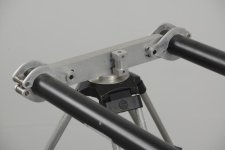
My homebuild.. one thing.. the bowl can be flipped so one can hang the camera for low shots or pointing the camera down.
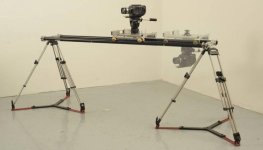
slider01.jpg
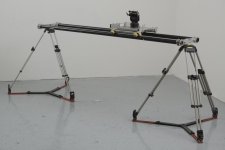
_SMM1526_03.jpg
_SMM1531_01.jpg
 
you will see the slider sits on tripods. (whose height and angle can be hugely manipulated)

I shot something and we used (longer) floor dolly when possible but on rough ground floor dolly was not happening.. so a big spec of the slider was the abiity to set on rough/sloping ground - I dont get putting danas on light stands.
 
That’s a sweet home-made dolly system that even looks to have some improvements over commercial systems, morgan_moore. Super low. Nice job.

That said, I’m wondering if there’s yet another way to do this.

Putting the wheels’ axes of rotation at right angles to each other (on each bogie or truck) is desirable because, as you say, gravity makes them fall into place and that guarantees straight tracking with no play. And I take your point about three wheels (like yours) also eliminating a potential source of wobble or judder that four wheels (each with no trail) might provoke.

However, once you have two tracks (pipes) and three or four bogies at fixed track spacing, you now have to make sure the bogie spacing exactly matches the pipe spacing. That’s inelegant and might cause its own problems, no? Because one bogie or the other, depending on a bunch of factors, has to ride up the pipe a little to take up any spacing error.

I wonder if a better system might be to have a single main load-bearing pipe, two longitudinally spaced three-wheel bogies on the dolly riding on that pipe, and a third outrigger wheel riding on a flat plate parallel to the pipe and offset by maybe 12 inches. The outrigger would be a single narrow wheel (like an in-line roller blade wheel) rotating in the vertical plane, centred longitudinally between the two weight-bearing bogies, and it would be free to track wherever it likes on the flat plate (inch-wide or so). This way you’d avoid the need for precision in matching the spacing of the dolly bogies and the pipes.

How important is torsional stiffness of the two-pipe system in Dana-type dollies? That is, if the pipes were the main beams of the ladder frame of a vehicle, does the vehicle’s torsional stiffness matter? I ask because the $200 Glide Gear seems to rely on pipes clipping into plastic end pieces. That might be a weak point.
 
Last edited:
One thing about these dollies on pipes is that they don’t travel anywhere near as long as the pipe. You have to subtract twice the clamp width (each end) plus the length of the dolly itself, and you don’t really want to be slamming the dolly into the stops at the end of the travel either. The shorter the pipes, the more of their length (proportionally) you lose to these factors.

To clarify, I am far from a professional and can shoot however I like with no client pressure. Moreover, I don’t have big cameras.

My fluid head has a 75 mm half bowl, but I think I could use a locked-down stills ball-head, because I still don’t know why I’d need to pan or tilt during a move. Examples of that?
 
My fluid head has a 75 mm half bowl, but I think I could use a locked-down stills ball-head, because I still don’t know why I’d need to pan or tilt during a move. Examples of that?

Panning and tilting with or against the subject while you are trucking is one of the oldest movements in cinema.
 
My fluid head has a 75 mm half bowl, but I think I could use a locked-down stills ball-head, because I still don’t know why I’d need to pan or tilt during a move. Examples of that?

To keep your subject/object in the proper place in frame as the camera is moving. Example: One of the biggest (overused)uses for dollies is to add movement (usually left-to-right & right-to-left) during interviews usually of a profile two shot of the subject and reporter/interviewer. The camera tracks back and forth (L-R/R-L) and at the same time pans in the opposite direction to keep the subjects within the frame. Otherwise if the camera is static(not panning) while still moving laterally(L-R/R-L), you are going to end up with them being out of frame at some point on either end and it’s just going to look like someone sliding a picture from side-side. Also, look up parallax motion.
 
I still don’t know why I’d need to pan or tilt during a move. Examples of that?

This vid is testing my slider in auto mode (its a test not perfect) you will see that Im counter panning all of the time to keep the 'subjeect' central.

 
Last edited:
This vid is testing my slider in auto mode (its a test not perfect) you will see that Im counter panning all of the time to keep the 'subjeect' central.

Thanks. Okay, I’ve seen that effect but always assumed gimbals or Steadicams were to blame. Does look useful for limited circumstances. Whether I’d be able to pull off moving the dolly, moving myself to keep up, counter-panning smoothly in synch with the slide, pulling focus, and timing the whole thing with a live subject … that’s another matter. Seems unlikely without more automation than I’m currently considering.
 
'limited circumstances'

Well if you are filming one thing then counter pan is 'standard'

Of course the A->B move is also legit .. sliding out from behind the rubber plant and revealing the room.
 
Thanks. Okay, I’ve seen that effect but always assumed gimbals or Steadicams were to blame. Does look useful for limited circumstances. Whether I’d be able to pull off moving the dolly, moving myself to keep up, counter-panning smoothly in synch with the slide, pulling focus, and timing the whole thing with a live subject … that’s another matter. Seems unlikely without more automation than I’m currently considering.

Of course you can do moves without panning or tilting in certain instances(like a reveal), but those are really 'the limited circumstances'. The VAST majority of the time you will be panning and/or tilting while sliding. And it's not as hard as it sounds. You just have to do it and get used to it. Then it becomes second nature and you don't really consciously think about it when you actually do it. Just like when you're shooting on a tripod or handheld and you're doing some type of pan and tilt at the same time, but maybe/maybe not at the same speed on each axis to keep whatever framed properly while zooming in or out and focusing. Sounds like a lot, but it becomes something you "just do".
 
Imo it is pretty hard! Well like most operating once you go above s35 50 it’s hard - on an 18 less so.

An item like a Dana has enough mass and inertia to work in the mild telephoto zone - no chance on a glide track sized linear slider
 
Imo it is pretty hard! Well like most operating once you go above s35 50 it’s hard - on an 18 less so.

An item like a Dana has enough mass and inertia to work in the mild telephoto zone - no chance on a glide track sized linear slider

Hard in what aspect?
 
Mainly not to wobble. Generally to be perfect in terms of acceleration focus et al.

Gotcha. Focus at longer focal lengths is probably the hardest of those(or doing a dolly in/out on an object/subject). Wobble, acceleration, movement can largely be taken care of(managing those aspects becomes easier) with proper equipment. Of course there is the skill/talent/practice part, but a rig with a lot of mass and a good head will make your life easier and make you look like you know what you're doing. And also, much like a gimbal, shooting in slow-mo, if you're in a situation that you can, helps to smooth off the rough edges, too.
 
Back
Top