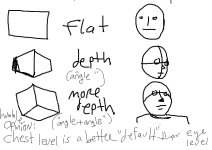
Get low low low low low low (angle)

Josh Bass

Veteran
I watch a lot of TV shows via netflix, DVD, etc. (I don't watch as many movies so can't if this also applies there). One thing I've noticed is that on many shows, almost always, unless the shot is some sort specialty shot, camera appears to always be below characters' eyelines (characters looking above the lens at other characters in dialogue scenes). This applies to every focal length shot, in every scene, regardless of mood feel etc.

I'm not going to say it doesn't look nice, but wondering what the psychology is behind this shooting style. I am familiar with the low angle = character looking powerful/intimidating school of thought, but I'm talking ALL THE TIME with this shooting style. A concrete example would be Dexter, which I've finally been catching up on via netflix.

So what's with all the lowness? shooting up helps hide cables on the floor? We think ceilings look more interesting? We love looking at blurry arms, waists, legs, and shoulder humps rather than heads in OTS shots? It's just somehow more dramatic?
 
It makes people look taller and therefore superior. Conversely, if you want a character to look small or inferior, shoot from above their eye-line. Shooting full body shots from hip/torso height also makes the subject look correctly proportioned - that's why fashion photographers always do this.
 
In terms of the shows mentioned I think it is power.

--

Personally I like the lens to be perpendicular - ie not tilted. When one pans or tilts one gets loses the verticals - wall lean in or out. Also people filmed from head height, their head will be too big (proportioned as Liam said). While such effects are there and hugely obvious with a wide they are still there with a long. But filming everything from mid height give a childs perspective, so is often not appropriate either!

Im not sure why shift lenses are not big in filming, with a shift lens one can get the camera at the appropriate height, avoid keystoning and mis proportion and control headroom. I have a nikkor 28pc and feel it to be an incredibly strong narative lens.

Coming from still I have decided that one is best to choose camera height and position and then sort out perspective in post. Again perspective correction in post is not a normal filming activity. Maybe once over sampling (4k for 1080) and post software simplifies the feel will change.

On the same line I feel (and most very much dont) that one is best to pick a camera position and use a zoom to create the frame. Different camera positions have different effects, power, weakness, (sexual) availability, distance, intimacy, vouyer et al. To me camera position comes first and the lensing should follow.

--
It is interesting (again coming from stills) where a height adjustment is easy, to find the frustrations of height adjustment in movies (tripod), Camera tools such as the PeeWee Dolly make booming pre or during a shot simple and give the DOP fast control of the lens position. Such control often shows the difference between a pro and an indy shoot..


S
 
Last edited:
In addition to what some other people have already written in this thread about camera height affecting the audience's perception of a character, there's also a very practical and non-artistically related reason to put the camera below someone's eye line. I've spoken with a handful of fashion photographers who say that it's a great technique for shooting women because it makes their legs look longer relative to their torso. Obviously that's a desirable effect in fashion photography, and it makes sense why you'd see it more in television than in film -- television, from an aesthetic standpoint, is geared toward making sure characters (often) look and sound their best.
 
The thing about perspective/keeping the cam level makes the most sense. The power/intimidation hero thing doesn't because EVERYONE is shot this way. If everyone has power, no one has power. As for flattering the figures, they do this in every shot, so shows that are 75% MCUs or tighter, well. . .
 
Hi Morgan - I'd never heard of this. Can you post examples?

"Im not sure why shift lenses are not big in filming, with a shift lens one can get the camera at the appropriate height, avoid keystoning and mis proportion and control headroom. I have a nikkor 28pc and feel it to be an incredibly strong narative lens."
 
I have used the 28shift in motion shooting but cannot easily aquire a frame to post.

Here is a shot from a stills shoot, digitally corrected, the camera is at a natural height (I can see what is on the tables) yet I have digitally straightened the verticals

I feel this is more natural perspective than lowering the camera to the point where the verticals were correct in camera..

Doing it digitally or with glass is irrelevant to the visual concepts involved.

01.jpg
 
Actually I found a narrative shot, (full-frame 5d2) where I shifted with the 28pc

This is actually an upshift, the lens is lower than the talent but there is no key-stoning, to give that away.

There is certainly an effect, in this case I believe it is mildly disconcerting which fitted the film, one could see it as mildly Kubrickian.

28pc.jpg
 
"Mad Men" was mentioned--that show has a specific visual bible of keeping the camera low and looking up at characters. Many other shows do not.

Traditionally, studio sets didn't have ceilings, being open to the grid. If you had an occasional shot that would see into the odd corner, there were sections of ceiling that could be dropped in from above for a given shot. These days a lot of sets are built as close to practical as possible to deliver more shooting possibilities. What appears to be ceiling may often be tightly stretched muslin, which allows space lights above to push ambience down into the set as desired.

Sam brings up an interesting point about shift lenses. I'd be hard pressed to recall cinema lenses that have the functionality built in but there are a number of systems that adapted still-style swing and shift mounts which was popular in the 90's as a look (using them for selective plane of focus more than the perspective adjustment). I always found it an immense pain the arse to work with under typical time constraints.

In my Steadicam days I was very sensitive to architectural elements and lines of convergence and was always aware of the height of the camera at any given moment, which was easy to tailor because of the three-foot boom range inherent to that system. There is a specific paradigm know as "boom for headroom" which says that as one pulls away from the subject, it's better to boom down to maintain a similar perspective than keep the same height and tilt down. An experienced Steadicam operator will thus adjust the boom height many times during a shot. Doing the same on the dolly can make the moves much more complex for the dolly grip and I used to request to do so sparingly!

In general, it's more interesting to see less floor.
 
I'd be hard pressed to recall cinema lenses that have the functionality built in but there are a number of systems that adapted still-style swing and shift mounts which was popular in the 90's as a look (using them for selective plane of focus more than the perspective adjustment). I always found it an immense pain the arse to work with under typical time constraints.

Didn't John Ford use tilt too, to keep foreground and background in focus? I think I've seen some examples in some documentary or something, but can't find any references now... (no idea how he managed, I don't know any cinema glass with tilt-shift capabilities; if they actually did this, they probably used some kind of DIY bellows adapter)

BTW, while looking for old-time tilt-shift references, I stumbled across this:
Another unorthodox method used in [Citizen Kane] was the way low-angle shots were used to display a point of view facing upwards, thus allowing ceilings to be shown in the background of several scenes. Since films were primarily filmed on sound stages and not on location during the era of the Hollywood studio system, it was impossible to film at an angle that showed ceilings because the stages had none. In some instances, Welles's crew used muslin draped above the set to produce the illusion of a regular room with a ceiling, while the boom microphones were hidden above the cloth and even dug a trench into the floor to allow the low-angle shot to be used in the scene where Kane meets Leland after his election loss.
 
In my Steadicam days I was very sensitive to architectural elements and lines of convergence and was always aware of the height of the camera at any given moment, which was easy to tailor because of the three-foot boom range inherent to that system. There is a specific paradigm know as "boom for headroom" which says that as one pulls away from the subject, it's better to boom down to maintain a similar perspective than keep the same height and tilt down. An experienced Steadicam operator will thus adjust the boom height many times during a shot. Doing the same on the dolly can make the moves much more complex for the dolly grip and I used to request to do so sparingly!

Charles - this will seem a little mental (as ever) but the process I was suggesting is that pulling back from a subject you should keep height and tilt down to maintain headroom, this will mean keystone (convergence) as you back off, this convergence can then be corrected in post (assuming you are shooting 4k for a 2k deliverable and have marked a suitable safe area on your monitor) - the result would the be most psychologically satisfying as when we as humans back away from a subject we neither experience convergence nor become shorter. In stills I certianly shoot for correction in post which is simpler than using a shift lens.

S
 
Samuel: I'm not sure who was the first to employ swing-and-tilt lenses on a motion picture camera and when. The classic way to achieve close and far focus was a split diopter, which is half of a close-up filter. That effect is is indicated by a rather severe line of demarcation where the focus changes--the rule of thumb was to bury this in an element like a post or similar where it wouldn't be that obvious.

Sam: You are, as always, a mad scientist! Interesting concept to think about.
 
Back
Top