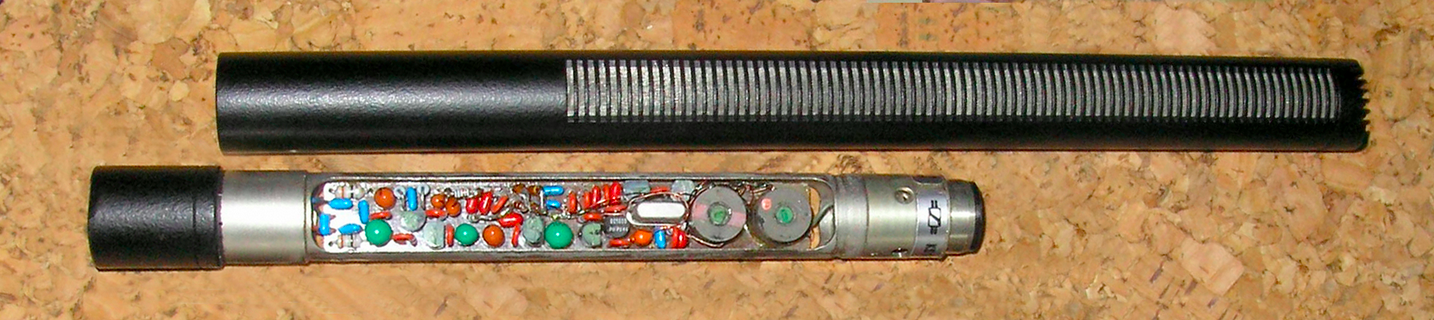
Genuine 416?

Hey there,

I have two second hand MKH 416 mics that I've purchased. I've been using one for a few years. They both sound pretty good but I'm afriad I don't have an ear for detecting a counterfit. I believe one is much older than the other and the internal circuitry looks very different. I'm not sure if it's because the manufacturing process is different these days or if perhaps one (or both) are not genuine. Before sending into Sennhieser to confirm, do you believe the difference of the internal appearence is an indication of one of them being counterfeit? Can anyone that owns one confirm that theirs look like either of the photos? (i've blacked out the serial numbers for posting online)

Also note that one of the capusles say KS 16 while the other says KS 15

Thank you!

1.jpg


2.jpg


3.jpg


4.jpg


5.jpg


6.jpg
 
My old 416 looks, IIRC, like your brass(ier) KS16 one. But maybe...maybe...your other one was an old 415 that was rehoused (like during an official trip back to Sennheiser)? That's just a wild guess, though. I just don't know enough about the history of 416s to know what's changed internally over the years.

Perhaps you could glean some info from Pete Verrando's blog? He's a long-time serious location-sound mixer based in Dallas. He also has a side business upgrading old T-Powered 416 (and Schoeps CMC4) mics to phantom power. So he's seen the insides of a whole lot of 416s (as have repair people at Sennheiser, and various dealers with repair departments). Anyway check out this article from a few months ago:

An unhealthy obsession with fake Sennheiser MKH416 microphones
Last month I knowingly purchased a fake MKH416 so I could compare it with a real MKH416. It just arrived today, with case, in a padded envelope...
http://www.txsound.com/blog/obsession-with-fake-sennheiser-mkh416-microphones/

Maybe you could chase down Pete and ask him... Or just send a couple of your pix to Sennheiser USA's service department?
 
I was told that the KS 15 one was sent into Sennheiser to be refurbished a couple of years back but that it was originally a 416. But I just want to make sure it's not a counterfit.
 
I looked at Pete's site again and I actually came across this photo of a genuine 416. Which looks like the mic in question. It seems that there are many versions of the internal circuitry.

Screen-Shot-2015-07-28-at-6.33.32-AM.png


I am fairly confident I have two genuine 416s, just different manufacturing processes. Thank you!
 
I was so concerned that I may have bought a fake 416 that I sold it and bought an MKH 8060. Then I became convinced that I had bought a faulty 8060 with the excessive 'noise issue' so I sent it back to Sennheisser and they replaced it but it still sounded the same so I now use an MKH 50 which sounds so good I now question that my life is a fake and the only connection I have with reality is through the MKH50.
 
I was so concerned that I may have bought a fake 416 that I sold it and bought an MKH 8060. Then I became convinced that I had bought a faulty 8060 with the excessive 'noise issue' so I sent it back to Sennheisser and they replaced it but it still sounded the same so I now use an MKH 50 which sounds so good I now question that my life is a fake and the only connection I have with reality is through the MKH50.

Yes, I am right behind you in that rabbit hole!
 
I was so concerned that I may have bought a fake 416 that I sold it and bought an MKH 8060. Then I became convinced that I had bought a faulty 8060 with the excessive 'noise issue' so I sent it back to Sennheisser and they replaced it but it still sounded the same so I now use an MKH 50 which sounds so good I now question that my life is a fake and the only connection I have with reality is through the MKH50.

But how do you see the world??
 
I'm actually a little shocked at the solder jobs on both! they didn'e even wash of the excess flux.
 
I confirmed with sennheiser that they are both genuine 416s. The bottom one uses discreet style components and was the process up until the early 1990's. From the Sennheiser Rep:

"The only real difference between the two versions is that the capsule construction is a little different on the newest version. The circuit, sensitivity, and frequency response are the same on each microphone. If you’re noticing a vast difference between the two, it may mean that one of the microphones might be out of alignment. This happens when the capacitive value of the capsule, and the circuit its matched to, fall out of tolerance with one another causing the microphone to have a reduced output. This scenario is not uncommon, especially with older versions of the MKH microphones, and is easily repaired with a cleaning and routine electrical alignment."
 
Back
Top