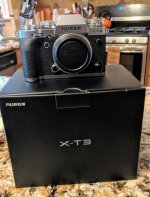
Fuji X-T3 released

Can someone please help me out with an xt3 question? I needed to know if the new Fuji xt3 had the 180 degree or 48 shutter speed like the xh1, or is it still only doing 1/50 of a second like the xt2. This is big for me, as I can definitely see some difference in motion. Any help with this would be greatly appreciated. My preorder shipped today and b&h could not offer any answer.
 
Can someone please help me out with an xt3 question? I needed to know if the new Fuji xt3 had the 180 degree or 48 shutter speed like the xh1, or is it still only doing 1/50 of a second like the xt2. This is big for me, as I can definitely see some difference in motion. Any help with this would be greatly appreciated. My preorder shipped today and b&h could not offer any answer.

Well how does the footage look of X-T3 videos online.
 
I'm really interested to hear how the 10-bit 4:2:0 internal recording holds up. It's great to have the bit-depth and a decent compression ratio. But 4:2:0 is violently compressed colour subsampling, and I suspect will demand shooting with Fuji's film emulation looks burnt in in order to record saturated enough chroma information.

I'm really interested to know how malleable it's going to be. My biggest fear would be wrangling mismatched white balances within a single scene if you're shooting outside in changing light conditions.

If there isn't enough chroma information to pull the white points into a matching space, it might still demand that you shoot with an external recorder (which is a bummer).

I wouldn't really call 4:2:0 violently compressed vs 4:2:2. 4:2:2 is already very compressed color. Yes there are color samples missing but the same is true of 4:2:2 as well and if one can notice it on one they can likely notice it on the other. When it comes to 4k I rarely find situations where 4:2:0 is more than enough to cover 99% of situations. Yes 4:2:2 would have been a better option but really we are talking splitting hairs here. Even for advanced VFX 4:2:0 can deliver very good results. It isn't the 4:2:0 that hurts amateur keying but they lack of understanding of lighting and how to manipulate the edges to get realistic results. 4k 4:2:0 has just as much chroma information as 4:4:4 2k does and that has been used for large Hollywood VFX movies for years. I like to think of 4k 4:2:0 as having a bonus luma vs a loss of chroma. You gain so much more detail and green values than you do from a 2k 4:4:4 source which makes keying all that much easier due to the finer edge details. Yes some of those edges could be slightly pixelated but then so would keying a 2k 4:4:4 source and scaling up to 4k as well.

The 10bit is so much more important because if 8bit isn't enough to capture the subtle range of colors the image is damaged forever. A good looking 8bit image can stay good looking in a 32bit float grading environment but once you have large gaps in the samples it is damaged forever. Especially when shooting with a flat format like log where the entire 8bit range may not be used or it has to get stretched too much in post. 4:2:0 to a flat profile doesn't damage the material anymore than it does to a baked in color profile. Grading also doesn't do any extra damage. 4:2:0 really just means color pixels that are 2x2 pixels in size.
 
  • Like
Reactions: dpc

Good news, its indeed better at high ISO's. Probably not a huge difference but there is definitely improvement. I'm really excited to see some footage out of the XT3 so post when you have the chance guys!
 
Just got my XT3 and confirm that the shutter in video mode can do 1/48.

View attachment 132752

Sexy and cheaper in Silver. I am sorely tempted, this would be a great low key documentary camera other than audio but I do have a couple of Tascam DR-10L laying around though, but it's hard to go back to dual system sound after shooting with my Canon C series for the past few years. But you can't argue with that Fuji color science and the presets are very, very nice looking. Let us know how you dig and post some good looking footage. 10-bit is icing on the cake, wish it had the XH-1's IBIS. They are really getting close to almost the perfect mirrorless. I had a GH5s to play with for a month and I liked it but it was pretty "video" looking. I dislike the Sonys color science, still, so this is about the best thing available if you want small, light, S35 imager with what seems to be evolving into pretty good AF.
 
I wouldn't really call 4:2:0 violently compressed vs 4:2:2. 4:2:2 is already very compressed color. Yes there are color samples missing but the same is true of 4:2:2 as well and if one can notice it on one they can likely notice it on the other. When it comes to 4k I rarely find situations where 4:2:0 is more than enough to cover 99% of situations. Yes 4:2:2 would have been a better option but really we are talking splitting hairs here. Even for advanced VFX 4:2:0 can deliver very good results. It isn't the 4:2:0 that hurts amateur keying but they lack of understanding of lighting and how to manipulate the edges to get realistic results. 4k 4:2:0 has just as much chroma information as 4:4:4 2k does and that has been used for large Hollywood VFX movies for years. I like to think of 4k 4:2:0 as having a bonus luma vs a loss of chroma. You gain so much more detail and green values than you do from a 2k 4:4:4 source which makes keying all that much easier due to the finer edge details. Yes some of those edges could be slightly pixelated but then so would keying a 2k 4:4:4 source and scaling up to 4k as well.

The 10bit is so much more important because if 8bit isn't enough to capture the subtle range of colors the image is damaged forever. A good looking 8bit image can stay good looking in a 32bit float grading environment but once you have large gaps in the samples it is damaged forever. Especially when shooting with a flat format like log where the entire 8bit range may not be used or it has to get stretched too much in post. 4:2:0 to a flat profile doesn't damage the material anymore than it does to a baked in color profile. Grading also doesn't do any extra damage. 4:2:0 really just means color pixels that are 2x2 pixels in size.

I can only disagree strongly. 4:2:2 subsampling throws aways half of your chroma information, that's not great, but in practice it leaves enough for a lot of purposes. 4:2:0 subsampling throws away half of that remaining half. It's recording only 25% of the chroma information that the sensor is providing.

If throwing away 75% of your chroma information isn't 'violently' compressing it. I don't know what is.

Yes, downsampling the image to 2k should yield a more robust image (relatively) on a per-pixel basis, but then you're losing your 4k image.

It remains to be seen how malleable the 4:2:0 image is going to be, and the impact it will have on maintaining colour consistency through a final graded scene. So Matt, if you fancy shooting a test for us, it'd be much obliged!
 
Please, just step back from the inflammatory hyperbole. We all know the difference between codecs without doing battle over adjectives.
 
I can only disagree strongly. 4:2:2 subsampling throws aways half of your chroma information, that's not great, but in practice it leaves enough for a lot of purposes. 4:2:0 subsampling throws away half of that remaining half. It's recording only 25% of the chroma information that the sensor is providing.

If throwing away 75% of your chroma information isn't 'violently' compressing it. I don't know what is.

Yes, downsampling the image to 2k should yield a more robust image (relatively) on a per-pixel basis, but then you're losing your 4k image.

It remains to be seen how malleable the 4:2:0 image is going to be, and the impact it will have on maintaining colour consistency through a final graded scene. So Matt, if you fancy shooting a test for us, it'd be much obliged!

Don’t ever apply math to describe how an image should look. Yes a lot is thrown out but how it is spaced out makes a big difference. It is an absolute fact that 4k 4:2:0 has chroma channels of 1920x1080 or 2048x1080 if you shoot 4k. It is less but it’s still the same amount of chroma detail as 2k 4:4:4. Stop thinking of chroma sub sampling as half empty with some kind of math. You will drive yourself nuts.
 
Just found out the XT3 can punch in while recording in 4k! This is a big deal for me. Been wishing for this feature on SLR's for a while!
 
Just found out the XT3 can punch in while recording in 4k! This is a big deal for me. Been wishing for this feature on SLR's for a while!

That's great to know, IBIS and able to punch in check focus is a must for me. too bad the XT3 no IBIS :(
 
Does anyone have any proper lit 24p footage they can share? It's been a few days now and literally nothing new on YouTube/Vimeo in way of video. I got my camera but my internet is down at the moment. I can definitely say I'm loving that eterna and fujis astetics. Dynamic range looks great and just overall looks phenomenal to my eye, but I've yet to put anything significant together to test its full capabilities. So anyone with time and kind enough to post a clip would be grateful.
 
Back
Top