Freelance Cinematography - essential gear

EDV

Well-known member
Okay so lets say you were more or less ready to start charging for your cinematography services. What are the most important things you need to bring to a job? ( besides your skills of course )
Not sure if a camera tops the list, because whatever you own, may not be what the Director and Producers have decided to use.
I would guess a range of prime and zoom lenses are fairly essential. What about Follow Focus, Filters, Mattebox? Or are these "extras"? If you own a set of lights... should you bring that too?
 
Nothing really. You bring stuff to make more money so the production doesn't have to rent it from someone else but you - in essence, extra stuff = more money in your pocket and more money in producer's pockets as usually you end up giving the stuff away for fraction of real rental price.
 
Okay so lets say you were more or less ready to start charging for your cinematography services. What are the most important things you need to bring to a job? ( besides your skills of course )
Not sure if a camera tops the list, because whatever you own, may not be what the Director and Producers have decided to use.
I would guess a range of prime and zoom lenses are fairly essential. What about Follow Focus, Filters, Mattebox? Or are these "extras"? If you own a set of lights... should you bring that too?

A light meter and some ducktape.
I'd only bring lights, lenses and camera if I was renting them out to the production- After all, they're paying me to do a job, not to bring gear.
If it's a project I feel could use my gear and for some reason cant afford renting them, of course I could see myself lending it; but it's definitely not a part of my 'service'.
 
Okay so lets say you were more or less ready to start charging for your cinematography services. What are the most important things you need to bring to a job? ( besides your skills of course )
Not sure if a camera tops the list, because whatever you own, may not be what the Director and Producers have decided to use.
I would guess a range of prime and zoom lenses are fairly essential. What about Follow Focus, Filters, Mattebox? Or are these "extras"? If you own a set of lights... should you bring that too?


The industry of videography/cinematography is very vast. I find many jobs call for different tools and approaches, so I would first examine what you think you'll be doing mostly. If you mostly shoot weddings, you will have a vastly different tool set than if you shoot commercials for Nike. Or maybe not.


More important than having the latest and greatest gear, the cinematographer must be very knowledgable of how his gear works. For instance, if you don't have an Alexa, but you know how to get every drop of goodness out of a GH2, the GH2 can look pretty damn good! Never will I say it's better or equal on paper, but it does make a big difference. Give me an odd new camera I've never used on a docu job or give me an HVX200. Despite some rather obvious pitfalls of the old HVX200, I'd likely deliver 10x better footage on the HVX200 than a camera I'm just learning or figuring out.


The job of the cinematographer is basically to be able to know how a camera, lens, and likewise equipment 'sees' and works, and is able to light, expose and compose to utilize the strengths of his tools and diminish the weaknesses of his tools.

This did not answer much, but if you are not more specific in what you are doing I cannot help you.

Not sure if a camera tops the list, because whatever you own, may not be what the Director and Producers have decided to use.
I would guess a range of prime and zoom lenses are fairly essential. What about Follow Focus, Filters, Mattebox? Or are these "extras"? If you own a set of lights... should you bring that too?
You are correct. Sometimes they will want something better than you have, sometimes they will not be able to afford what you have, sometimes they won't care and you decide. Every job is different. Sometimes a big cinema camera is the best, sometimes a fast and dirty DSLR is appropriate. Again, one of my favorite things about this industry is that every job has different needs.

That said, if you don't buy a camera, why do you ask this question of essential gear?

Most people choose a camera that is flexible and correlates with the type of work they think they will do. If you know for yourself and you are tough enough to play this ever accelerating 'camera game', you should consider it because most of the time, there is a slight advantage for your pricing if you already own a camera and can bundle your services and that rental together. However, you don't need to play this game. It's often very tough for beginners and in the last 5 years has really gotten out of control with a new camera being released every three months. So I'd say a camera is not essential, although it can be if you choose that business model.

If a camera is not essential due to changing circumstances... what is?

Lighting? Some would say so... as a working cinematographer/assistant, I'd say certainly not. Lighting, unless you shoot mainly the same thing all the time, is almost more fluctuating by job than camera. Sometimes you want soft, sometimes you want hard, sometimes you need kino's, sometimes you need HMI's, sometimes I go all tungsten, sometimes I want LED light panels. And then comes the grip! Again, you can get some basics, but as far as my experience, I always need special lighting or grip gear to appropriately light my work. I can't always use the same Arri soft-bank kit! So again, not essential, and another rabbit hole which many have happily gone down and many have happily not.

Professional lenses seem to be a good investment, so long as you get a mount or interchangeable mounts that correspond with the type of cameras you think you and/or your directors/producers will be insisting on. For me that is PL, for many up and comers it is now Canon and/or PL. Again, you'll need to pick lenses for your potential clients. I own some, but they are not Master Primes, because only about 10% of the jobs I work are willing to pay 1,500/day for just lenses.

Long and short:
If you want to get into the camera hustle, it's a commitment to constantly be fighting the waves of incoming technology. It's not easy but it's certainly possible! If you want to get into the lighting game, that has more longevity as lighting tech does not get replaced as often as camera models, but it's a slippery slope if you do more than just interviews. Soon you'll have a garage full of misc gear and you'll be on Ebay shopping for a 3-ton truck!

If you just want to be a cinematographer, many people have become cinematographers without owning any of their own gear. In that case, a light meter is essential gear (although this day and age it depends how you work I suppose) but I still find it's very useful.

Otherwise the most important gear might just be a good demo reel.
 
Last edited:
I've got a bag with little stuff that makes the job a little easier and can save a day. Different color sharpie's, rubbing alcohol, grease pencils, rope, heavy duty scissors, gray-card, ear-set for a walkie-talkie, camera tape, black paper tape, white and black gaffer tape, allen wrenches, screw driver set, letterman, compass, note-book, light-meter, heavy duty push-pins, cube tabs, pig nose, ground lift adapter, zip-ties, flash light, sunscreen, power bars, T markers, business cards, phone charger and aspirin. Then I've a box with 75, 150 and 250 watt 3400K light bulbs for practicals, a box with duvetyne scraps and a pack of 1'x1' mirrors that I will bring to set.

And always have a clean shirt in the car in case the director or leading lady/man invites you for dinner after the shoot.
 
Last edited:
Okay so lets say you were more or less ready to start charging for your cinematography services. What are the most important things you need to bring to a job? ( besides your skills of course )
Not sure if a camera tops the list, because whatever you own, may not be what the Director and Producers have decided to use.
I would guess a range of prime and zoom lenses are fairly essential. What about Follow Focus, Filters, Mattebox? Or are these "extras"? If you own a set of lights... should you bring that too?
As pointed out... It really depends on what you are doing.

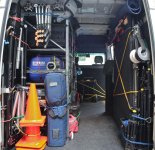
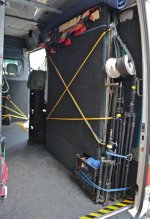
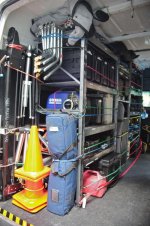
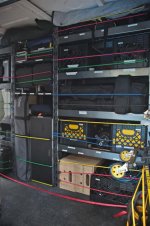
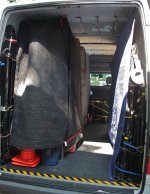
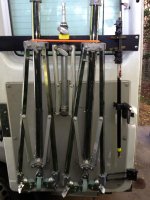
But I will also add that there are no strict rules. For example... I have changed my base gear set over time to roll with the changes in how I work. A few years back I sold my Red One and all my big lights & senior stands and now a 2K on a junior stand is my biggest light. Gotta love modern cameras! Well this weekend I have been reconfiguring my ride along base set once more, to roll with the changes in how I work now doing mainly TV commercials. I pulled everything off my Sprinter van, and have reconfigured it from basically a light & grip van with a ride along camera cart, into a lean mean production machine, with a base set of what I use to service the majority of my ad agency client's needs.

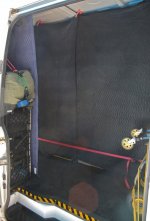
Here is the rear of my van now.

With flags, scrims, diffusion, reflectors, sand bags, weights, clamps, tape, light weight stands, audio boom, cine-saddle, mini skater dolly, riding on the right side.

And power, camera support, cameras, lenses, camera assist, lights, stingers, dimmers, nested apple boxes, tools, audio, makeup kit, grip clamps, a couple of pony stands, and only 5 C-stands, on the left side.

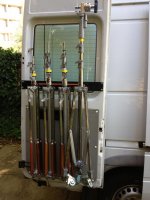
Other stands ride on the back doors.
 

Attachments

  • Sprinter 02.jpg
    Sprinter 02.jpg
    61.1 KB · Views: 0
  • Sprinter 03.jpg
    Sprinter 03.jpg
    61.1 KB · Views: 0
  • Sprinter Rear 01.jpg
    Sprinter Rear 01.jpg
    107.9 KB · Views: 0
  • Sprinter Rear 03.jpg
    Sprinter Rear 03.jpg
    69.6 KB · Views: 0
  • Sprinter Rear 02.jpg
    Sprinter Rear 02.jpg
    79.6 KB · Views: 0
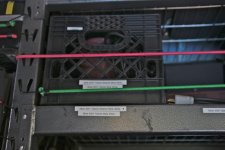
I then OCD labeled everything in it's new place.
 

Attachments

  • Sprinter OCD Labeling.jpg
    Sprinter OCD Labeling.jpg
    83.2 KB · Views: 0
  • Sprinter OCD Labeling II.jpg
    Sprinter OCD Labeling II.jpg
    72.9 KB · Views: 0
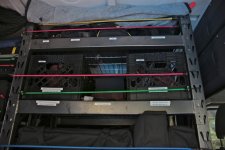
I now keep a much smaller mix of Tungsten lights, along with a set of LED, Fluorescent, and pair of HMIs.

If I need more, I just load it in!
 

Attachments

  • Sprinter Lighting Side.jpg
    Sprinter Lighting Side.jpg
    66.7 KB · Views: 0
I am humbled David.

Ive been thinking about getting a sprinter van to do the same thing for my load out.

Did those shelves come with it?
 
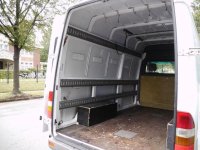
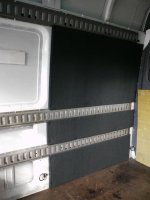
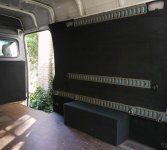
Here is what it looked like when I bought it used Matt, and installed the E-Track.
 

Attachments

  • sprinter 01.jpg
    sprinter 01.jpg
    94.5 KB · Views: 0
  • sprinter 03.jpg
    sprinter 03.jpg
    90.5 KB · Views: 0
Last edited:
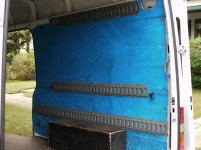
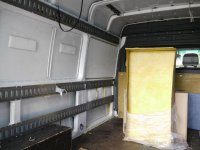
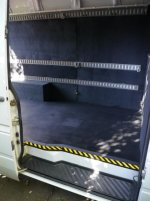
Then I insulated and built panels.
 

Attachments

  • Sprinter install 01.jpg
    Sprinter install 01.jpg
    75.8 KB · Views: 0
  • Sprinter install 03.jpg
    Sprinter install 03.jpg
    85.3 KB · Views: 0
  • Sprinter install 04.jpg
    Sprinter install 04.jpg
    44.1 KB · Views: 0
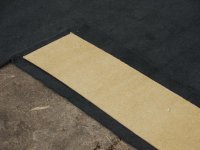
And then finished off the floor with bed liner.
 

Attachments

  • P1000234.jpg
    P1000234.jpg
    62.9 KB · Views: 0
  • sprinter side.jpg
    sprinter side.jpg
    36.8 KB · Views: 0
Last edited:
They are more or less a safety net riding under the blankets, with straps over the blankets. Never had an accident, but I'm always looking for a better idea.

Give rope ratchets a shot. They can very quickly and easily tighten down on the shelves, but have no chance of coming flying out. They are also much more handy than ratchet straps as they aren't such a pain to loosen and tighten. I wouldn't use them to strap down a cart or anything, but we usually use them for our head carts and distro carts.

Really you don't need anything to shoot though, maybe just your friends to get you there and a light meter. I like my ipad too with sun seeker and the artemis viewfinder.
 
Last edited:
Back
Top