Flexi tracks?

AveCeasar

Member
Hey there!

I wonder if any of you have heard about these so-called flexi tracks and if you've been able to try them out. There is very little information on them on the web, unfortunately. They seem to be what I'm looking for (a flexible and cheap dolly system) but it seems a bit to good too be true at the moment.

Two examples of flexi tracks I found:
http://www.bhphotovideo.com/c/produ...ETRAC_System_Complete_Dolly.html/prm/alsVwDtl
http://www.flycamshoppe.com/fc/PROAIM-36ft-Long-Flexi-Track.html
 
Last edited:
I use them since years and yeah, when your underground is not a forest trail or cobblestone, they work quite well.
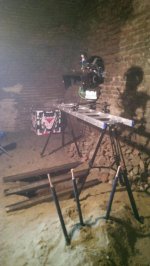
For rough terrain I use the same dolly as on the rubber tracks, but on a ladder, that sits on two cheap tripods.
 
Well, there's plenty of information about the original manufacturer of this concept: http://www.porta-jib.com/flex-trak.htm. I'm sure there are those who will scoff at the price of that system in comparison, but that's the difference between innovation and shameless ripoff, it's always cheaper to do the latter.

I can't tell you how the Varizoom or ProAim versions compare to the original (which I own), although the latter appears to be missing the articulating leg which is the absolute key to this design. Without it, the track must be laid perfectly straight which is very difficult to do (Losmandy offers a number of great accessories that can actually turn the FlexTrak into the equivalent of straight dolly track). Managing the track itself is reasonably easy especially with the improved version of the track that has less "memory" and thus will unroll straighter, and again, the cheaper versions may or may not offer this feature. Part of the advantage of the system is that you can create compound curves in whatever shape you like, but these can be a little tricky to operate with a dolly that you have to walk alongside. I've owned the flex system for ten years at least and have never laid it down in anything other than a straight line!

Considering the other options out there today, if you tend to do longer dolly moves that would take you out of the realm of a slider or similar fixed-length system, this is a good option. Extremely smooth moves with little effort. It's best on level floors, not great for exteriors unless you have the complete kit that allows you to level it like regular track.
 
Hey guys, thanks for all the advice and some great links! I'll be sure to consider all of your suggestions before buying ;).

Postmaster - I find your idea with a dolly on a ladder extremely interesting. What kind of ladder are you using?
 
Thanks for the photo :). I did some research while waiting for the reply and now I'm really interested in trying out this ladder solution. Of course with ladders transportation becomes an issue. It would be interesting to see if shorter ladders can be somehow connected to form a longer dolly.
 
I've seen very successful shots done with a ladder rig, but as noted transporation is a whole other thing. I'm pretty sure it would be a serious challenge use multiple ladders joined together as it would be quite difficult to keep the resulting bump at the join out of the shot.

The advantage of the flextrack comes in when a physically longer move is required vs a slider, ladder etc. Also, not having physical structure inbetween the sides of the track can be helpful for certain shots, such as talent walking towards camera as it pulls back. I last used the setup a few years back on this clip, from :13 to :37. It was sort of a poor-man's motion control concept, with the camera moving forward at constant speed via the edit (in reality, a friend pushed the dolly to a counted cadence regulated by hash marks on the floor). Unlike standard dolly track with crosspieces in the middle, the actors were free to move in and around the Flextrak more easily.
 
That shot seems pretty nice. From what I can see here, it's obvious that a dolly move (towards/from the subject) would be better with this flexible track.

I agree with you on the point you made concerning the ladders. Joining them together would be a challenge. I might have access to a specialist who could perhaps do it, though. I'm planning to buy him a long ladder, ask him to cut it to pieces and try to join these pieces together. I'm also thinking about getting some sort of material to cover the whole track with so as to smoothe the transition between the pieces.

The problem I'm worried about is putting this assembled track in the air - the joints might not be strong enough to support the weight of the camera. I'm still waiting for him to reply and frankly speaking I believe that I'll end up using this track on the ground with a tripod... but until he tells me it's impossible to put this track in the air - one can dream!
 
The advantage to using an elevated system is on uneven terrain as it requires only two points of leveling, and you are done. If you are thinking it's just as likely to end up on the ground, consider as well using PVC pipe, lengths of which can easily be joined with inserts. If you use a system like the Flextrak dolly or the Varizoom version that has the articulating leg, you don't have to worry about the pipes being perfectly spaced apart.
 
My colleague invested in floppy rubber tracks (cheap ones) and all he does is tell me how lousy they are. I am happy with my 10 foot aluminum conduit pipes for track and doorway dolly I can put my tripod on as well as stand on if needed. I also got a Dana Dolly recently which is similar to the ladder idea and quite nice to work with.
 
My colleague invested in floppy rubber tracks (cheap ones) and all he does is tell me how lousy they are.

Not surprising. As usual, you get what you pay for. Losmandy revised their design a few years ago and the current one doesn't have memory (unwinds without holding the curled-up position) and are a lot lighter.

I've used the Dana Dolly and like that a lot also.
 
Yeah, the soft track dollies are great on flat surfaces - god help you if you're on uneven terrain though!

I opted for a Cinevate Atlas 200 slider for my simpler lateral and horizontal moves. It's super smooth and unlike Dana-Dolly/Ladder style setups, there's no risk of your camera toppling off (you can also undersling it for over-the-top shots which is great); you can also switch out the rails for longer lengths - I use 4' rail normally (allows the slider to pack into a pelican case and travel easily), and carry 8' rails on the roof rack for when a longer move is needed; it's also able to support a fully loaded camera on my 6' jib for when I want to get really fancy (on the cheap).

I figure if a production needs anything more complicated than what a good slider can provide - they can fork out the damn cash for a proper dolly and dolly grip!
 
Back
Top