scotchtape
Active member
Wanted to condense and start a new thread on these from the other super long thread plus add some of my measurements.
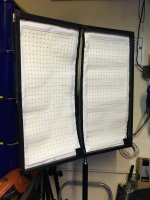
Wattage of FL-3030A @ 100% (5500K) using stock PSU = 30W draw
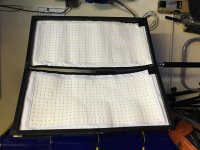
Wattage of FL-3060A @ 100% (5500K) using stock PSU = 50W draw
I tried using another 24V 6A power supply I bought from Amazon - I got a couple hundred lux brighter on the FL-3060A (really nothing in the grand scheme of things).
https://www.amazon.com/gp/product/B01AJQ9G2C/ref=oh_aui_detailpage_o02_s01?ie=UTF8&psc=1 for reference.
Conclusion: The 30A is a 30W LED panel, and the 60A is a 50W LED panel.
NOT as advertised... 3030 is advertised as 50W and 3060 as 85W.
LUX measurements ($30 lux meter, not super accurate nor scientific)
FL-3030A @ 100% (5500K) @ 1M BARE = 1,500lux
FL-3030A @ 100% (5500K) @ 1M Diffuser = 1,500lux
FL-3030A @ 100% (3200K) @ 1M Diffuser = 1,150lux
FL-3060A @ 100% (5500K) @ 1M BARE = 2,000lux
FL-3060A @ 100% (3200K) @ 1M BARE = 1,700lux
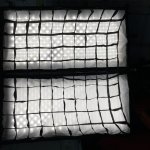
FL-3060A @ 100% (5500K) @ 1M Diffuser = 1,700lux
FL-3060A @ 100% (5500K) @ 1M Diffuser = 1,400lux
For comparison, using my Aputure COB 300D through a 32'' Godox Octa I'm getting 3,000lux using the included double diffusion, and 4,500lux using double frost.
The 200W Godox SL-200W does 2,500lux and 3,800lux respectively.
I imagine putting 2x 3060As together you can get around 3,000 lux @ 1M (5500K) which isn't bad for a lighweight "soft/diffused" LED panel at $150 per panel = $300.
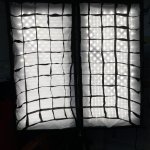
I tried putting my Aputure 672S behind the diffusion of the 3030A frame, and surprisingly got less than 1,000lux @ 1M despite it putting out closer to 6K lux bare.
Main plan for this is for a lighweight kit when using transit to get downtown. 2x 3060A for key and 2x 3030A hair and fill.
Cheaper than the Falconeyes stuff and I like the fact that it sets up so quick and includes the diffusion.
Not the best by any means, but really light and inexpensive. Not sure about the actual light quality but seems less green than other LEDs, and who knows about the durability.
Another con is that it just lacks any punch if you need it to fight the sun.