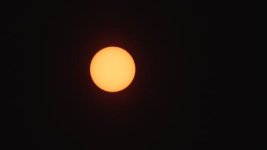
Filming the solar ecplise

Essami

Well-known member
Hi!

Theres a solar eclipse on March 20th and I was thinking of giving it a go and filming it with my Sony FS700 and Odyssey 7Q in 4K.

How much ND do I need? I doubt the internal ND's are enough. I was thinking of getting the Lee Big Stopper which is 10 stops and using that along with the internal ND's.

With the 10 stop reduction is there still a worry about burning the sensor?
 
I dunno man, maybe it's a common thing and I just haven't researched it enough but there aren't enough nd's in the world for me to feel comfortable about pointing my camera directly at the sun for an extended amount of time
 
Bear in mind that even without ND's, only a tiny fraction of the sunlight that's hitting the front of the lens will actually make it through the iris and to the sensor. You're also pretty far north so you'll get a good amount of atmospheric filtration at this time of year due to the lower altitude angle. I can't imagine that 10 stops of ND wouldn't be enough.
 
You can google Kendrick Solar Filters and see that they are ND5.0 for visual use and ND3.5 if only used for photography (I.e. Never look through). I have used them on 300mm+1.4TC combo and an 8" telescope and they work very well for full sun or partial eclipse phases.
 
You can google Kendrick Solar Filters and see that they are ND5.0 for visual use and ND3.5 if only used for photography (I.e. Never look through). I have used them on 300mm+1.4TC combo and an 8" telescope and they work very well for full sun or partial eclipse phases. NOTE: These strengths are what work when used in front of the lens. Internal ND filters will receive a more concentrated I.e. Hotter beam and an equivalent ND value probably won't be enough.
 
A solar filter that is manufactured for that purpose is probably your best bet - they typically have metal film deposited on the surface and reflect all wavelengths of light, whereas an ND filter may pass IR. There are also some specialized filters that pass only certain wavelengths, but pretty spendy.
 
Besides a filter, you need a pretty big lens to get a decent shot.

SE-35mmScale1x.JPG
 
I guess you're filming from Finland, so you're seeing the partial eclipse...? About 80% or more, I think. I'm going to be in the UK, doing the same thing.

If you point your camera at the Sun without significant filtration, it will overheat, and -- I would think -- eventually be damaged. So it's important to use filtration, and it's important to use filters which can block UV and IR completely, while letting some visible light through. The Sun produces so much IR that with the wrong filter, you could have good exposure and still have enough IR coming though to kill your sensor -- that's certainly a problem if you use sunglasses to view the eclipse by eye, except in that case your retina gets destroyed.

I've done tests using the solar filter film you can buy on Amazon --


That's a strong filter which you can use for viewing the Sun with your eyes. I taped it over the camera's rectangular lens hood. On a camera, it basically gives you a "well-exposed" image of the Sun; so, for example, you could film Sunspots if any were visible. Here a screen grab; this was shot with my X70 with the digital extender:

Screenshot (1).jpg

The problem with this filter is that everything else is black! So if you want to shoot the eclipsed Sun hovering over a dramatic landscape, or ancient ruins, that won't work. I'm not sure if that can be fixed, the Sun is so crazy bright relative to everything else.

Here are some observing tips, with link to solar photography info (shameless plug, this is my web site):


And sunspot info here; it looks like a big active region, 2297, is coming into view right now:

 
Hi,

Thanks for the answers! I've been doing research and I think the Tamron 150-600mm lens will do the trick as Im using a Sony FS700 which has a S35 sensor, hence the 600mm will be around 900mm on it.

What has proven really hard is finding the solar safety film, it's all sold out in Finland everywhere! :D Guess I'm a bit late to the party. Even with speedy shipping options from overseas it's a bit of a gamble.
What I want to do I think is shoot some wide shots (24mm) from a tower overlooking the city at the beginning of the eclipse and then some close-ups with the 600mm and the solar filter.

Do you think the 24mm wide shots would need any additional filtration? I've shot these types of wide shots many times with the sun in the frame and haven't had any problems before... But shooting for more then a minute or so? Im unsure...
 
Do you think the 24mm wide shots would need any additional filtration?

No idea here, sorry. I would say yes, for safety; I've had overheat warnings go off with fairly wide shots with the Sun in view. However, I'm thinking that without heavy filtering, you won't be able to see the eclipse, because the Sun will just totally blow out.

Having said that I just landed in the UK and the forecast for the 20th is rain... so it may be moot... :-(
 
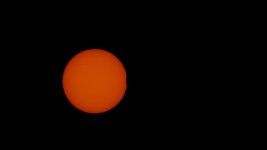
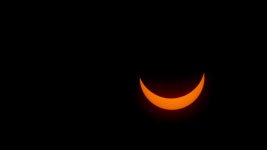
Here's two shots! Luckily there was only a few clouds. Shot with Sony FS700, Odyssey 7Q in 4K with the Tamron 150-600.

I happily shot a few scenic shots directly into the sun with my 24mm and 14mm lenses, no problems at all.

Solar Eclipse March 2015.00_10_59_05.Still004.jpg

Solar Eclipse March 2015.01_00_04_05.Still003.jpg
 
Last edited:
Back
Top