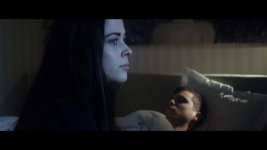
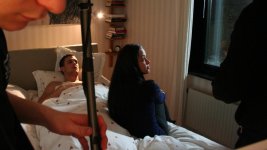
Faking Moonlight within a room (not outside a window)

I have read a lot about faking moonlight and lighting a room at night and from what I''ve read placing the light outside the window seems to be a popular option. However, I am shooting on the 7th floor of an apartment and cannot put a light outside the window. How would I go about lighting the room with only "moonlight"? The character does turn on a table lamp later on which will help light the scene but it starts off with him in "darkness".

here is a photo of the room. the window is on the right.
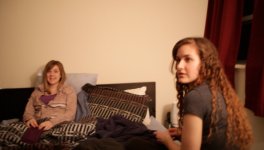
 

Attachments

  • Interior.jpg
    Interior.jpg
    277.1 KB · Views: 0
This is a lighting technique I teach at the performing arts school I work at. It's pretty easy. There's several ways, we sometimes actually make a fake window setup, but if you have a window, you can use it as your motivation for your lighting. The first thing you will need to do, move your set around( at least I would, but if you can't). I would caddy corner the bed, and shoot into a corner, this will open up the space a little and make it easier to light. If thats not possible. And your framing is what the picture suggests, you will need a good boom setup, I would use a cookiecutter as well. And a full ctb gel. A little atmosphere may help, but may not be the look your going for. Play around with it. Also the moon can make some pretty hard shadows, keep that in mind. That back wall is awful stark, I would hang a picture, without glass. that way you will not have reflections to deal with. Plants are great for moonlit scenes as they create some cool shadows. I feel like i'm forgetting something, I will keep thinking about it till it pops in my head.
 
You are going to have to rig a light on a boom outside the window.

The qualities of moonlight are very similar to sunlight: They both are about the same size in the sky, which is half a degree of arc. Moonlight is just as contrasty as sunlight.

From a story telling perspective we've been conditioned to think of moonlight as being "blue" light, so most people will use cool blue light ( half CTB or more ) to "illustrate" the idea of moonlight. ( the reality is that moonlight is simply reflected sunlight, and has a daylight color temperature )

My choice to simulate moonlight would be a fresnel light with a half CTB filter ( or stronger ) that is far enough away for the light to appear collimated. ( low fall-off and strong shadows )
 
Last edited:
Some quick for-what-it's-worth thoughts:

-- Do you have to show the entire room? Do you have to show the window? Can you just shoot in close-ups? If so, easy to fake moonlight, right? To sell the souce of the light, add some sort of shape falling on the walls or on actors' faces (branches, window shape, slits of lights through blinds, etc).
-- Can you shoot day-for-night? Do a test. Underexpose when shooting (but probably add some light to faces). Maybe stick ND gels to the window or otherwise dim the sunlight. Get some CTB gels happening. Fiddle with it in post. Is the image believable? Andrew Kramer has a day-for-night tutorial that essentially involves adjusting contrast, adding in highlights, and doing sky replacement.
-- One thing I've done more than once... though it's pretty dodgy... get a light on a light stand and stick the whole thing outside the window, pointing in. I'm assuming you can open the window? Preferably get someone holding the stand, or else dodge it up with gaffer tape. Just make sure you're doing it all securely, and preferably have someone else clearing the area on street level outside, so you don't kill anyone when light or light stand falls.
 
For one film we did, we faked moonlight (coming through a window though, but still). I'll explain how I did.

Here's a screenshot, plus a Behind The Scenes still, so see what it looked like.
Amanda 1.jpgAmanda 3.jpg

I also put both shots on my showreel, the first one opens it and you see the one in still at 1:10.

The scene was lit with only three lights:
First was a Coollights 4 tube Flourescent (like a KinoFlo Diva 400) right outside the room, pointing at the door (the director wanted a sort of "heavenly, dont't go into the light" feel outside and wanted the door to be really white), but it gave us a nice, soft bounce that provided us with both some fill into the room, plus a nice backlight for the actess (you can see it gives a nice soft light on her face when she walks in).
Next was a practical bed light, which you see on the wall in the behind the scene shot, which was pointed on the actors face and was his key light. The white tacke also bounced it, softening and adding some extra fill.
Last was the moonlight. It was a softbox CFL light with 4 daylight 45W bulbs, plus some extra diffusion was provided with the curtains hanging there. It was pointed so that it would shine down on the bed and provide the actress with a key.

But there was another key for it to feel like moonlight: It was shot with a tungsten balance, but the light was uncorrected (being 5600K, as such daylight) and then had a blue tint, without looking too blue. This is how you give the effect of moonlight in most other films, as it will have the feel of a colder light, compared to the warmer lights inside (the practical we used was around 2000-2500K, which added warmth that we liked, also a good idea).

So even if you don't have a window in the room (then make sure you design the shots so that the place where the window would have been isn't shown, but impliead), add a daylight colored light there and the rest use tungsten lights. Make sure it's fairly soft too, as it feels more natural. Lastly, feel free to add some texture to it, perhaps putting some blinds in front to help sell it.

The shot up there is fairly similar to the one I did, so I would also light most of it with the moonlight, provide a key using the practical (which you might want to use some CTO on, to get it warmer, to make it more distinct) and then keep the rest of the room fairly low key (perhaps adding some very soft fill from the back).

One idea I got! You live on the 7th floor... But you use a light that isn't too heavy (like a CFL) you could perhaps fast it using a Magic Arm, then getting it outside the window?
 
Last edited:
Thanks for all your replies everyone. However, it should be known that there is no way we can place a light outside as there is no balcony or anything, just a straight drop to death haha.
 
Thanks for all your replies everyone. However, it should be known that there is no way we can place a light outside as there is no balcony or anything, just a straight drop to death haha.

So there's no way you could stick a boom out another window with a light on the end of it ?
 
Have you tried to cut a few lights to paint the look of moonlight gelled with a 1/4 CTB and a pale green. No fill lights. Just make sure the practical is a few stops brighter than your "moonlight" to sell the effect, possibly enhance it with a China ball that turns on with the practical, have the actor "turn it on" and plug both in/ turn the power strip on. Rim light the frame of the window carefully as to not let it known the light is in the room. That should take care of it.
 
So there's no way you could stick a boom out another window with a light on the end of it ?

That or using something like a magic arm and clamp on a window. This way no stand is needed.

Have you tried to cut a few lights to paint the look of moonlight gelled with a 1/4 CTB and a pale green. No fill lights. Just make sure the practical is a few stops brighter than your "moonlight" to sell the effect, possibly enhance it with a China ball that turns on with the practical, have the actor "turn it on" and plug both in/ turn the power strip on. Rim light the frame of the window carefully as to not let it known the light is in the room. That should take care of it.

Good idea, I would use more CTB (but I like strong colors). But removing fill lights is something to remember. I recently read an interview with Vilmos Zsigmond who said that for the movie Assassins, he lit the night scenes just like the day, only they took away the majority of the fill light and then didn't correct for the color temperature.
 
The Roscolux #376 Bermuda Blue is a great gel that will give a nice moonlight color. Pure blue looks too video-y or theatrical to me, though a nice cyan doesn't look too bad.
 
Back
Top