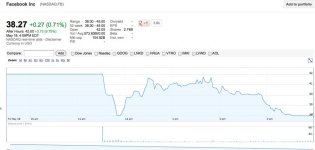
Facebook IPO Eclipses Google, GM

groveChuck

U-matic Member
Wish I'd gotten an early hookup on this!

Facebook Inc. gained as much as 18% in its trading debut, following a record initial public offering that made the social network more costly than almost every company in the Standard & Poor's 500 Index.
The shares advanced 11% to $42.18 at 11:30 a.m. in New York, after earlier surging as high as $45, giving it a market value of $123.4 billion.

Facebook sold 421.2 million shares at $38 each to raise $16 billion yesterday.

The IPO price valued the company at 107 times trailing 12-month earnings, more than every S&P 500 member except Amazon.com Inc. and Equity Residential.


facebook-nasdaq-zuckerberg1.jpg

Facebook's Mark Zuckerberg rings the Nasdaq bell.


That valuation also made Facebook the largest company to go public in the U.S. Now co-founder Mark Zuckerberg has to reward investors by squeezing more profit out of advertising, said Erik Gordon, a professor at the University of Michigan's Ross School of Business.

"It shows tremendous confidence in the guy wearing the hoodie," said Mr. Gordon, referring to Zuckerberg and the signature sweatshirt he wore during meetings to market the stock. "He hasn't specified how he's going to do it, but he'll have to do it to justify this price."

In less than a decade, Mr. Zuckerberg, 28, has overseen Menlo Park, Calif.-based Facebook's evolution from a Harvard University dorm-room project into a social network with more than 900 million users. Still, revenue growth is poised to slow for a third straight year and advertising sales haven't kept pace with user additions.

Facebook priced at the top end of its range of $34 to $38 a share, valuing it at about 26 times sales in the 12 months through March 31. As of yesterday, that was more than twice as much as AvalonBay Communities Inc., currently the most costly company by that measure in the S&P 500.

"It seems like a very full valuation, but I'm sure there was an almost insatiable amount of retail interest in Facebook and that's how the bankers looked at it," said Dan Veru, chief investment officer at Palisade Capital Management in Fort Lee, N.J. "Everyone wants a piece of Facebook."

At $16 billion, Facebook's sale surpassed that of General Motors Co., making it the second-largest in U.S. history, excluding so-called over-allotments, which let underwriters buy more shares at a later date, data compiled by Bloomberg show.

GM raised $15.8 billion in November 2010, before expanding the sale to $18.1 billion when underwriters exercised the over-allotment option. Visa Inc. raised $17.9 billion in its 2008 IPO, the biggest in the U.S., and later expanded the sale to $19.7 billion. Facebook's underwriters may buy an additional 63.2 million shares at the IPO price, which would enlarge the IPO to as much as $18.4 billion.
Facebook's offering price gave it a market capitalization almost double the $60 billion United Parcel Service Inc., previously the biggest company to complete an IPO, was valued at when it went public in 1999, according to data compiled by Bloomberg and Dealogic.

Facebook stock is listed on the Nasdaq Stock Market under the symbol FB.

The IPO price gave Facebook a market value about half the size of Google Inc., which was worth more than $200 billion as of yesterday. The search-engine operator's value has jumped almost ninefold in the eight years since it went public. To hand its public owners the same returns after pricing at the top of its offering range, Facebook would have to be worth about $920 billion by 2020. Apple Inc., the most valuable company in the world, had a market value of about $496 billion as of yesterday.

Facebook's offering eclipsed the 2004 IPO of Google, one of its chief competitors for online advertising. Google raised $1.9 billion in its initial share sale, including an over-allotment option. The shares sold at $85 apiece, giving Google a market value of about $23 billion, or about 10 times sales in the 12 months through June 30, 2004.

More: http://adage.com/article/digital/fa...mail&utm_medium=newsletter&utm_campaign=adage
 
A lot of people are going to lose a lot of money on Facebook stock. Be glad you didn't get an early hookup. If you believe in the long-term prospects of Facebook and you want to own it, wait a few months and buy it at a steep discount from today's price.

Alessio Rastani makes a great case for why Facebook stock is "muppet bait". If you don't know the term, Goldman Sachs refers to end-customer traders (retail investors) as "muppets", brainless entities who are there to be sucked dry of their money. And Goldman Sachs is one of the primary underwriters of the Facebook IPO. Rastani points out that Goldman Sachs is dumping half their stake in Facebook in the IPO, a pretty obvious sign that they know it's headed down, especially when initially they planned on selling off only 23% but as the frenzy grew, they decided to sell off over twice as much as they'd originally planned.

And will Facebook even exist five years from now? There was an interesting article I can't find right now, about how the web itself, as now constituted, may not be nearly as popular five years from now as it is currently, that the future is on mobile devices and apps entirely, and that's where Facebook is currently pretty weak. Is it possible for Facebook to get MySpaced? Facebook is a very different business than Google. Google makes money. Facebook -- not so much. At its current price it's priced somewhere around 125x earnings, which is an insane valuation. Apple is only priced at 13x earnings! Is Facebook worth 10x as much as Apple, based on earnings?

Hey, everyone is entitled to their own opinion in these matters, and the market will speak as to how it really all turns out. I have no idea where Facebook stock will be five years from now, but I think I have a pretty good idea where it will be six months from now, and I'd be buying put options if I could. Unfortunately they don't have put options established on Facebook yet.
 
Facebook is becoming bloated with advertisements and stupid new ideas that are too convoluted for the average user (the Timeline). I liked Facebook when it was very simple. I'm willing to bet it will start to lose steam and eventually die out like Myspace.
 
Great Rastani article, Barry, thanks (the Roth article, too)! If you find the
I did not, however, realize I was but a Muppet (Cookie Monster?).

It's mind boggling that GS would dump 50% of their FB shares (but perhaps repurchase them after the post-IPO drop?).

I presumed FB would be overpriced, but that it would sort itself out and begin rising. Even though FB is, no, not a Google.
Not being a FB user, I'm not even sure what their business model was proclaimed to be... ads?
But remember when people said Google's IPO was way overpriced?

I'd followed the Groupon price drop, assuming the IPO was just way too high...

But definitely post the future-of-the-web-in-5-years article if you find it!
 
that the future is on mobile devices and apps entirely, and that's where Facebook is currently pretty weak.

Not sure what that means. True, their actual app isn't worth spit, but the mobile version of their webpage seems to work identically to how the app is SUPPOSED to, and I can't help but notice how many are becoming pretty exclusive in terms of mobile use of it.

I hate the place more and more, but I'm not sure "pretty weak" is accurate for its mobile presence.
Read the coverage of facebook prior to the IPO, it was the #1 biggest complaint big institutional investors had about facebook.

Things are changing rapidly. The web, as we know it, may have its days numbered. People don't even ask me "do you have a website" anymore, they ask "are you on facebook?" Facebook has become, for many, their portal to the world.

Problem is -- everyone who's gonna get on it, is already on it. Where's the growth going to come from? And as far as ads go, yes, ads are their business model, it's the only real place they have that they can collect revenue. And they have ENORMOUS data on you, the user, so -- ideally they could target you pretty precisely. Google was overpriced when it first came out, but the brilliance of AdWords or AdSense or whatever they call it, has made Google a behemoth. Facebook hasn't figured out the ad thing yet. In order to support their valuation, they would need to collect, IIRC, one out of every ten advertising dollars spent. On the PLANET. That just seems -- unlikely. Especially, the day before the company went public, General Motors (one of the biggest advertisers in the world) just announced that they're not going to bother advertising on Facebook anymore, because they're finding the ads just don't work.

NPR article talking about the valuation here. And, note, that was when the company was estimated to be coming public at $100 billion, but the actual first trades put it at something like $110 billion.

Also note, while it was up to $42/share earlier today, it's already (at the time of this writing) back to $38.

Not ragging on Facebook in general -- just trying to point out that we "muppets" are being asked to be taken to the cleaners, and I think we should just say "no". If you love Facebook and you want to hold a chunk of it, go ahead and buy it. If you want to save some money, buy it at a discount (i.e., wait three or four months when it's trading down around $25 or less).

The people who are/were going to make a fortune on Facebook, already have. They already sold all their shares. And they're making that fortune off of us retail investors (well, not off ME, but off of tons of us).

I think it's a sucker play. Don't be a sucker. :thumbsup:
 
Regarding mobile, here's a Forbes article that describes it better.

Also note, in comparison to Google -- Google collects six TIMES as much revenue per user as Facebook does. That's why Google is a behemoth, and Facebook is (at the current prices) a risky, risky bet.
 
Again -- ANYTHING could be a great buy, at the right price. And anything could be a terrible buy, at the wrong price. Facebook has a lot to offer, and they have 845 million users worldwide. 845 million. That's one in eight people on the PLANET. And their percentage of wealthier people is probably substantially higher, considering that some of the world's highest-population countries are also some of the very poorest and therefore the least likely to have daily or monthly computer access and facebook accounts.

So their reach is incredible. Unparalleled. But that's also part of the problem -- where does the growth come from? If everyone who's already able to afford it, is already on it, then -- how can it grow? Better hope they find life on another planet and we can introduce those folks to Facebook, because there's not much growth going to come from Earth... :)

Anyway, it's an incredible success story, with incredible reach, and at the right price it's a no-brainer. But at the price that they dumped the stock on the end user, I think it's crazy. It's like gold -- gold at $400/ounce, I'd buy every ounce I could get. But gold at $3,000/ounce -- em, no thanks. Of course, that's also relative to time -- that's based on price TODAY. Five years from now gold could be a steal at $3,000/oz.

So look at Facebook TODAY, and what you're getting for your dollar today. Is it a good deal? Does it make sense? If you think so, buy in. If you think it's overpriced, wait it out. Just don't get caught up in any "mania" or "hype", because -- well, we went through this in 1999, when people were taking dot-com's public and they literally were saying "it's not about revenues, you don't need revenues, this is a war for eyeballs" and such. Everyone found out after the stunning dot-com crash that yeah, guess what, revenues really DO matter... :D
 
Regarding mobile, here's a Forbes article that describes it better.

Also note, in comparison to Google -- Google collects six TIMES as much revenue per user as Facebook does. That's why Google is a behemoth, and Facebook is (at the current prices) a risky, risky bet.

Ah. The problem is not so much that Facebook is weak in mobile, but that the revenue-making aspects of it (as they currently exist) are diminished on mobile devices.
 
The shares advanced 11% to $42.18 at 11:30 a.m. in New York, after earlier surging as high as $45, giving it a market value of $123.4 billion.

Quoting this for fun -- yes they surged as high as $45. And then they plummeted to $38 right now.

So some poor muppets paid $45/share and have already lost 20% of their investment in one day. And that $123.4 billion market capitalization has already fallen to $104 billion. So could you argue that the "muppets" just got fleeced for $20 billion?

That's the kind of thing I'd like to see our folks avoid. Not saying Facebook's a bad company, but this deck is severely stacked against the retail investor turning a short-term profit, unless you were one of those lightning-quick guys who bought it right at $38 and dumped it on the poor unsuspecting retail investor at $45.
 
Ah. The problem is not so much that Facebook is weak in mobile, but that the revenue-making aspects of it (as they currently exist) are diminished on mobile devices.
Basically, yes, where growth is strongest and expected to accelerate, that's where they're weakest. They have a poor implementation of mobile that keeps them from really making any money off their mobile users, yet it's expected that more and more people will be using mobile primarily, and many will go exclusive. He (or she) who is strongest in mobile products, will win. Hence why Apple, under the genius of Steve Jobs, declared "we are now a mobile products company." They saw it coming, and in fact were instrumental in making it happen.
 
Well, that didn't take long.

Looks like the market makers are no longer artificially propping the stock up, so it's free to sink like a stone, which is what it's doing. It's at ~$33 now. That's down $12 per share from its peak, and down $5 per share from what the early adopters got in at, and shaving another $10+ billion off its market cap...
 
And the plunge continues, it closed today at $31. Market capitalization of $66 billion. That's about $60 billion in market value erased from its peak.

This is happening fast, I was expecting it to hit $25 within six months, at this rate it'll hit $25 in six trading days.

Here's the thing though -- the company hasn't changed. Its revenues and its potential haven't changed. If someone really believed that Facebook was gonna be huge, then every day it falls, is another day it becomes cheaper to buy in. So be glad you didn't get in at the beginning, you're not one of the suckers who paid $38/share, you can buy the exact same shares over the counter for $30.50 as of right now (in aftermarket trading). Not saying that's a good valuation, just that it's a heck of a lot more attractive than $45/share was!

Will it hit $25? Will it go lower? Who knows? There's a saying on Wall Street, you don't try to catch a falling knife, so ... I still wouldn't be in any rush to buy in. But at some point the shares will turn up. Even if it's just a "dead cat" bounce... and what it's priced at today, is not necessarily reflective of what it might be priced at five years from now. If it plummets to $15/share, and you buy in, and five years from now it's at $38, well ... those guys who got in at the beginning would have made zero, but you'd have made a 150% gain...

There's probably money to be made on Facebook, it's all about buying at the right price. And clearly, the IPO price was totally NOT the right price...
 
I read somewhere that more than 40% of IPOs this year are currently trading under their IPO price.
 
Facebook Debut Raises Questions on I.P.O. Process
http://dealbook.nytimes.com/2012/05...erns/?nl=todaysheadlines&emc=edit_th_20120523

Just days before Facebook went public, some big investors grew nervous about the company’s prospects.After publicly warning about challenges in mobile advertising, Facebook executives held conference calls to update their banks’ analysts on the business. Analysts at Morgan Stanley and other firms soon started advising clients to dial back their expectations. One prospective buyer was told that second-quarter revenue could be 5 percent lower than the bank’s earlier estimates.
As investors tried to digest the developments, Morgan Stanley was busy setting the price and the size of the stock offering. While some big institutions scaled back on their plans, others placed large orders. And retail investors clamored for shares.

In the end, Facebook and the Morgan Stanley bankers decided they had enough demand and interest for Facebook to justify an offering price of $38 a share.
They didn’t.

When Facebook went public on Friday, its shares barely budged — and they have been falling ever since. On Tuesday, the stock closed at $31, more than 18 percent below its offering price.
The I.P.O. of Facebook was supposed to be Morgan Stanley’s crowning achievement, but it is turning out to be a big embarrassment, raising broader questions from regulators about the I.P.O. process.
Over the last year, Morgan helped usher in a new generation of technology companies, leading the offerings of LinkedIn, Groupon, Pandora and more than a dozen other start-ups. Facebook was poised to be the biggest and most ambitious. When the dust settles, Morgan Stanley could make more than $100 million in fees on the I.P.O.

But rival bankers and big investors have complained that Morgan Stanley botched the debut. They contend that the bank set the price too high and sold too many shares to the public. Facebook’s management team is also shouldering some blame. David Ebersman, the company’s chief financial officer, spent more than a year orchestrating the stock offering, drafting the prospectus and meeting with investors long before the company picked its bankers.
Facebook’s fate as a public company is hardly sealed. Many newly public companies stumble out of the gate and later become top performers with appealing stocks, a group that includes Amazon.com.

But regulators are concerned that banks may have shared information only with certain clients, rather than broadly with investors. On Tuesday, William Galvin, the secretary of state in Massachusetts, subpoenaed Morgan Stanley over discussions with investors about Facebook’s offering. The Financial Industry Regulatory Authority, Wall Street’s self-regulator, is also looking into the matter. The chairwoman of the Securities and Exchange Commission, Mary L. Schapiro, said Tuesday that the agency would examine issues related to Facebook’s I.P.O., but she did not elaborate.
 
Back
Top