External SSD Thunderbolt Vs raid

offbeatbryce

Well-known member
Hello,

I am wondering what everyone's opinion is on whether I need a raid or if I can use a SSD thunderbolt external drive. All I care about is the speed and one of my friends said that a SSD thunderbolt external is just as fast as a raid.
 
It really depends on configuration settings, USB-3 vs. Thunderbolt 2/3, as well as other factors. What you really want to test are the various read and write speeds of the configurations you can afford.

Currently I recommend HHD Raid 5 for storage, and SSD Raid 0 for working media. SSD Raid unit, 4TB, can be had for $1,500. This is blaaaazing fast. Then you can do read from SSD Raid and write to HDD Raid. HDD are much safer storage medium since data can be recovered. Even with Raid, it is still better to store in HDD. SSDs are not safe for storage, but are much faster in terms of read/write speeds.

But, I don't know what your budget is, nor your data requirements so your mileage may vary.
 
I'm wicked cheap. I can't afford a raid at the moment and which Is why I was wondering if a SSD external thunderbolt would work for now.

If if I were to get a raid in the future could the WD raid systems work? Those are the cheapest I've found.
 
You don't really say what you are trying to achieve here, full frame playback of 4K? Fast transcode? The sad fact about Thunderbolt is that although the pipe is huge, the R/W performance of most storage is actually pretty pathetic, meaning that you only can use a tiny portion of that great interface for disk i/o. The bottle neck is usually in the controller on the device or the actual R/W performance of the drive connected. Atmos supplied card readers, for example, have blue USB3 connectors on them, but the SATA controller in them only runs about 200-230 MBS. Even if you buy fast SSD's you only get 200MBS in and out. USB3 is way cheaper than anything ThunderBolt though, and if you are using a single drive, the fastest single R/W you can get is off a pro level SSD like a Samsung EVO. A 1T is about $365 and Convergent Design USB adapter cable is about $55. That will get you 500 MBS R/W (more or less) which should give you pretty good playback of 4K ProRes on most machines suitable for editing. These are gross generalizations. Back up your SSD onto a conventional USB3 HHD External every night, and you'll have a fast basic, pretty safe system. As you add RAID's and additional backup, you can improve on that to some degree, but all the original gear will still be useful. Buy a second SSD and a RAID box and you can increase performance by going RAID 0, or mirror for a real time backup. All these devices can eventually go into a T-Bolt system and your USB3 cable will still be useful for off load of shooting media in the field.
 
Ok

Ok

You don't really say what you are trying to achieve here, full frame playback of 4K? Fast transcode? The sad fact about Thunderbolt is that although the pipe is huge, the R/W performance of most storage is actually pretty pathetic, meaning that you only can use a tiny portion of that great interface for disk i/o. The bottle neck is usually in the controller on the device or the actual R/W performance of the drive connected. Atmos supplied card readers, for example, have blue USB3 connectors on them, but the SATA controller in them only runs about 200-230 MBS. Even if you buy fast SSD's you only get 200MBS in and out. USB3 is way cheaper than anything ThunderBolt though, and if you are using a single drive, the fastest single R/W you can get is off a pro level SSD like a Samsung EVO. A 1T is about $365 and Convergent Design USB adapter cable is about $55. That will get you 500 MBS R/W (more or less) which should give you pretty good playback of 4K ProRes on most machines suitable for editing. These are gross generalizations. Back up your SSD onto a conventional USB3 HHD External every night, and you'll have a fast basic, pretty safe system. As you add RAID's and additional backup, you can improve on that to some degree, but all the original gear will still be useful. Buy a second SSD and a RAID box and you can increase performance by going RAID 0, or mirror for a real time backup. All these devices can eventually go into a T-Bolt system and your USB3 cable will still be useful for off load of shooting media in the field.

I'm editing AVCHD which I then do the render and replace to ProRes before Color Correction. I found SSHD the hybrid kind. Those are cheaper. Seagate sells them for 70-90 dollars. 1TB even for that much. Can I put a SSHD into a Drive Docking station? That's all I was asking.
 
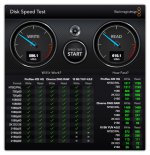
Here is a speed test from my 4xHD Thunderbolt RAID. It would be much faster if I were using SSD rather than hard drives.
 

Attachments

  • DiskSpeedTest2016.jpg
    DiskSpeedTest2016.jpg
    177.7 KB · Views: 0
Last edited:
I'm editing AVCHD which I then do the render and replace to ProRes before Color Correction. I found SSHD the hybrid kind. Those are cheaper. Seagate sells them for 70-90 dollars. 1TB even for that much. Can I put a SSHD into a Drive Docking station? That's all I was asking.
You can put any SATA drive into any SATA connector. You said you wanted cheap and fast. You really don't need too fast a drive for AVCHD, the files are low data rate, and small in size to move around. You can work them easily on a very cheap USB3 HDD drive. Assuming ProRes is your deliverable, why not color correct on the AVCHD, then render to final ProRes? Less computational overhead with same result. What type/ model computer?
 
Last edited:
Back
Top