Eliminating Shadows

N3D

Active member
Hello legends of dvxuser.


I'm basically using 3 dedos and various practical lamps for a low budget web series. How do i avoid harsh shadows?

Also any ideas on how to avoid making hard light look amateurish? That might be a silly question and hard to explain, but i want it to feel like cinematic lighting. Not just a bunch of lights pointed at people, ya know?

I'm going for low key lighting, for a horror based web series.


cheers


Ned
 
For dark look you might want to make it seem like the lamps themselves are lighting the scene. But once you expose your talent properly for that light chances are the rest of the room will appear too dark. So my suggestion is use some extra light to raise the ambient light level in the room. You can do that quite easily by pointing your light source at the ceiling but you need to pay careful attention between the balance of ambient and the practical light acting as a key light on your subjects.

Where on the ceiling do you point your light? Well an option is to aim one of your dedos at the ceiling where the practical lamp is located, appearing as if that table lamp itself is lighting the whole room leaving the other parts of the room looking dark. This might only work for the wide shot, then on closer shots you can kill the ambient light or put it on a dimmer so you can get the balance you like between your subject and what you see in your background.

What if the ceiling is painted? Staple or tape white foam core, bristol board, or bleached muslin to the ceiling and then aim your light at that. If not you will fill the room with the color that the ceiling is painted. No good.

Another method is to light your subjects from behind. What? Yes, setup your most powerful light as a RIM light on your subject then use a reflector to act as fill on your subject. Or you can use a light to work as your fill by putting it in a softbox and if you don't one that then aim it at a piece of foam core and there becomes your soft fill light.

Some tricks for simulating moonlight which could be helpful is to gel your lights with blue gels but leave your camera white balance set to somewhere around 3200k. The tungsten lights will appear nice and warm but the gelled light will appear blue. You can blast a hard light gelled blue out of frame through a doorway and suddenly it is a "night scene" lit by moonlight. Again use different methods to raise the ambient in the room by coming up with ways to add room fill.

If you were shooting at night and you had the lighting power, you could put lights outside the windows and again gel them blue (or use HMI's since they are 5600-6000k) and blast them through the windows along with the indoor practical lamps and some fill to light your overall scene.

There are probably a hundred ways to go about this but when I light any scene I keep three things in mind: light my talent, light my room, what lights are in the shot that I want to see and are they overpowering my lighting and if so do they need to be adjusted? Sometimes lights are in the shot but not really lighting anything. In some cases these lights can actually be way too bright relative to the rest of your lighting so you need to either dim them, put ND gels around the bulb, or replace the bulb with lower wattages.

Shadows themselves are not amateur, but if they go upwards on a wall behind your talent then YES that is amateur. Keep a good amount of space between your actors and walls and that will keep shadows going downwards. As will making sure lights are generally higher than your subject but that should be obvious.

Also don't be afraid to mix color temperatures as I've outlined, and also don't be afraid to mix hard and soft light.

Anyway I hope this helps,
 
Last edited:
  • Like
Reactions: N3D
That is some solid advice thank you.
I was also thinking maybe use some soft lights to fill shadows.

Maybe a soft box like you mentioned or a china ball.
 
No problem.

Yes I often use softlight to fill shadows because its fast and somewhat cheap. If you get your hands on some fluorecent tubes, it works great in this regard but you just have to do more to control the direction and spilling of it. Remember that softlight like a softbox or flo are less soft and become more like hard lights the further away they are from the subject they are lighting. If you are trying to raise some light on a background, I just find softlight easier because it spreads like magic.

If you're interested in a more in depth look at simulating night/moonlight I wrote a pretty in-depth post earlier this year after finishing 2 day shoot all "day for night". We black-wrapped an entire barn and built tents outside the windows which housed the main lights, blocked daylight, and kept the rain off our lights for 2 days. :) http://www.dvxuser.com/V6/showthrea...ou-use&p=1986331559&viewfull=1#post1986331559
 
  • Like
Reactions: N3D
hard light is hard to do.

Diffusion or bounce

I would think hard shadows are normally added to a difuse base light wash, in all but the most extreme cirumstances
 
Here's a frame from my "barn shoot" with three things going on lighting-wise.

1.) The key is "hard light" on left side of the Germain soldier. It was a 575w HMI PAR with medium spot angle lens and no diffusion.
2.) His right side is filled using a 6x9 reflector bouncing the key. I kept it kind of darker but there is still fill there. Some contrast was added in post
3.) The stone wall behind the solider and the wall along his left side (currently blocked since the American soldier is walking into frame) is lit with a 4 bank kino with only 1-2 tubes turned on.

9195081907_104811302d_z.jpg
 
  • Like
Reactions: N3D
The goal was to maintain somewhat of a "classic horror" look so I used nets on occassion but otherwise stuck with direct hard light. Depending on your theme, etc.. it can work.
 
I just i want to clear something that might have not come across properly earlier.

I want to eliminate harsh shadows that cast on WALLS, FLOORS, TABLES etc

Also avoid casting shadows of other actors onto each other.

The issue is the apartment is very very small. Tight spaces.

My collegue is suggesting add some sort of background light to wash out the shadows that cast on walls and such.

Think about motivating your lighting angles and diffusion to look like they come from existing practical lights in the room. Then the shadows don't look out of place. Where there is light there is shadow, so learn how to use both to good effect. Experiment with different lighting angles.
 
  • Like
Reactions: N3D
Think about motivating your lighting angles and diffusion to look like they come from existing practical lights in the room. Then the shadows don't look out of place. Where there is light there is shadow, so learn how to use both to good effect. Experiment with different lighting angles.

Bingo!
 
Yes BINGO will definitely help get rid of shadows. I play BINGO all the time and it does help.

But for real, it is not the point to entirely eliminate shadows. Perhaps because of your geographic region where is is cloudy, grey and rains all the time you are use to shadow-less everything and thus you want to create this look in your film - but kidding aside indoors it will be tough to have dramatic low key lighting without creating shadows result. As other suggested just make sure they make sense in the shot and everything will be dandy.
 
  • Like
Reactions: N3D
C'mon guys there must be a way to limit shadows.

I just did a test with flash lights and i get horrible shadows.

Starcentral, the image you posted has no shadows.

I've seen many shorts and films that shoot in small apartments that don't have harsh shadows casting everywhere.

I always have this issue about shadows :(

Even when i focus the lamp on a dedo, i get harsh, strong, ugly shadows.
 
The advice has been good so far. If you're seeing shadows on the walls, move the actor away from the wall and see if you can change the angle, higher or to the side, to throw the shadow out of the frame.

Hard light is hard light and the shadows it throws are hard. One thing I've tried is soft keys with little or no fill. It gives you the contrast with out the harshness.

Soft light rolls off much faster and you can sometimes get away with the softer shadows. Bounce it as suggested or diffuse it through a silk but getting that actor away from the wall, is your best bet.

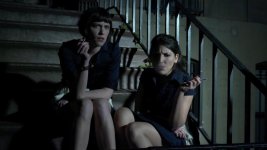
Or use the shadows. What's wrong with shadows? With hard light, you'll get them. Here I like the shadows of the railings, the shadows of the actresses roll off into the darkness. The angle of that light makes a difference as to whether or not the shadows are pleasing.

NightStairs.jpg
 
Last edited:
  • Like
Reactions: N3D
Just about every lighting instrument will cast some sort of shadow. The tricky part when working in a small space is keeping those shadows out of your shot. With cast shadows, it's really all about the placement of your characters and the lights. Rule of thumb - keep your actors the hell away from walls! Doing this alone will solve most shadow issues. But if you really can't do that for a specific shot, and a shadow is intolerable, you have to find a placement for your fixture that eliminates it.

Now, for the attached shadows (quality of light on your actors' faces) Do you already own these dedos or are they being rented? What wattage are they? If you want to lessen the harshness of light from a fixture that has such a small source you'll need to bounce or diffuse them, which eats up a lot of light. They wouldn't be my first recommendation for lighting up a whole scene with.
 
  • Like
Reactions: N3D
C'mon guys there must be a way to limit shadows.

I just did a test with flash lights and i get horrible shadows.

Starcentral, the image you posted has no shadows.

I've seen many shorts and films that shoot in small apartments that don't have harsh shadows casting everywhere.

I always have this issue about shadows :(

Even when i focus the lamp on a dedo, i get harsh, strong, ugly shadows.

Yes the way to limit shadows is to work on larger sets, or cheat everything indoors by pulling your actors, couch, table, etc.. away from the walls - even if that means you are down a hall shooting through a doorway, or even outside of the house shooting back in through a window. Seriously, you gotta do what you gotta do.

In my frame you can see the shadow of the soldiers nose exactly sideways to the left a little. If you want to get picky, this isn't even a flattering position for a nose shadow. In general there doesn't seem to be any shadow because the lighting is coming from the side. Also the back wall is lit separately, not with the same light as the one lighting the actor.

Don't be afraid of shadows, especially if you're shooting mysterious, dark, or horror... :)
 
Last edited:
  • Like
Reactions: N3D
Trust me when i say this, i appreciate all your advice. You guys are awesome.

Im renting dedos (3 x 150w) because they are small and dont get too hot. The apartment is tiny! But is the only reasonable amount the producers can afford. Actually they are gone over budget, everyone here (London) thinks they should charge sh!t loads of money because someone is shooting a film. Like as if every filmmaker is loaded with £££ ($$$).

Anyway i will try to light my background by raising ambient lights with the use of practicals.

Again thank you all!

Ned.
 
Ned sorry to say but I don't think a couple 150's really aren't going to do anything you are probably going to need. I'd consider an assorted kit instead, like 1k, 650w and 300w, or replace the 300w with the 150w. Anyway its hard to say what you'll need but Im just saying 150's are kind of low.
 
Back
Top