Dumb Question About Image Circle

tommygdawg

Well-known member
As noted, this may seem like a dumb question, but I've started wondering something. Correct me if I'm wrong, but no matter which lens you attach to any given camera, the center of the image will always be the same, correct? IE...

APS-C 50mm on Super16
APS-C 50mm on MFT
APS-C 50mm on APS-C
APS-C 50mm on FF35

The one thing in common with all of these, is that the center of the image will be the same, correct? The only thing that changes is the amount of vignetting you'll get. So, my question is, why don't they just make all lenses with an FF35 image circle and call it good? Just plop the same lens on any camera you have, and just assume that everything is cropped by the same amount because every lens you have is an FF35 lens, does this make sense?

The other question I have is (and where my confusion comes from primarily), how do you know what size the image circle of a lens is when purchasing? This is particularly an issue when purchasing used lenses, for instance when people may just note that it's a Canon lens, and not specifically note if it was designed for APS-C sensors or full frames. The lenses are labeled based on the camera they're made for, correct? IE, if I buy a 50mm lens made for an MFT sensor, an equivalent lens on an FF35 would be approximately be approximately 25mm, correct? Or am I way off, assistance would be greatly appreciated :)
 
As noted, this may seem like a dumb question, but I've started wondering something. Correct me if I'm wrong, but no matter which lens you attach to any given camera, the center of the image will always be the same, correct? IE...

APS-C 50mm on Super16
APS-C 50mm on MFT
APS-C 50mm on APS-C
APS-C 50mm on FF35

The one thing in common with all of these, is that the center of the image will be the same, correct? The only thing that changes is the amount of vignetting you'll get. So, my question is, why don't they just make all lenses with an FF35 image circle and call it good? Just plop the same lens on any camera you have, and just assume that everything is cropped by the same amount because every lens you have is an FF35 lens, does this make sense?

The other question I have is (and where my confusion comes from primarily), how do you know what size the image circle of a lens is when purchasing? This is particularly an issue when purchasing used lenses, for instance when people may just note that it's a Canon lens, and not specifically note if it was designed for APS-C sensors or full frames. The lenses are labeled based on the camera they're made for, correct? IE, if I buy a 50mm lens made for an MFT sensor, an equivalent lens on an FF35 would be approximately be approximately 25mm, correct? Or am I way off, assistance would be greatly appreciated :)

The 'reason' why they don't make everything good for 35mm Full Frame... is it's more expensive to get a larger 'flat' field...

Questions:

1) Are all axes of the various lenses made such that they are aligned with the center of the imaging device? I believe that to be true.
2) Fall off (non flatness of field...)? Fall off may occur when taking a lens designed for a smaller sensor when used on a larger sensor camera. Flatness of Field issues can also be mitigated by stopping down the lens. Not a major 'tweak' but can lessen the vignetting.
3) How do you know? Ask the seller exactly what model/series lens they are selling... if they don't know... worry...

4) Field of View for a lens of a given focal length, relative to the sensor size? There are calculators online which allow you to determine the Field of View for lens focal length vs sensor in camera.

Here's an online calculator which has various Canon Camera options. http://www.howardedin.com/articles/fov.html
 
It's not the calculation I have a hard time with, I'm just trying to understand when to do the calculating I guess. So to clear up confusion: a 50 on an FF35 is also a 50 on MFT, but on the MFT you're getting a 100mm field of view? How does it work in reverse? If you put a 50mm made for MFT on an FF35 and expand the image circle so that there's no vignetting, will it become the equivalent of approximately 25mm field of view? As stated, it's not the number crunching I have trouble with, it's just trying to understand the practical application of the numbers.
 
There is no such thing as a "100mm field of view". The lens doesn't have some set field of view based on its focal length; it has a magnification factor. The sensor size determines how much of the lens's image gets seen by the sensor.

The lens projects an image onto the sensor. If the sensor is smaller, it will "see" less of the image (hence leading to the perception that it has a smaller field of view).

If you put a 50 made for MFT onto a FF35 sensor, you would see the identical image that you'd see on the MFT sensor, but on the FF35 it would be surrounded by a sea of black, because the lens's circle of illumination doesn't extend far enough to cover the FF35 sensor.

If you put a 50mm lens made to cover a FF35 sensor onto an MFT camera body, you would get the exact same image as if you'd put on a 50mm lens made to cover an M43 sensor. The difference is that the FF35 lens will be spraying extra image all around the sensor, which will of course be ignored.
 
I guess most of that I understood, but I had some confusion in terminology. The biggest area of confusion for me is your last example about the 5mm. If you were to take that same 50mm lens from the FF and literally shrink it down so it's an MFT lens (or increase the size of your MFT sensor), would it then not be equivalent to an MFT 25mm (give or take)?
 
I guess most of that I understood, but I had some confusion in terminology. The biggest area of confusion for me is your last example about the 5mm. If you were to take that same 50mm lens from the FF and literally shrink it down so it's an MFT lens (or increase the size of your MFT sensor), would it then not be equivalent to an MFT 25mm (give or take)?

Shrinking the diameter, relative aperture, and coverage circle of a lens for a smaller format does not change its focal length. If you use a lens for a larger format on a smaller one, you are also scattering a lot of extraneous light around that can affect image contrast or cause unwanted internal reflections too.
Lenses designed for smaller formats should ideally be sharper with higher MTF to produce equivalent resolution. An M4/3 lens needs to be twice as sharp to produce equal resolution for a 16mp 4/3 sensor vs a full frame 16mp sensor for example.
 
Okay here's what I don't get. FF lens, image circle is huge. On a smaller sensor, you're essentially cropping out the edges of the image circle, correct? So an FF 50mm on M4/3 is effectively 100mm (give or take). This is all correct?
 
Alright, I think I'm starting to get it! Here's what I hope is my final question: are all lenses marked with a FF35 sensor in mind? That is, if I take a 14mm lens made for M4/3 sensors, is it measured as 14mm on FF35 but cropped? Does that make sense? This is hard to explain...

I guess what I'm asking is, are lenses marked with crop factor in mind? IE, Is the Lumix 14-140mm equivalent to a 14-140 on FF35? Or is it really a 28-280?

--edit--
Maybe this simplifies my question. Are all lenses, even those manufactured for smaller sensor size cameras such as micro four thirds, measured by an FF35 standard?
 
Last edited:
Alright, I think I'm starting to get it! Here's what I hope is my final question: are all lenses marked with a FF35 sensor in mind? That is, if I take a 14mm lens made for M4/3 sensors, is it measured as 14mm on FF35 but cropped? Does that make sense? This is hard to explain...

I guess what I'm asking is, are lenses marked with crop factor in mind? IE, Is the Lumix 14-140mm equivalent to a 14-140 on FF35? Or is it really a 28-280?

--edit--
Maybe this simplifies my question. Are all lenses, even those manufactured for smaller sensor size cameras such as micro four thirds, measured by an FF35 standard?

No. Focal length is independent of the size of sensor. A 14mm lens on a M4/3 will 'focus at infinity' at 14mm... just as it will on a Full Framed 35mm sensor...

It is the SENSOR SIZE that determines the 'cropping'.

If you put a 14mm lens made for a M4/3 on a Full Frame 35mm sensor you will get 'vignetting' because the M4/3 was not designed to 'cover' the larger sensor.

I'd recommend dropping the whole comparison to Full Frame 35mm, unless you have been shooting Film Film for years... and even then it is an awkward concept at best.

The simplest way to deal with what your frame will 'look like', is to use a calculator and only deal with the sensor in your camera and the focal length of the lens you want to use.

However, the 'calculation' is usually done backwards... that is, you have a scene, there's a man (6' tall) standing in a room... what focal length do you need to have a feet to head of the man + a little bit of room for the shot.

That is a 'field of view' question, and so, one can estimate 6' + 1 foot for the feet, + 1 foot for the head, so the feet and head are not touching the frame... that gives a field of view height of 8 feet.

Since the frame has a fixed ratio to width, that will give the required width of the field of view.

Since I don't carry around a pile of tables... I use a couple of iPhone apps to do this sort of 'brain work'.

I'd suggest getting either Toland or pCam and then using the calculator to 'understand' how this works. There are some online calculators as well... but it's not convenient to use them while walking about...

The only time a comparison is required is if you are shooting with two different cameras, but want to maintain the same 'field of view' or other parameter like 'depth of field'... Then you need to compare what focal lengths you need on each camera to have the same Field of View.

Update thought:... the other place where one may worry about the size of the image 'circle' a lens may have, is when using a lens shift/tilt. In that case having a lens with a larger image circle will allow one to move the lens (shift) up down/around (however it works), and still have a reasonably 'flat' field.

But that is a specialty item anyway...
 
Last edited:
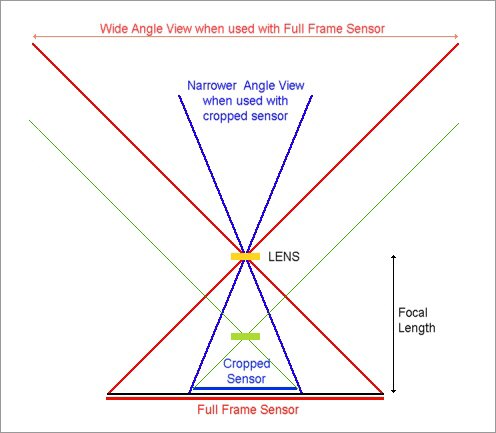
Ok. Here is the diagram I was thinking about but couldn't find... I think I've posted this before in other such discussions about 'crop factor'...


cropped_sensor_view.jpg


Notice that when comparing a lens of a 'given' focal length the 'full frame' angle of view is wider than the 'small sensor'.

The second thing to notice, is to achieve the 'same angle of view' on the smaller sensor, one has to have a 'shorter' focal length lens...
 
Got it, thanks for the in-depth writeups and links! The question I still have is what is the standard by which lenses are marked? For instance is a 50mm lens designed for M4/3 going to give you the same angle of view as a 50mm designed for full frames? The question I have is, is there a standard for marking the lens focal length? Is a 50mm lens designed for M4/3 equivalent to 50mm on full frame, or is it equivalent to 100mm (give or take) on full frame?

Does this make sense? The question I'm asking is not how crop factor works, but more how lenses are labeled in relation to one another.
 
The question I still have is what is the standard by which lenses are marked?
Their focal length. That remains standard irregardless of what sensor they project their image onto.

For instance is a 50mm lens designed for M4/3 going to give you the same angle of view as a 50mm designed for full frames?
Of course -- when used on an m43 body, they will deliver an identical image.

The question I have is, is there a standard for marking the lens focal length?
Of course -- it's the length! The length of the lens is physically measured as 50 millimeters. The millimeter is the standard of measurement.

Is a 50mm lens designed for M4/3 equivalent to 50mm on full frame
,
50mm = 50mm, no matter which ruler you use to measure it.

The amount of image magnification is the same. The difference is in how big of a circle of light the lens projects.

or is it equivalent to 100mm (give or take) on full frame?
That's a different question. The lens is the same, but the sensor is bigger, so therefore the sensor sees more of the edges of what the lens is projecting, and therefore the larger sensor sees a wider field of view through the same focal length lens.

The focal length doesn't determine the field of view. The focal length determines the magnification. The "circle of illumination" is a measurement of how large of an image the lens projects. The sensor size determines how much of that circle of illumination the sensor can see.

If you have a short focal length lens, it will have very little magnification, so the rendered image will look far away. If you project that image onto a large sensor, it will look like a wide field of view. If you have a tiny little sensor instead, it will only see the very centermost bit of the image, and will make a final frame out of just that center bit, and therefore it will look like a telephoto field of view.

Because the m43 sensor is about half the width of the "full frame" sensor, it only sees about half as much of the image as the full frame sensor does. So therefore, if you wanted to match the field of view, you'd need a lens that was twice as wide on the m43, or one that was twice as long on the full frame.

The question I'm asking is not how crop factor works, but more how lenses are labeled in relation to one another.
Lenses are labeled by their actual, measured focal length.

The circle of illumination is not labeled, but it's basically known by what mount the lens is designed for. EF-S lenses have smaller circles of illumination than EF lenses do. M43 lenses have slightly smaller circles of illumination than EF-S does.
 
Thanks, Barry! I'm sorry if I seem like I'm being a pain in the butt, it's just that as a filmmaker and cinematographer, I really want to understand these concepts, rather than just trusting calculators and knowing that they work. So, just to make sure I understand correctly, let's see if this following train of thought is correct...

Focal length is the literal measured distance from the lens to the sensor plane...
A 50mm lens has a distance of 50mm from the lens to focal plane, irregardless of the sensor size. (By the way, is this measured from the rear lens element?)
Therefore, a 50mm on an M4/3 is technically the same, in terms of actual measurements, as a 50mm on FF.
Following that, if I want to replicate a 50mm FF35 lens on an M4/3 sensor, I will need to use an M4/3 lens that is 25mm.
Conversely, if I want to replicate a 50mm M4/3 lens on a FF35 sensor, I will need to use an FF35 lens that is 100mm.

Is this train of thought correct?
 
Focal length is the literal measured distance from the lens to the sensor plane...
No, that's the flange distance. Focal length is a measurement of the length of the actual lens itself.

A 50mm lens has a distance of 50mm from the lens to focal plane, irregardless of the sensor size. (By the way, is this measured from the rear lens element?)
No, it's a measurement of the lens itself, or more appropriately the distance the light travels within the lens.

Therefore, a 50mm on an M4/3 is technically the same, in terms of actual measurements, as a 50mm on FF.
Yes. 50mm = 50mm, no matter what mount is stuck on the back of it.

Following that, if I want to replicate a 50mm FF35 lens on an M4/3 sensor, I will need to use an M4/3 lens that is 25mm.
Forget which lens you're talking about. If you want to replicate the field of view of a full frame sensor, on an m43 sensor, then you're going to have to use a lens with half the focal length. The m43 sensor is smaller, and sees less of the image that the lens projects, so accordingly you'd need a wider lens to project that image in order for the m43 to see a comparable field of view.

Conversely, if I want to replicate a 50mm M4/3 lens on a FF35 sensor, I will need to use an FF35 lens that is 100mm.
If you want an ff35 sensor camera to match the field of view of an m43 camera, you would have to use a lens that's twice as long, yes. That will compensate for the larger sensor size of the m43 camera.
 
Got it!


Is that from the very front element to the very rear element?

For a 'simple thin' lens the distance from the mid point in the lens along the axis to the image surface is used for determining the focal length. The focal point is the point where parallel 'rays' converge. This can be done on an optical bench and a 'smoke' source to visually indicate the 'focal point'.

For 'complex' lenses the 'equivalent simple lens' is used to determine the effective focal length...

Where knowing the actual point in a complex lens becomes important is if one wants to 'pan' (or create panoramas...) and does not want to have optical distortions, parallax, due to the rotation of the lens about a point which is not at it's 'optical center'.
 
While I thank you for the response, I think, for me, that raised more questions than it answered :P

I think... there is a tendency to 'over think this crop factor' business...

Because early on in my still photography experience, I used 35mm, 2 1/4x3 1/4, and 4x5 film formats... I had to over come the 'what does this lens length on this camera relate to that lens on that camera' very early. And further on my 2 1/4x3 1/4 and 4x5 cameras I could have had 2 1/4 square and 2 1/4 x 2 3/4. So it was 'real obvious' when I had the 4x5 setup with my 200mm lens, and put the smaller format back on... eh wala... narrow field of view...

It was also easier to understand certain 'lens' features, because on a 4x5 the lens comes in 2 halves, front and back, divided by the lens board, and mounted on the shutter. And with a full feature 4x5 one could rotate the lens along all three axes, as well as move the lens and film plane boards up and down...

This sort of adjustment capability is not available, except in limited ways to the 35mm shooter... so the 35mm shooter most likely never has thought about all this.

I highly recommend the two apps I mentioned earlier to 'keep it all straight'...

The basic 'rule' that was the greatest help, was to ask 'what is the 'normal' length lens for this format'... in the case of 35mm (full frame Film film...) it is approx 50mm... for 2 1/4 x 3 1/4 it was 90mm and for the 4x5 while it was nominally 150mm, I usually shot with a 200mm lens... after that basic rule, doubling the of the 'normal' for that format would give 'telephoto'... and halving the length would give 'wide angle'. (The Wife who mostly shot 35mm or 2 1/4 square, would use her 105mm on the 35mm for the portrait lens... but oddly used only the 80mm for most of her 2 1/4 shots...).

At the time I did not need to have precise estimates of Field of View, so these 'rules of thumb' were good enough.

With moving pictures however, I've found it useful to be more precise about Field of View, especially when working on locations, and whether this or that lens will give me the framing I want. Even if I use my zoom I still like to know whether 25mm is good, or whether 14mm for my GH-1 is required...
 
Last edited:
All of the numbers are still a bit over my head, but let me see if I get this straight in regards to focal length...

Focal length is the literal measure of how far the light travels before it's sharply in focus on the rear elements, correct? So a shorter focal length, ie 20mm, travels a shorter difference in the lens, yes?

Here's a question, how then can you have these huge (in literal size) cine lenses that are, say, 50mm? The light obviously has to travel a much longer path to get to the rear elements than it does in my tiny FD lens.
 
Back
Top