Do you think it's possible to shoot an AMAZING feature for under $10,000?

Do you think it's possible to shoot an AMAZING feature for under $10,000?


  • Total voters
    157
But heck, let's indulge it a little bit. Suppose a producer gives a director a project which the producer considers commercially viable. Suppose further that the director decides it's within his artistic vision of the project to plaster pictures of dead babies everywhere. That director will have scuttled the commercial viability of the project no matter if it's artistically "sound."

That director will not be asked to direct again, and probably won't even be allowed to finish the film.
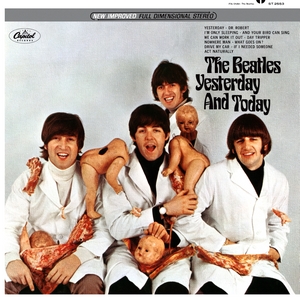
Hah, I love it! Because David has been (rightly so) invoking The Beatles, and this is the original cover to "Yesterday and Today"...
The_Beatles_-_Butcher_Cover.jpg


Of course, the producers pulled the plug on that very quickly...
 
If you fellas could put together a project like that and put out a DVD with extensive BTS extras, you would make more than a little bit of cash, IMHO. So, where do I pre-order?

No pre-orders. Pre-orders = death. I won't take anybody's money until the product is in my hands and can be shipped that same day.

But yeah, that would be the basic idea of the business plan. I think we can do a no-lose project here.
 
Hah, I love it! Because David has been (rightly so) invoking The Beatles, and this is the original cover to "Yesterday and Today"...
The_Beatles_-_Butcher_Cover.jpg


Of course, the producers pulled the plug on that very quickly...

Ha! That could have been why I chose that particular image. :)
 
Ah, sorry, thought it was an invitation.

When you copywright the treatment, let us know.
I might need a great and dependable sound designer who could work for free, but like I said this is very much a non-commercial gig and the only reason to do it would be for the hell of it.

There won't be a treatment floating around. There won't be a title on the project either. It won't be on IMDb.
 
But the producers of those plays know what direction the director is going in; and chances are the producers have more say in that than anyone, hence setting up the guidelines prior to things even starting. Having grown up in the theatre it was always VERY clear that the person paying the bills told everyone exactly what was going to go down, and if that director did not jive with the person with the money, they were gone, simple as that.

Thus, unwillingness to to compromise gets in the way of your career opportunities. You may simply be an entirely unmarketable director. As such, you won't be a professional.


But again, I've rarely seen it in theatre where a director was let go because of creative differences with the production staff. That was why it was such a major coo at the latest Spiderman show.

I think the best way for us to agree to disagree or at least for you to understand my position clearly, IMO the producer builds a box. He tells the writer/director/creator that they must stay within said box. But the producer doesn't dictate WHY the box was built in the first place. That comes from the story written on the page. For a producer to be involved in the reason the box is built is, again, the death of artistic ingenuity. And *yes* artistic ingenuity on its own may be the death of artistic ingenuity (e.g. you may create something that no one wants to see and so leaves you broke and homeless), but that *shouldn't* happen if you have the right set of people around you or a firm producer hat who can take the reigns.

Artist: Creates the reason

Producer: Builds the box

Technicians and Artists: Play within the confines of the box

As I said, you have an unrealistically rigid impression of the roles played.
 
Make something, get my money back, and get these folks started on their careers.

Or better yet, what is your metric for AMAZING??

If you just treat this from a strictly business model standpoint and apply an analysis such as Porter's Five Forces, the barriers to entry are much lower than ever before which increases many new entries into the field (currently happening) and leads to lower profitability for all firms in the industry.

So, I would hope that it is possible, but I expect the overall ROI to be much lower.
 
Last edited:
Or better yet, what is your metric for AMAZING??

If you just treat this from a strictly business model standpoint and apply an analysis such as Porter's Five Forces, the barriers to entry are much lower than ever before which increases many new entries into the field (currently happening) and leads to lower profitability for all firms in the industry.

So, I would hope that it is possible, but I expect the overall ROI to be much lower.

Huh? You're saying that a 10K cash investment from Barry wouldnt' return itself swiftly??? This post confused me.
 
Huh? You're saying that a 10K cash investment from Barry wouldnt' return itself swiftly??? This post confused me.


Sorry, it didn't include the comment he was responding to. It was really a response to the original post. So, I'm saying it would be possible to make an amazing feature film for under 10k, but I don't think your ROI would be that great with the current market.
 
Thus, unwillingness to to compromise gets in the way of your career opportunities. You may simply be an entirely unmarketable director. As such, you won't be a professional.


As I said, you have an unrealistically rigid impression of the roles played.


So like I said, we can agree to disagree. I don't think money should be involved with the creative inception of a piece. I will never be capable of accepting that as a viable option. So, agree to disagree.
 
No pre-orders. Pre-orders = death. I won't take anybody's money until the product is in my hands and can be shipped that same day.

But yeah, that would be the basic idea of the business plan. I think we can do a no-lose project here.

If this comes together and there is a need for original instrumental (guitar based) tracks, I'm game to help out. I've got a few songs on Reverb Nation under the artist name Swimming To Mars...just for reference. ( I could easily write pieces to fit just about any story)
I'm making this offer because I don't want to say this project can be done without being willing to help out.
 
I might need a great and dependable sound designer who could work for free, but like I said this is very much a non-commercial gig and the only reason to do it would be for the hell of it.

There won't be a treatment floating around. There won't be a title on the project either. It won't be on IMDb.

Sound good; let me know.

I've always wanted to do something Lovecraftian inspired at a low budget. I'm pretty sure Cthulhu is public domain. I've been working on a proof of concept 3D composite of Cthulhu attacking the NoHo 14 outside my apartment at night just for the hell of it. I was thinking it would be cool to do a Cloverfield style survival-horror monthly web series on it--ground level stuff. It would definitely have a built-in audience.

Other than that, on the horror side of stuff, I was thinking it would be cool to do a more serious take on the mock-u-mentary genre with a story that follows a Ghost Adventure/Ghost Hunters like crew in a notorious building for a night in which everything goes wrong. Single night/single location--8 or so people.
 
IMO the producer builds a box. He tells the writer/director/creator that they must stay within said box. But the producer doesn't dictate WHY the box was built in the first place. That comes from the story written on the page. For a producer to be involved in the reason the box is built is, again, the death of artistic ingenuity.
Except a lot of producers don't even read screenplays. They don't understand them, can't interpret them and aren't interested in them. It takes too long and they don't get anything out of it. They can't judge the quality of one. It's not their job. Even if they did, they shouldn't meddle based on what's on the page.

What they know is numbers. Statistics. What distributors want. That's their business and they make the decisions based on that, unlike the writer and director who makes their decisions based on the story as written on the page.

That's why there's often a conflict between directors and producers, but IMHO that conflict is necessary in order to make a great film because it makes films marketable.


About the whole Artist vs Commercialist argument....

Let's do an exercise.

1) Stand up.

2) Hold your arms straight out in front of you, shoulder level.

3) Connect your hands, forming what is essencially a basketball hoop with your arms.

If what you're doing is interesting to everybody inside that hoop but nobody outside of it, you're wasting everybody elses time and money.
If what you're doing is interesting to everybody outside that hoop, and only maybe to everyone inside of it, you're not wasting anybody's time and money because even the people inside the hoop will benefit.
 
Except a lot of producers don't even read screenplays. They don't understand them, can't interpret them and aren't interested in them. It takes too long and they don't get anything out of it. They can't judge the quality of one. It's not their job. Even if they did, they shouldn't meddle based on what's on the page.

What they know is numbers. Statistics. What distributors want. That's their business and they make the decisions based on that, unlike the writer and director who makes their decisions based on the story as written on the page.

That's why there's often a conflict between directors and producers, but IMHO that conflict is necessary in order to make a great film because it makes films marketable.

About the whole Artist vs Commercialist argument....

Let's do an exercise.

1) Stand up.

2) Hold your arms straight out in front of you, shoulder level.

3) Connect your hands, forming what is essencially a basketball hoop with your arms.

If what you're doing is interesting to everybody inside that hoop but nobody outside of it, you're wasting everybody elses time and money.
If what you're doing is interesting to everybody outside that hoop, and only maybe to everyone inside of it, you're not wasting anybody's time and money because even the people inside the hoop will benefit.


But art was never meant to be profitable, it was supposed to be educational by any creative means necessary. People have perverted the concept over time, but the inception of a story still has to be rooted in that most basic concept for it to have any intrinsic value to, ya know, the species.

Maybe where the splitting hairs has come in is the actual concept of *filmmaking*. Maybe the problem with my argument is that filmmaking, unless wholly improv, is not the inception of the thing but instead the production of the thing. Maybe from the first moment one is *filmmaking* the reason the film is being made is already ten steps removed.

So to put my argument to bed, I will say that a STORY should never be created primarily for reasons of financial gain. A story should be written because the writer has something to say. I understand that there are many people, even very famous people, who deviate from this, but I don't personally agree with their method.
 
I personally just want to make films that entertain people. Does that make me not an artist? I hope not.
 
I would call that being a kind of performance artist or exhibitionist artist. To me they are the ones whose motivation is based on audience reaction.

I actually remember a moment in an acting class in college when I told my classmates that I didn't care whether or not the audience enjoyed anything I did on the stage. They were all completely mortified because for them it was all about audience reaction, whereas for me it was about the character I was playing and my personal interaction with that character. I would have felt the same performing in a closet or on a stage. The audience was of no real consequence.
 
I personally just want to make films that entertain people. Does that make me not an artist? I hope not.

Jawa and I had a go back and forth on this not long ago on another thread. Defining characteristics of art include deliberate arrangement of symbolism and the affecting of the senses. Therefore it can be said that you need an audience to interpret it in order to declare what you've created to be art. 'Entertaining' is largely another matter, but I suppose if you want an audience in the first place...
 
Back
Top