Do You Own Cine Glass?

And to continue what Charles was saying, Michael Ballhaus owned pretty much at least one of everything ARRI, because they always JUST WORKED for him with sensible design and controls. And in the digital age it is much the same, as I can assure you that as the guy who used to sell 'em, many DPs purchased Alexas and often multiple models for whatever work they were doing.

Right, but Deakins and Chivo used 2 or 3 different models of Alexa on each of the projects I mentioned, including the 65 which can't be purchased. It's totally plausible to me that they could own one model and rent that to production on top of what they bring in from a rental house. But I doubt they could own all the kit they use each time. Re: lenses, it seems much more feasible for them to supply the lens kit if they use Master Primes 80% of the time for 5+ years.

To bring this back around to lenses, wanna know why Roger Deakins likes the Master Primes so much? Because they're functionally invisible to him. He feels that they're like looking through a clear window, which means he can rely on his own eyes and his lighting to shape the image.

I disagree with the 'clear window' notion a bit, because I have numerous lenses that exhibit less glare or halos or whatever than my eyes do when looking into a blinding backlight. I could get a better idea of what the scene looked like by taking a picture of it and looking at the picture than by looking at it in person. Which is why I think there's something natural about flare/veiling flare. That's not to say that it's always desirable.

Similarly, they say that "the camera adds 10 pounds." My Sony GM 24mm has a useful distortion profile (which I'm sure is not unique). It's quite square around the periphery and has modest pincushion distortion in the center. The result is that I can move in relatively close on a subject, and the distortion flatters them. (Especially compared to the barrel distortion common with wide angles, including every midrange zoom I've ever owned.) So, what is more like looking through a clear window - the lens that shows you reality as you felt it? Or a distortion-free lens that adds 10 pounds?

And in the end I think that's the most sensible answer to 10 pages of posts on this topic: the best lens choice is the one that doesn't get in your way.

I agree with that formulation. Deakins doesn't want to use a lens that will call attention to itself (with a strong flare) or create some ugliness that causes you to reframe or reblock (say, when your subject is close to camera at the corner of a wide-angle shot). That's why I use straightforward lenses. They never make me change my game plan.

But there are many times when I'm shooting with such a lens and then encounter a specific shot where I wished I was on a dirtier or more idiosyncratic lens just for that shot. With enough time and/or support, I'd gladly swing lenses to make that happen.

AF also complicates your statement because it can do amazing things for me down in the land of no-focus puller. But AF lenses are typically never as good for MF. Can't have it all
 
To bring this back around to lenses, wanna know why Roger Deakins likes the Master Primes so much? Because they're functionally invisible to him. He feels that they're like looking through a clear window, which means he can rely on his own eyes and his lighting to shape the image. And in the end I think that's the most sensible answer to 10 pages of posts on this topic: the best lens choice is the one that doesn't get in your way.

I bet he doesn't own them...
 
When I worked with him, they were a specific handpicked set that lived at a rental house on permanent hold only for his use.

When did you work with him? Does the rental house hold them for him owing to his prestige or does he need to pay for that? And i imagine he handpicked them to find the cream of the crop?
 
I don't know if this is relevant to any particular discussion point we're having in this thread, but I've just faced a little cine-lens selection crisis on the series I've just started, so I figure I'll share it anyway.

So I'm currently in Kuwait, having just started on an 8-episode Arabic period drama over here (as you do...). And the industry here is small, so gear availability and selection is pretty limited (our whole camera + lighting package is coming from a single supplier). And for lenses, I had three options to choose from, Master Primes, Ultra Primes and Mini S4s (given the pace of our schedule, I would probably have preferred zooms, but that's not an option here).

Now because this is a period drama (about the Souk al-Manakh crash - a really fascinating piece of history) and our budget for digital set extensions/street replacements etc. is limited; what I call "subtractive cinematography" is going to be pretty essential to framing this series up. That means using a lot of shallow depth of field, and longer lenses to frame-out or blur-out period-innappropriate elements (of which there are a lot here, as the series is set in 1980, and Kuwait has changed immensely since then).

This ruled out the Mini S4s (which are lenses I like very much) for their slower T/2.8 aperture, but left me with a conundrum chosing between the Masters and the Ultras.

The Master set was 18mm, 35mm, 50mm, 75mm, 135mm (the 25mm is currently in Germany being repaired), and the Ultras 16mm, 24mm, 35mm, 50mm, 85mm, 100mm. Now this is painful on multiple fronts. On the wide-angle end, an 18mm is a much more useful day-to-day lens to me than a 16mm, because the perspective distortion is significantly lower, so I can use an 18mm far more frequently. But in tight locations (and our whole series is being shot on practical locations) 18mm isn't always going to be wide-enough.

Then on the long-lens front, our director really likes extreme close-ups, and between that requirement, and the need to use long-lens for our wide-shots outdoors (to frame out period-inappropriate elements), the 135mm of the Master set would really come in handy.

Having T/1.3 on the Masters would also be really helpful for blurring out things we can't have the audience see, and for any low-light work (I have a 3-tonne lighting truck on this one, but it's an old-fashioned package, 4k/2.5k/1.8k HMIs, then a few tungsten heads, and flourescent Kinoflos - so I have a bit less control/speed than I would with LEDs). Also, with the expectation of doing so much work close to wide-open on the aperture, having the optical performance of the Masters would be another boon there too.

BUT... missing that 25mm is a massive issue. We tried to get them to sub-in a 24mm from the Ultra set, or even the 24mm from the Mini S4 set, but the supplier wouldn't budge. So ultimately, I had no choice but to settle on the Ultras instead.

Now Ultra Primes are fine, good-looking lens. But those compromises of a more limited-use wide-angle lens, and a more limited-range telephoto lens were a hard hit to take from a functional perspective.

That said, the tighter grouping of focal lengths with the Ultra set is helpful for us, for any cross-coverage we shoot with both cameras rolling (I have a Mini and a regular Alexa, and we only have the one lens set between them).

So there's all sorts of considerations that go into these decisions, and the answers are never necessarily clear cut - choosing the advantages of one set, might cost you something in another area.
 
When did you work with him? Does the rental house hold them for him owing to his prestige or does he need to pay for that? And i imagine he handpicked them to find the cream of the crop?

Between 2000 and 2007, on various movies. Rental house held for him (and I would imagine still does). And yes I believe handpicked.

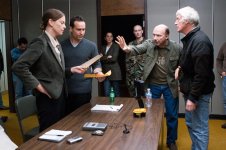
I am sad that I have no good BTS stills from any of those projects. The only one I've ever seen was this from "In the Valley of Elah" where I'm mostly buried behind Charlize and I would guess, recovering from a very intense Steadicam shot pulling her through the doorway at high speed. At one point on that show Roger and I were side by side with duelling handheld Arricams--there's a pic I certainly wish I had!

image_129463.jpg
 
Last edited:
BTS pic is funny - I worked from 1998 to 2010 or something with two photographers in an office - I don’t think we have one frame which is actually a shame - constant phone fiddling is the other extreme and also a shame
 
looks like there's a new cine zoom from a new company on the market: the CHIOPT 28-85mm T3.2 for $2900

https://www.newsshooter.com/2022/02/...m-t3-2-review/

It doesn't sound like it's that good re:sharpness and distortion. Better marks for breathing and chromatic aberration. Something like 6lbs.

my feeling is that you can get prettier images from stills lenses in this price range. You have to pay for good cine zooms. But if you want parfocal and gears and limited breathing, and maybe you like the look of the lens, then it might be helpful. Certainly i think the range is more useful than the Catta
 
looks like there's a new cine zoom from a new company on the market: the CHIOPT 28-85mm T3.2 for $2900

https://www.newsshooter.com/2022/02/...m-t3-2-review/

It doesn't sound like it's that good re:sharpness and distortion. Better marks for breathing and chromatic aberration. Something like 6lbs.

my feeling is that you can get prettier images from stills lenses in this price range. You have to pay for good cine zooms. But if you want parfocal and gears and limited breathing, and maybe you like the look of the lens, then it might be helpful. Certainly i think the range is more useful than the Catta

Yes, and the current (glorious) state of AF also favours first-party stills glass, at least at my lowly end of the market. If one of the big players started producing a range of excellent video-forward FF stills lenses I'd be all over them.


Want:
- Great AF but also decent manual focus with a nice feel and longer throw
- Small and lightweight
- Minimal breathing (though something like Sony's in-camera breathing control possibly acceptable)
- Optical image stabilisation (Gyro data is no substitute)
- Parfocal zooms (might accept help from in-camera processing)
- Consistent aperture zooms - no sneaky loss of half a stop at the long end

Not so bothered about:
Zooms that don't corkscrew in like stills lenses, with the centre of the frame moving. This would be nice but not worth large increase in size / weight (to me)

Don't care about:
Servo

I say 'video-forward' as I think the above list has more in common with good stills glass than traditional cine lenses. I'd pay 2 to 3 times the cost of high-end stills glass - so pricing something like the Sony 16-35 2.8 cine is fine. I've just got no use for something as big and heavy as the Sony 16-35 cine.

Perhaps I'm deluded but I think that the market for something like this would be bigger than the market for traditional cine glass. So many of us are working with tiny crews or working alone. You'd also get some of the non-pro enthusiast market who would never consider a lens the size and weight of a baby's head plus photographers who value nice manual focus or who just want 'the best'.
 
Last edited:
Between 2000 and 2007, on various movies. Rental house held for him (and I would imagine still does). And yes I believe handpicked.

I am sad that I have no good BTS stills from any of those projects. The only one I've ever seen was this from "In the Valley of Elah" where I'm mostly buried behind Charlize and I would guess, recovering from a very intense Steadicam shot pulling her through the doorway at high speed. At one point on that show Roger and I were side by side with duelling handheld Arricams--there's a pic I certainly wish I had!


It might be your only BTS shot...but...you are the only one in focus in that shot so there's that!
 
Back
Top