
Navigation
Install the app
How to install the app on iOS
Follow along with the video below to see how to install our site as a web app on your home screen.
Note: This feature may not be available in some browsers.
More options
You are using an out of date browser. It may not display this or other websites correctly.
You should upgrade or use an alternative browser.
You should upgrade or use an alternative browser.
Do you need 4K lenses to film 4K?
- Thread starter Amadou
- Start date

El Director
Veteran
Never heard of a 4K lens. You'll pretty much just find stills lenses like you're already using, and then there's Cine lenses that are designed for film work. Focus on a stills lens is a lot more difficult to find and maintain, so even if you're *sure* it's in focus, it may be a bit soft. A cine lens is much easier to focus and will generally be sharper.
Quality of the glass also comes into play. A Canon kit lens will be softer than an L series like the 24-105mm. Better glass equals better image (usually)
Quality of the glass also comes into play. A Canon kit lens will be softer than an L series like the 24-105mm. Better glass equals better image (usually)
Take a still camera (e.g. D850, or any still camera where you can mount the lenses with >= 5.7K Bayer sensor) and take raw photos. Bring the raw photos into Photoshop (Adobe Camera Raw) and process. Now resize in Photoshop to 4k. How's the detail? If the shots were in focus and still soft, it's the lenses. If it's sharp and the video camera footage is soft, it's the camera and sensor (possibly adapter). For example, the FS7 only has a 4K Bayer sensor, which is not sufficient to capture 4K RGB content. You need a 5.7K sensor (minimum). To get UHD "4K" you need 3840/.67 = 5732 Bayer photosites to get True 4K (UHD). More for 4096 4K (DCI): 4096/.67 = 6114 Bayer photosites. Here's what True 4K looks like (Red has had > 5.7K sensors for a while, have not seen anything this detailed from anyone on YouTube in 4K (not even the Alexa 65)): https://www.youtube.com/watch?v=0EWyDHgcpTI . Look at the fine detail- very clear and no artifacts, even for the brick walls (typically a challenge with aliasing/moire if a very strong OLPF isn't used).
While you can always sharpen in your NLE to help reduce softness, you're going to get aliasing and digital crunchiness, especially if you push sharpening too far, and especially on high contrast specular edges. A slight amount of edge sharpening and local contrast enhancement (using Unsharp Mask with a large radius e.g. 100-300) can improve acutance, or apparent sharpness, without ugly digital artifacts.
While you can always sharpen in your NLE to help reduce softness, you're going to get aliasing and digital crunchiness, especially if you push sharpening too far, and especially on high contrast specular edges. A slight amount of edge sharpening and local contrast enhancement (using Unsharp Mask with a large radius e.g. 100-300) can improve acutance, or apparent sharpness, without ugly digital artifacts.
combatentropy
Veteran
I saw 4K lenses advertised when cameras were still using small sensors. 2/3" chips, which are actually less than 1/2" diagonally, measure 9.6mm horizontally. 4K across 9.6mm is about 400 pixels per millimeter, or 200 line-pairs per millimeter, which is a top-of-the-line lens.
4K across S35 is only 80 line-pairs per millimeter. Most lenses are between 100 and 200 line-pairs per millimeter, even the old ones. In fact some of the old ones are still the sharpest around, especially those old Nikons.
Your focus is off. Or it's the adapter. Or maybe the lens got messed up in some way.
Last edited:

JPNola
Veteran
Never heard of a 4K lens. (usually)
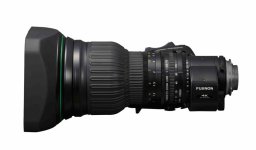
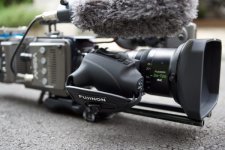
Fujinon Cabrio 19-90 Version 2 is marketed by Fujinon as "4K certified". Which suggests that the 19-90mm Version 1 is not 4k certified.
_________________
As to the question of "Do you need 4K lenses to film 4K?", my answer is that it depends. But that said, generally speaking, no. You don't need a lens that is marketed as "4K" or "4K certified" to shoot 4K video. Particularly not if the end product is not going to be shown theatrically, on a huge screen, and will instead be watched on consumer televisions or on laptops, smartphones, tablets.
A similar issue came up years ago when video went from standard definition to high definition. And then, as takes place today with "4K", high-definition or "HD" was widely used as a marketing tool. Lens makers released "HD" lenses that had greater resolving power than their previous, non-HD lenses. Or so they claimed. I have no doubt that the lens makers did in fact produce lenses capable of capturing higher resolution. But at the same time it was marketing and a way to convince every owner of an existing zoom lens that they had to upgrade to an "HD" lens.
The interesting thing that only just occurred to me while writing this is that the "HD" and "4K" marketing of lenses mostly took place with zoom lenses and with broadcast news lenses, or "ENG zoom lenses", in particular. Canon and Nikon weren't marketing photo zooms as "HD" or as "4K". The Cinema lens big boys such as Cooke, Panavision, and ARRI were not marketing as "HD" or "4K" either.
I am not aware of any industry standard as to what does or does not constitute a "4K lens" or a "4K capable" lens.
JPNola
Veteran
We use classic Nikon Lenses on our 4K camera (E-Mount) using an MTF adaptor. Even at full focus the image is slightly soft. Is this due to the adaptor or to the Nikon lenses? In other words, once you get to 4K, do you need "4K lenses" to get the full sharpness?
Most likely it is that the lenses need to be shimmed since they do not have a back-focus adjustment. That said, I've used numerous different lenses mated to my Fs7 via lens adapters and never had any issue with the lenses being soft. So it is possible that your issue will not be resolved with shimming. Typically when adding a shim it is placed between the lens and the adapter, as explained in this article:
http://www.adamroberts.net/blog/shimming-your-metabones-cine-smart-adapter/
Out of curiosity, I recall your saying you decided to purchase a C300 and not a Sony Fs7. But here you are saying you use an e-mount adapter. Is this for another camera other than the C300 that your company owns?

cpreston
Veteran
We use classic Nikon Lenses on our 4K camera (E-Mount) using an MTF adaptor. Even at full focus the image is slightly soft. Is this due to the adaptor or to the Nikon lenses? In other words, once you get to 4K, do you need "4K lenses" to get the full sharpness?
I have a set of old Yashinon lenses. They are probably older than your Nikon lenses and they are single coated, so it isn't a perfect comparison, but they are not nearly as sharp or contrasty as my Canon 18-80 t/4.4 ("designed for 4K"!). You don't need "4K" lenses to get perfectly sharp images at S35, but lens design has come along way in the past 50 years. Almost any contemporary lens isn't going to create any obvious loss of resolution in 4K. The lenses are designed to go in cameras at least twice the resolution of 4K. Your problem might be the age of your classic Nikon lenses.
morgan_moore
Major Contributor
JP
It is unlikely a lens need shimming - shimming serves two purposes;
Making zooms par focal and making focus witness marks accurate.
Neither are generally relevant to stills lenses used in video.
—
Overall the stills camera test is the way to find out.
I tested all of my old Nikon lenses on my 6k d600 camera and they all performed very well.
I have two old nikkors that are soft when wide open 50 1.2 and 28-2 - both sharpen up nicely when stopped down to f2 and 2.8
Compressed video codecs and poor focus are the element that generally introduce softness.
I’d guess that there is a 90% chance that lenses are not the weak link in the chain

Amadou
Carbonite Member
We use a C300 Mark II with Canon lenses and an FS7 with Nikon Lenses (Incidentally I have some things to say about that, but not on this post). This brings me to the adaptor issue. The reason we got the MTF adaptor is because the Metabone adaptor did not give us sharp images. This surprised even the salesperson. For some reason, the FS7 with a Metabone adaptor and Nikon lens did not yield sharp images whereas the MTF adaptor did. I have no explaination for that. However this is the reason I am asking about this issue. How reliabe are these adaptors anyways? And if a high end MTF adaptor can't be trusted, then what can?
Imamacuser
Veteran
For the sake of being thorough I have to ask, do have have any kind of filter on the front or rear lens element? Filters blend into the lens and are easy to forget about, especially the rear element filters.
Could you list your Nikon lens set and tell us if they look soft at all apertures?
Could you list your Nikon lens set and tell us if they look soft at all apertures?
morgan_moore
Major Contributor
We use a C300 Mark II with Canon lenses and an FS7 with Nikon Lenses (Incidentally I have some things to say about that, but not on this post). This brings me to the adaptor issue. The reason we got the MTF adaptor is because the Metabone adaptor did not give us sharp images. This surprised even the salesperson. For some reason, the FS7 with a Metabone adaptor and Nikon lens did not yield sharp images whereas the MTF adaptor did. I have no explaination for that. However this is the reason I am asking about this issue. How reliabe are these adaptors anyways? And if a high end MTF adaptor can't be trusted, then what can?
You need to be clear if your adapters have glass elements in them.
If they do clearly you are evaluating the system, not the vintage lenses.

David W. Jones
Veteran
We use a C300 Mark II with Canon lenses and an FS7 with Nikon Lenses (Incidentally I have some things to say about that, but not on this post). This brings me to the adaptor issue. The reason we got the MTF adaptor is because the Metabone adaptor did not give us sharp images. This surprised even the salesperson. For some reason, the FS7 with a Metabone adaptor and Nikon lens did not yield sharp images whereas the MTF adaptor did. I have no explaination for that. However this is the reason I am asking about this issue. How reliabe are these adaptors anyways? And if a high end MTF adaptor can't be trusted, then what can?
http://www.metabones.com/article/of/infinity-adjustment-speed-booster-only

Grug
Veteran
A 4K image is 9 megapixels. I doubt there's a lens that's been made since the 1940s that can't resolve that. It's not a big ask optically. As combatentropy pointed out, it's really only an issue where tiny 2/3" broadcast cameras are concerned.
Is your lens only soft wide-open? Or does it sharpen up at an ideal f/5.6-f/8 aperture?
If it's always soft, you may have an element that's out of alignment.
Is your lens only soft wide-open? Or does it sharpen up at an ideal f/5.6-f/8 aperture?
If it's always soft, you may have an element that's out of alignment.
cpreston
Veteran
It sounds like you are using a magnification/speedbooster adapter. It might be worth just getting a cheap spacing adapter and testing each of your Nikon lenses. They could be out of alignment. I like to test each new lens on a chart. Also, some of the older wide angle lenses are designed with nonplanar focal plane. At a focus of 1M in the center, the outer edges might actually be focused to 2M. That was a surprising finding for me.
Amadou
Carbonite Member
Our MTF adaptor has no glass and neither did the Metabone. The MTF delivers in focus images, but not the Metabone.
MTF
https://www.bhphotovideo.com/c/product/765121-REG/MTF_Services_Ltd_MTNIKSEM_Nikon_G_to_Sony.html
Metabone: https://www.bhphotovideo.com/c/product/1191277-REG/metabones_mb_nf_e_bt2_nikon_f_to_e_mount_nex.html
MTF
https://www.bhphotovideo.com/c/product/765121-REG/MTF_Services_Ltd_MTNIKSEM_Nikon_G_to_Sony.html
Metabone: https://www.bhphotovideo.com/c/product/1191277-REG/metabones_mb_nf_e_bt2_nikon_f_to_e_mount_nex.html
cpreston
Veteran
Our MTF adaptor has no glass and neither did the Metabone. The MTF delivers in focus images, but not the Metabone.
MTF
https://www.bhphotovideo.com/c/product/765121-REG/MTF_Services_Ltd_MTNIKSEM_Nikon_G_to_Sony.html
Metabone: https://www.bhphotovideo.com/c/product/1191277-REG/metabones_mb_nf_e_bt2_nikon_f_to_e_mount_nex.html
That doesn't make any sense to me. As far as I know, an adapter that just adjusts the flane focal distance shouldn't have any effect on how sharp an image appears when it is in focus distance. You might start to see affects when you are using extension tubes, but that is a different issue.