Do I need a super high sensitivity shotgun mic for bird recording? Some little though

ARIELLimited

New member
Hi there, I am a newbie to documentary video shooting for birds and have some questions about sound recording. Believe me, I have done tons of research about bird recording, and the answer is always “buy a ME66/K6” without further explanation. That’s why I am eager for your assistance.

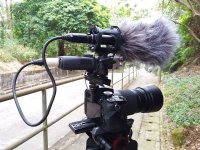
I am now using an AT875R with Zoom H5 (preamp & recorder) line out to my Panasonic G85. The mic is from my Panasonic HC-X1000, it’s just a temporary setup and apparently not the best in the world. I understand that sound recording is all about distance and good audio means recording separately at close distance. However, for a one man crew under practical situation, the distance from me to the birds is ALWAYS around 3-20 meters. In addition, for a documentary purpose, I MUST record the audio at the same time as recording the video. The use of camera top mic is inevitable.

Below is one of my work with sound record through a Takstar 598 camera top shotgun mic with an internal +10db preamp if you are interested.
https://www.youtube.com/watch?v=YKc-6ciCbY4

I know that under normal situation, the max level should be around -12db by controlling the gain of preamp. Under a good environment with the mic close to the sound source, this setting is perfectly ok. However, for my recording environment which is long distance with a less than ideal preamp, I am wondering if I should turn down the gain as much as possible and this might resulting with minimal preamp hiss and “rejected” background noise as the level is too low to be recorded. Theoretically, I can push the level in post to a more suitable level without amplifying too much hiss/noise. In that case, why do I need a super high sensitivity mic for the usage?

I am not sure of my theory is correct or not. Does pushing level in post lead to distortion or other technical problem?


More question for the ME66/K6 mic. Is the K6 module a mic preamp? I am assuming that the K6 module is a mic preamp to boost ME66’s performance, which means Sennheiser is “cheating” on their spec sheet, as I can’t find any mic with the same level of sensitivity on the market. If my presume is true, I can just buy a mic socket preamp driven by phantom power and save a few hundred bucks for similar performance (sensitivity).


Sorry for my poor English and composition. I hope you understand what I mean and I would appreciate for your help.

Thank you.
 
Last edited:
I have just spent some time recording ambients outdoors, and I am surprised at how loud individual birds are in the wild! You need a signal chain with the lowest possible noise floor and a microphone with the greatest rejection of surrounding sound. The biggest problem I think you would encounter in your current set up is noise from your camera/tripod setup transmitted into the mic. Mount the mic on a separate shockmount on a separate stand use as little windscreen as you can get away with, point the mic at the bird and crank up your gain to get the bird sound in the fat part of the signal on the meters. If the animal is really distant, you might consider a parabolic reflector to gather more sound energy. The H5 is a good, but not great recorder for this purpose, there are other (more expensive) alternatives with even quieter pre-amps. Your English is fine.

After listening to your posted video, the background "noise" sounds more like just ambient "roar" that you are going to find in any urban/suburban environment as opposed to camera or audio chain noise. There is a lot of people noise creeping in too. A more focused, medium to long shotgun would really help. With the birds in the cage you could certainly move a mic in fairly close before luring the birds into the frame.
 
Last edited:
The K6 is the electronics that normally sit in any condenser mic body - in mics with interchangeable capsules, this is a common unit. It is a preamp in the sense that it takes the output of a mic element and produces a pretty standard microphone output level at the connector. It still needs further amplification, like all mics do.

Gain wise, once you know your equipment, you identify the component you have that performs worst with gain addition, and which one is better at adding gain. If you need to add gain, it makes sense to add it where it has the least impact on noise and distortion. Adding gain in post changes the level on the meters but does not change the available signal to noise - all you are doing is applying maths - adding level in a linear manner.

I've found that many of my cameras over the years have pretty decent preamps. A few have performed a little worse. If they are good enough then very often they're good enough to let the camera record the faint sound of a finger finding the buttons, or the quiet whine of the lens servo. If your system is this sensitive, then that's really going to be the limit - if the noise is low enough to let you hear the lens working, then unless your distant sound is louder, nothing is really going to make it better - apart from moving the mic closer, or away from the unwanted noise. Back in the 70s, I discovered my Ferrograph reel to reel connected to an SM57 outside could record ambient sound quite well - and that is with tape and no noise reduction. Practically everything nowadays has to be better in spec than that.

I'm not sure if these help as comparisons. Both clips I did years ago comparing camera mics to shotguns.
https://vimeo.com/84244265
This is a test clip of on camera audio on one channel and a distant but fixed shotgun on the other. (A 416 in this case - BUT using a wireless link to the camera.
https://vimeo.com/5474351This is a similar clip on a beach - the gain was pretty high but noise is good.

replace the football or beach with your location and have a think if the sound 'type' would work?
 
I have just spent some time recording ambients outdoors, and I am surprised at how loud individual birds are in the wild! You need a signal chain with the lowest possible noise floor and a microphone with the greatest rejection of surrounding sound. The biggest problem I think you would encounter in your current set up is noise from your camera/tripod setup transmitted into the mic. Mount the mic on a separate shockmount on a separate stand use as little windscreen as you can get away with, point the mic at the bird and crank up your gain to get the bird sound in the fat part of the signal on the meters. If the animal is really distant, you might consider a parabolic reflector to gather more sound energy. The H5 is a good, but not great recorder for this purpose, there are other (more expensive) alternatives with even quieter pre-amps. Your English is fine.

After listening to your posted video, the background "noise" sounds more like just ambient "roar" that you are going to find in any urban/suburban environment as opposed to camera or audio chain noise. There is a lot of people noise creeping in too. A more focused, medium to long shotgun would really help. With the birds in the cage you could certainly move a mic in fairly close before luring the birds into the frame.

Thanks for reply. The scene was inside a park which fairly close to the street, 6-7 guys was shooting right next to me with some serious DSLR. The dramatic scene of bird versus bird was not expected, I had no room to move around before the bird left me in the dust.

Here's a new video to demonstrate the sound with the AT875R + H5 fed to the camera, I think the gain of H5 was set to 7.
https://www.youtube.com/watch?v=is3I2VXSl5U

The Panasonic G85 is notorious for its IBIS "fan noise". The former video was shot with firmware 1.1 . The Takstar 598 shock mount is not that effective but I have no idea whether the noise was came from the camera or the environment. This one was shot with firmware 1.2 with huge improvement for reducing the "fan noise" according to some test on youtube. The cheap Chinese rubber band shock mount for the new setup is VERY effective, I don't think the mic can pick up any "fan noise" from the camera. It seems the XLR connector cable come with the AT is smaller than average and slips out from the H5 quite easily, I put some tape to the connector in order to add some friction on it.

20170225_143939.jpg

I have considered the Tascam DR70 for the purpose, but I doubt if the preamp is that good to compensate for its gain in size and weight. Also, the center of gravity of the whole setup will be raised due to the camera bottom attachment design. It's no big deal for a 50mm lens, but with a 1200mm equivalent focal length, it's less than ideal.

For the parabolic reflector, I read that the minimum diameter for any practical usage is 24cm, which is not possible to operate with the camera with my two hands at the same time.
 
In that bird shot those two birds are only calling about a quarter of the time, you are picking up other birds for the rest. So, if that is what you want you do not need a more directional microphone.

Serious bird call recordists do use parabolic microphones. However they are not trying to get them on video at the same time.

A more sensitive microphone, like my AT4073A, might help. In as test shot I did film a crow from about 120 feet away and it came though loud and clear. Now a crow is a loud bird, but I also thought the camcorder mounted AT4073A did very well. The AT4073A is about the most sensitive shotgun mic readily available. It is long out of production, but I paid $180 for mine used on eBay.

The ME66... Never used one, experts I respect say, tsk, tsk, tsk about it. I kind of think it would do no better than your AT875R.

If you do need a more directional mic one of the longer shotgun mic's might be the place to look.
 
The K6 is the electronics that normally sit in any condenser mic body - in mics with interchangeable capsules, this is a common unit. It is a preamp in the sense that it takes the output of a mic element and produces a pretty standard microphone output level at the connector. It still needs further amplification, like all mics do.

Gain wise, once you know your equipment, you identify the component you have that performs worst with gain addition, and which one is better at adding gain. If you need to add gain, it makes sense to add it where it has the least impact on noise and distortion. Adding gain in post changes the level on the meters but does not change the available signal to noise - all you are doing is applying maths - adding level in a linear manner.

I've found that many of my cameras over the years have pretty decent preamps. A few have performed a little worse. If they are good enough then very often they're good enough to let the camera record the faint sound of a finger finding the buttons, or the quiet whine of the lens servo. If your system is this sensitive, then that's really going to be the limit - if the noise is low enough to let you hear the lens working, then unless your distant sound is louder, nothing is really going to make it better - apart from moving the mic closer, or away from the unwanted noise. Back in the 70s, I discovered my Ferrograph reel to reel connected to an SM57 outside could record ambient sound quite well - and that is with tape and no noise reduction. Practically everything nowadays has to be better in spec than that.

I'm not sure if these help as comparisons. Both clips I did years ago comparing camera mics to shotguns.
https://vimeo.com/84244265
This is a test clip of on camera audio on one channel and a distant but fixed shotgun on the other. (A 416 in this case - BUT using a wireless link to the camera.
https://vimeo.com/5474351This is a similar clip on a beach - the gain was pretty high but noise is good.

replace the football or beach with your location and have a think if the sound 'type' would work?

Wow, that's really great sounding with that distance. I guess it was more quiet back in the days. I am from Hong Kong, a place which full of people, traffic and NOISE. Even in the suburb, it's really hard not to capture some noise from civilization.

Please don't mind, but my question was not resolved yet. To make it simple, I think I should rephrase the question.
What is the max level should I target at under a bird recording situation? Some of the small birds such as a wabler sounds really soft and quiet, even though it's 1-2 meters from me, the preamp is needed to be run on almost full throttle to meet -12db. The preamp noise is so loud that it can "drown" the signal even though the bird call is recorded with enough loudness.

Is there any cheap alternative to a ME66/K6 for high sensitivity and highly directional recording? I am not going after tonal quality but "pureness" of signal. The price of the Senn asking is a bit steep for a on camera mic. I understand that it is not possible to have a absolute clean signal under the situation but I am always trying to figure out the best way/result for the money. Also, just wanna let you know that I own a SGH-6 shotgun module for the Zoom H5, but the sensitivity is fairly low for the application.

Do not remember the source right now, but I am sure I have seen people using parabolic microphones for recording birds.
Also, a quick google let me to this, which kind of reassures me I did not make it up http://www.wildlife-sound.org/equipment/newcomersguide/

Thanks for the information, I have looked into the site sometime ago, it certainly does help to build some confident by knowing that a bird song record straight from a Olympus LS10 is quite well.
http://www.wildlife-sound.org/equipment/newcomersguide/usenospeechrec.html
 
In that bird shot those two birds are only calling about a quarter of the time, you are picking up other birds for the rest. So, if that is what you want you do not need a more directional microphone.

Serious bird call recordists do use parabolic microphones. However they are not trying to get them on video at the same time.

A more sensitive microphone, like my AT4073A, might help. In as test shot I did film a crow from about 120 feet away and it came though loud and clear. Now a crow is a loud bird, but I also thought the camcorder mounted AT4073A did very well. The AT4073A is about the most sensitive shotgun mic readily available. It is long out of production, but I paid $180 for mine used on eBay.

The ME66... Never used one, experts I respect say, tsk, tsk, tsk about it. I kind of think it would do no better than your AT875R.

If you do need a more directional mic one of the longer shotgun mic's might be the place to look.

No, I was intended to record the black birds (myna) but the bulbuls in the background are every where. If I need to add some ambient sound, I can always use my H5's XY mic together with the shotgun. I have no control to the bird where to land and when to sing, all I can do is to shoot and shoot and shoot and hoping for some luck. That's why I have to be ready all the time and carry no fancy gear to fiddle around.

The AT4073A, -23 dB (70.8 mV) re 1V at 1 Pa, that's crazy amount of sensitivity, it's a pity that AT decided to discontinue it. Thanks for letting me knowing for the option. I have just checked on ebay and no good deal available at this moment.

Yes, I am thinking for getting a more directional mic, but all the mic I found sub $250 is less hot than the AT897R. Actually, it seems the sensitivity of shotgun mic in the world stops at 30mV with the exception of ME66. I am not sure if something like a "XLR connection type preamp" like the one below would help.
https://www.bhphotovideo.com/c/product/522285-REG/MXL_MIC_MATE_USB_Mic_Mate.html
 
That Mic Mate is for recording into a computer. Not, I think what you are looking for.

I tend to think that I am at the bottom of the pile; but I am not, I think, as equipment strapped as you. Preamp wise I have a Shure FP2, a couple of old broadcast quality (no phantom power) portables, and my Zoom F4. The AT is the highest quality mic in my kit (understand that was a world class mic when it was new). Understand that I have been into audio for a lot of years.

What you do have seems to be a reasonalby solid kit. Learning all the tricks might be a better option for you than investing in more equipment. Stangely, most people seem to think that more expensive gear will make up for the thousands of hours of study and practice they do not have. It never will, don't be like them.
 
I've never been a big fan of parabolic mics, but that's my own personal preference. For birds, if you want a long shotgun, a Sennheiser 816 is about as long a shotgun as you can get. It's VERY directional and good at getting stuff from far away. My second choice would be a Schoeps CMIT5.
 
Lovely shots of the birds. It almost makes me wonder if most people actually shoot their best footage after learning basic composition and how to use a tripod, but before they learn about sliders and fancy editing ;-)

Please don't mind, but my question was not resolved yet. [. . .] What is the max level should I target at under a bird recording situation?

I don't know if there is a hard answer to this question. It depends on whether you're shooting for your grandparents or the BBC.

Is there any cheap alternative to a ME66/K6 for high sensitivity and highly directional recording?

The ME66/K6 already is cheap. Your AT875R is the best bang per buck of any shotgun mic out there, and I am loathe to encourage you on any wild-goose chase for a magic mic. The differences are barely noticeable, especially at the distances you've been recording.

I'm going to sound like yet another one here who keeps answering a question that you're not asking, but I would really encourage you to at least try to get the microphone off the camera and closer to the subject, preferably on a pole, pointed at an angle down at the birds (or if they're really high, get the mic below the birds pointed upwards at them). I think you can do it, at least some of the time, because your shots are static. Focus on the birds, and step away with your boom pole and get as close as you can without scaring them away. The reasons I say this are:

1. Whether one mic amplifies more than another doesn't matter if there are other noises around you. Most shotguns have generally the same pick-up pattern. It's better to think of a directional mic as a mic that has taken the idea to ignore certain sounds as just a suggestion. (Obviously the mic consistently lowers the volume of side noises, but when you're watching the footage later, you might wonder if the mic has an Attenuation Deficit Disorder.) Shotgun mics actually do really well at lowering the volume of sounds directly to the left or right of them. They do more poorly at rejecting sound behind them. And they're no good at rejecting sound in front of them (like a car in the background behind the bird). If you somehow can get the mic more vertical, then you are using its pattern to your advantage. Its deaf sides are pointed at everything around the birds, but its nose is pointed at the birds, and the only thing beyond the birds from its perspective is the ground (if pointed downward) or the sky (if pointed upward --- watch out for that plane!). (Here, watch this [5:29]).

2. Sound obeys the Inverse Square Law. That means if you get twice as close to those birds, the sound will get four times as loud. Or if you double your distance from those other extraneous noises, their sound will drop to 1/4 of their original level. What I'm trying to say is, get that mic as close as you can to the birds, or as far as you can from the other things, or both.
 
Last edited:
I have been filming birds for over 5 years now and have spent a lot of time working on capturing the best audio possible. Like you, I shoot with my mic attached to my camera, there is simply no other reasonable solution for a one man band.

I started out using a Canon 600D with a Rode VideoMic Pro, but now use a Sony F5 with a Sennheiser MKH8060 in a Rycote Windshield. I run the mic straight into the camera and it produces excellent results. It actually records things that I miss in real life, like soft bird calls and even wing movement noises.

My technique is pretty simple, and learnt from trial and error.

1. Record as loud as possible. I have my level at maximum and only ever turn it down if I'm close to a loud bird, which doesn't happen very often. Even recording at max level I normally have to increase it in post.

2. Try and film in places with no other noises and at the quietest times of day, often dawn is best. Shooting at maximum level picks up everything, which is great when all you can hear is birds and the wind in the trees, not so great otherwise.

3. Make sure your gear is silent otherwise it will be in your recordings. I learnt this the hard way. I have the raw recorder for my camera which produces the most beautiful moving images I have seen, but has a fan that never stops. So now I don't use it. I prefer to shoot lower quality video with pristine audio than the other way around.

4. Use the best wind protection possible. The biggest drawback of the Rode VideoMic Pro for me was not being able to effectively shield in wind, so it become almost unusable in even a gentle breeze.

5. Learn to edit your sound. This has been one of the most rewarding parts for me. Generally I run a high pass filter to cut out any rumble, increase the level and sometimes run a compressor to even the loud and soft calls out. This doesn't always work though. I also use the spectral view in Adobe Audition to remove individual sounds, this is an incredibly powerful tool. I also have the Izotope RX-5 plug in for noise reduction, it can do a great job in the right situation but I prefer not to use it.

This is a clip I shot when I was first starting out. It's using the Rode VideoMic Pro mounted directly onto a Canon 600D.

https://www.youtube.com/watch?v=JuqYjPr3Vu4

I hope this helps in some way.

Cheers,
Wes
 
In addition, for a documentary purpose, I MUST record the audio at the same time as recording the video. The use of camera top mic is inevitable.

Sound design is done carefully for documentaries. Sounds are mostly recorded separately and inserted later. At times, similar sounds are recreated and inserted in relevant places. Search how the NGC/BBC/Animal Planet documentaries design the sound and you will know.

Having said that I always have a Sennheiser MKH 416 on my camera for some sounds which can't be recreated. Even with an assistant at times we miss the sound. Despite having a parabolic microphone I can't use it often. Once a leopard was calling and the MKH 416 simply couldn't record the sound, as it can't beat the laws of physics. My parabolic was not on at that time. So we do miss sounds.

At times, the places where I shoot is so noisy that natural sounds can't be recorded without the ambient traffic noise. So you have to plan and move your microphone close to the subject. If your microphone is close to the sound source and you can record at the right levels, then the background noise will appear muted. At times you simply can't move close. For eg. while shooting flamingos, we tried moving close and placing a hydrophone where they were feeding. However, after a few steps in the creek, my partner sank upto her waist and with great difficulty I could extricate her. Those adventures were for making this doc: https://youtu.be/qHLXDXF3KgU

There are some aerial shots in the above documentary. Do you think I recorded those sounds while shooting aerial? Those were added in post.

It takes hours of planning to get not only the shot but also sounds. I love listening to the forest sounds, and have spent many nights alone in forests.

The preamps in the cameras are not great. Many cameras record sound in 16bits. It is only recently that cameras are giving us 24bit sound. However, they don't spend enough money to give us good preamps in our cameras. Recording to a good external recorder at 96KHz will give you enough leeway to push and pull your sounds.

PS: Your example video was from a bird feeder. Those are controlled conditions and you can certainly place a microphone close by.
 
That Mic Mate is for recording into a computer. Not, I think what you are looking for.

I tend to think that I am at the bottom of the pile; but I am not, I think, as equipment strapped as you. Preamp wise I have a Shure FP2, a couple of old broadcast quality (no phantom power) portables, and my Zoom F4. The AT is the highest quality mic in my kit (understand that was a world class mic when it was new). Understand that I have been into audio for a lot of years.

What you do have seems to be a reasonalby solid kit. Learning all the tricks might be a better option for you than investing in more equipment. Stangely, most people seem to think that more expensive gear will make up for the thousands of hours of study and practice they do not have. It never will, don't be like them.

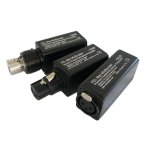
Here's a exact type of device I am taking about. Basically, it's just a extension of the mic. This might allow to turn down the recorder's gain without adding too much bulkiness to the system. I have seen someone recommended for one on B&H for a reasonable price but I can't find the link anymore.
mini-micbooster-standard.jpg


Yes, I agree with your point after listening to the below samples recorded by a Olympus LS10 only. Exploring how to get as close as possible to the bird and take the shot is more important than carrying some fancy & bulky world class equipment and have nothing back home.
http://www.wildlife-sound.org/equipment/newcomersguide/recordings.html


Lovely shots of the birds. It almost makes me wonder if most people actually shoot their best footage after learning basic composition and how to use a tripod, but before they learn about sliders and fancy editing ;-)


I don't know if there is a hard answer to this question. It depends on whether you're shooting for your grandparents or the BBC.


The ME66/K6 already is cheap. Your AT875R is the best bang per buck of any shotgun mic out there, and I am loathe to encourage you on any wild-goose chase for a magic mic. The differences are barely noticeable, especially at the distances you've been recording.

I'm going to sound like yet another one here who keeps answering a question that you're not asking, but I would really encourage you to at least try to get the microphone off the camera and closer to the subject, preferably on a pole, pointed at an angle down at the birds (or if they're really high, get the mic below the birds pointed upwards at them). I think you can do it, at least some of the time, because your shots are static. Focus on the birds, and step away with your boom pole and get as close as you can without scaring them away. The reasons I say this are:

1. Whether one mic amplifies more than another doesn't matter if there are other noises around you. Most shotguns have generally the same pick-up pattern. It's better to think of a directional mic as a mic that has taken the idea to ignore certain sounds as just a suggestion. (Obviously the mic consistently lowers the volume of side noises, but when you're watching the footage later, you might wonder if the mic has an Attenuation Deficit Disorder.) Shotgun mics actually do really well at lowering the volume of sounds directly to the left or right of them. They do more poorly at rejecting sound behind them. And they're no good at rejecting sound in front of them (like a car in the background behind the bird). If you somehow can get the mic more vertical, then you are using its pattern to your advantage. Its deaf sides are pointed at everything around the birds, but its nose is pointed at the birds, and the only thing beyond the birds from its perspective is the ground (if pointed downward) or the sky (if pointed upward --- watch out for that plane!). (Here, watch this [5:29]).

2. Sound obeys the Inverse Square Law. That means if you get twice as close to those birds, the sound will get four times as loud. Or if you double your distance from those other extraneous noises, their sound will drop to 1/4 of their original level. What I'm trying to say is, get that mic as close as you can to the birds, or as far as you can from the other things, or both.

It does make sense as a higher sensitivity mic will also amplify the environmental noise. I am not sure how much a more directional mic and better preamp would help for the final result.

I don't want to act like I am stubborn, but a boom is just not going to work under a real world situation. The birds were static because I kept certain distance from them or there's was pond/slope/cliff between us. About the shotgun mic placement angle, I think it's a valuable lecture but it's also hard to work out as I only have two hands and any movement of me is taking risk to scare the bird off.
My shot is not always static, it just depends on the bird................
https://youtu.be/1joxD8xaZuE?t=126
 
Last edited:
I have been filming birds for over 5 years now and have spent a lot of time working on capturing the best audio possible. Like you, I shoot with my mic attached to my camera, there is simply no other reasonable solution for a one man band.

I started out using a Canon 600D with a Rode VideoMic Pro, but now use a Sony F5 with a Sennheiser MKH8060 in a Rycote Windshield. I run the mic straight into the camera and it produces excellent results. It actually records things that I miss in real life, like soft bird calls and even wing movement noises.

My technique is pretty simple, and learnt from trial and error.

1. Record as loud as possible. I have my level at maximum and only ever turn it down if I'm close to a loud bird, which doesn't happen very often. Even recording at max level I normally have to increase it in post.

2. Try and film in places with no other noises and at the quietest times of day, often dawn is best. Shooting at maximum level picks up everything, which is great when all you can hear is birds and the wind in the trees, not so great otherwise.

3. Make sure your gear is silent otherwise it will be in your recordings. I learnt this the hard way. I have the raw recorder for my camera which produces the most beautiful moving images I have seen, but has a fan that never stops. So now I don't use it. I prefer to shoot lower quality video with pristine audio than the other way around.

4. Use the best wind protection possible. The biggest drawback of the Rode VideoMic Pro for me was not being able to effectively shield in wind, so it become almost unusable in even a gentle breeze.

5. Learn to edit your sound. This has been one of the most rewarding parts for me. Generally I run a high pass filter to cut out any rumble, increase the level and sometimes run a compressor to even the loud and soft calls out. This doesn't always work though. I also use the spectral view in Adobe Audition to remove individual sounds, this is an incredibly powerful tool. I also have the Izotope RX-5 plug in for noise reduction, it can do a great job in the right situation but I prefer not to use it.

This is a clip I shot when I was first starting out. It's using the Rode VideoMic Pro mounted directly onto a Canon 600D.

https://www.youtube.com/watch?v=JuqYjPr3Vu4

I hope this helps in some way.

Cheers,
Wes

1. I am not sure if I should do so as the preamp noise is very high at that point. I have very limited experience for post production with Power Director 14. The noise reduction function for audio is just a joke........

2. Yes, it certainly does help to shoot early.

3. As you said, I need some more test and trial to figure out the optimal settings for my gear. The preamp of the H5 might not be great, but that's what I willing to carrying around with all camera stuff and tripod for all day long. Would you mind to share the gear you are using right now?

4. The result from the Chinese made dead cat is not great but bearable, it cost me around $8 bucks.

5. That's the tricky part, too much software options to start out. All I need is a cheap one with stellar noise reduction performance.

I am happy to have your 7th post on the forum. It surely does help.

AN


Sound design is done carefully for documentaries. Sounds are mostly recorded separately and inserted later. At times, similar sounds are recreated and inserted in relevant places. Search how the NGC/BBC/Animal Planet documentaries design the sound and you will know.

Having said that I always have a Sennheiser MKH 416 on my camera for some sounds which can't be recreated. Even with an assistant at times we miss the sound. Despite having a parabolic microphone I can't use it often. Once a leopard was calling and the MKH 416 simply couldn't record the sound, as it can't beat the laws of physics. My parabolic was not on at that time. So we do miss sounds.

At times, the places where I shoot is so noisy that natural sounds can't be recorded without the ambient traffic noise. So you have to plan and move your microphone close to the subject. If your microphone is close to the sound source and you can record at the right levels, then the background noise will appear muted. At times you simply can't move close. For eg. while shooting flamingos, we tried moving close and placing a hydrophone where they were feeding. However, after a few steps in the creek, my partner sank upto her waist and with great difficulty I could extricate her. Those adventures were for making this doc: https://youtu.be/qHLXDXF3KgU

There are some aerial shots in the above documentary. Do you think I recorded those sounds while shooting aerial? Those were added in post.

It takes hours of planning to get not only the shot but also sounds. I love listening to the forest sounds, and have spent many nights alone in forests.

The preamps in the cameras are not great. Many cameras record sound in 16bits. It is only recently that cameras are giving us 24bit sound. However, they don't spend enough money to give us good preamps in our cameras. Recording to a good external recorder at 96KHz will give you enough leeway to push and pull your sounds.

PS: Your example video was from a bird feeder. Those are controlled conditions and you can certainly place a microphone close by.

Yes, I understand about sound design/foley which the pros are doing. But for my purpose, like the below video. I am usually intended to shoot a specific bird instead of crowds of birds. I must record the sound at the same time. Otherwise, the audio just won't match the movement of the bird beak and looks weird/unreal.
It's a pity that I didn't have a directional mic in hand when shooting this video, internal mic only.
https://www.youtube.com/watch?v=1glYS3BnsUE

The G85 only records for AAC compressed audio, that's why I put a H5 on top of it just in case I need those better files from the recorder.

Actually, that's not a bird feeder but a Chinese style bird cage. Some axxhole captured the same specie and put it in the cage. He decided to hang the cage on the tree in order to piss off the wild bird to have some fun.
Very nice work from you and glad to know there are so many species in common between India & Hong Kong.
 
Last edited:
Sound design is done carefully for documentaries. Sounds are mostly recorded separately and inserted later. At times, similar sounds are recreated and inserted in relevant places. Search how the NGC/BBC/Animal Planet documentaries design the sound and you will know.

While I agree with this method it should be pointed out that there is a major split in the "documentary world" about what is "proper" in terms of sounds.

One camp is pretty much as you describe. As long as the sounds valid for the time place etc. you can add as much as you want. There is however another big camp of only sounds recorded at the time you shoot being acceptable. There is also a small contingent of anything goes but those folks are mostly in the reality TV end of things.

I'm firmly in the camp of as long as what you add is not a lie or misleading it's OK. So I'm OK with sounds that my not be accurate to the time and place as long as they don't steer the viewer in a wrong direction. So for instance if the farm you shoot at happens to be in earshot of the highway and your show is not about farms and traffic I have no problem using BG's that don't have traffic in them. A friend was doing a radio show on a sheep ranch and every time she tried to record the sheep they would shut up. In the end she used other recordings of sheep. In that case she was actually creating a more accurate picture since the sheep were bleating all the time, till she pulled out the recorder. But she also got trashed by a bunch of people for "faking" the sound. Completely ridiculous in my mind.

So if you are going to do a documentry you should figure out which camp you are in, or maybe your sponsor is in, and act accordingly.
 
Last edited:
I use a Sennheiser MKH8060 shotgun mic plugged directly into a Sony F5 camera. It's not a cheap mic but it is brilliant. I think that recording in a noisy environment makes it very difficult, and no combination of gear can prevent that. Short of using other audio as others discussed or shooting in quieter locations, I'm not sure what else to suggest. It's tough I know! I spend a lot of time driving to get to quiet locations to film birds. I'm fortunate to live in Australia where there is a lot of space, I'm sure it is much, much harder in Hong Kong.
 
Back
Top