DIY 4' Florescent 4 bank Project. Do I need Kino Flo 5500K Bulbs?

Erik Naso

Veteran
Today I picked up a couple four foot T8 4 bank lights from Lowes. These are not going to be in my van. I'm going to leave them in a studio for lighting a green screen and seamless backgrounds so durability inst an issue.

I've struggled in the past getting even lighting and have wanted the Kino Flo 4-banks for a long time just didn't want to spend that kind of money for lighting a screen. I've watched a few videos on making DIY 4' banks and they look promising and easy. The only issue i have is with the bulbs that you get from the hardware store. They are 5000K and probably not very color accurate. Most don't have CRI ratings either. I ended up with GE 5000K. I could shop around and see what else is I can find or drop $14 each on Kino Flo 5500K tubes.

What do you think? Know of other options like LED T8 tubes that are 5600K?
 
There are plenty of LED replacements for those tubes, but the CRI is going to be poor. You can get reptile "full spectrum" tubes that big, but they will cost you.
 
There are plenty of LED replacements for those tubes, but the CRI is going to be poor. You can get reptile "full spectrum" tubes that big, but they will cost you.

Yeah I figured the LED models aren't ready for prime time yet. I think the Kino's are my best bet so far.
 
The more I hear about those the more suspicious I get.

Considering a four-foot, 30-watt Quasar tube, they're similar in performance to two one-metre strips of Yuji's high-CRI LED tape stuck side by side. The LED tape is almost a third more powerful, smaller, lighter, easier to drive and practically half the price.

Having not tried this, I may be overlooking something, but on paper...

P
 
Phil, are you taking into account the diffusion built into the tubes which LED tape doesn't have (which will certainly eliminate that 1/3 more powerful spec)? That the tubes are plug and play into existing fixtures, where the tape has to be mounted to something that mounts to something else if you want to put it into a work environment? LED tape is a raw material, the Quasars are finished fixtures. Of course the tape is going to be smaller and lighter. It's not apples to apples.
 
I think you might be be misunderstanding the idea of them being more powerful. Two 4-foot runs of Yuji's strip works out to roughly 43W, so assuming you used similar diffusion, it'd be brighter. That's not really the point, though.

You have to ask: why are we talking about buying devices designed to approximate fluorescent form factor with LED technology for a homebrew project? There's nothing intrinsically good or useful about a four foot long, inch-and-a-quarter tube. It just makes them bulky, expensive, and less effective. Even if you had an old Kino-Flo you wanted to convert to LED, I'd query it. What is a Kino-Flo, once you overlook the tubes and the ballasts? It's a fold of almost-cardboard with a clamp on the back.

What this is really about is fashionability. The Los Angeles movie production scene has decided that these Quasar tubes are acceptable. This is a largely arbitrary decision. Yes, there are jobs on which one could not turn up with anything homebrew, and it is worth spending $280 per four-foot, four-bank unit so you can have something with the appropriate branding on it.

Now, if you wanted an actual, technical objection, it would be that the LED strip might consume a given wattage, but it's resistively-ballasted and possibly a bit less efficient, photoelectrically speaking, than the Quasar tubes. Someone would need to perform some basic tests to find that out.

Hail Kinda-Flo!

post-29-0-99126900-1373466116.png
 
Last edited:
Also, is the intended use for the product to light the green screen itself, or the talent in front of the green screen? If it's the screen, then you can buy LED Strips which put out a very rich green color and use those to light the backing as evenly as possible. If it's the talent, then the CRI would be critical, as would be durability and mobility, since lighting schemes on the talent change depending on the needs of the shot.
 
I overlooked the part about backgrounds, in that case, does cri even matter? As mentioned, green LED's are powerful and probably cheap. You could use a neutral color backdrop and light with green or blue LED to produce a chroma-key background.

If using regular hardware store tubes, I'd probably buy a bunch of warm, cool, and daylight to have on hand. Mix and match as needed to get the color the way you want. Mixing might raise the cri too.
 
Also, is the intended use for the product to light the green screen itself, or the talent in front of the green screen? If it's the screen, then you can buy LED Strips which put out a very rich green color and use those to light the backing as evenly as possible. If it's the talent, then the CRI would be critical, as would be durability and mobility, since lighting schemes on the talent change depending on the needs of the shot.

My main goal was an inexpensive (cheap) way of lighting a background. White Seamless and green screens mainly. I really don't have anything broad enough and the idea of soldering a bunch or LED strips together didn't appeal to me. I also use Kino Flo Divas a lot. We have 4 of them and ParaBeams as well. Makes sense to stay in the same color temperature of 5500K.

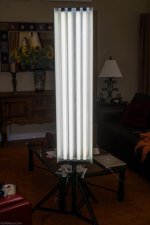
I just put one together this morning.

4 foot DIY Bank.jpg

Simple long broad light but the GE bulbs I bought have way to much green. I white balanced and got 5100K with +2 Magenta. I had my lovely bride stand in front of the fixture and I could see the green. These bulbs are going back. I'm going to go to another store and get Phillips 5000K model as recommended. I have 8 T8 Kino Flo's on order but they won't be here for a week so since the Philips are pretty cheap i'll get 4 to play with and let people know how they compare to the Kino Flo's. Might help make this decision easier for others and i'm curious too!

As for lighting talent? Yeah if the source is clean i'll use it but I don't intend on traveling with the lights. They will be in my home for when I want to shoot stuff I review or in the studio at the station. I'm testing the idea for myself as a proof of concept then show the station what I got.

4 foot DIY Bank_light stand mount.jpg

4 foot DIY Bank_light stand mount wide.jpg

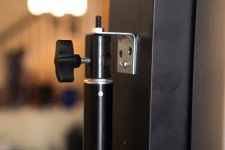
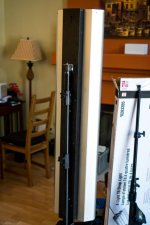
My next step is adding a Avenger F800 3-Inch Baby Wall Plate to the center of the fixture. I have a light stand receiver on it now that holds fine but can't rotate the light and it's kind of close to the stand. With the plate attached I can use a grip head to attach to the light stand. I think it will be much better.
 
Last edited:
I'm hearing more and more good things about Quasar Science. Their crossfade lamps have my attention, but they also do direct T8 replacements.

Love the idea but I just can't justify the $75 per lamp cost for this project. For two four 4' lamp fixtures it would cost $600 or $300 each plus the price of the fixtures and added hardware. I need two fixtures.
I'm at approximately $70 per fixture with hardware i'm adding plus the Kino Flo T8 lamps at $17.00 each which includes shipping comes to another $136 for a total of $276 for two finished fixtures. That is cheap and the light quality will be on par with the Kino Flo 4 Bank only not as rugged and probably less output since I don't have the reflector like they use or the larger lamps it has. I'm considering adding in some of that mirrored duct tape to get more output.
 
I helped someone make one of these in the past and it worked beautifully for a fraction of the cost of a true Kino (though it was very heavy.
We used standard Kinoflo bulbs but I noticed that the output was only half what i expected. We went to a local lighting shop and the owner who was knowledgeable explained that the kino bulbs needed a more powerful ballast or some part of the ballast ( I don't recall) as the voltage draw on the bulbs was greater. It was an easy and inexpensive switch to make in the ballasts and they worked great after that. We made a pair of 8 bulb units.
Actually I only told them very generally what to do ( get some hardware fixtures) and they did the actual work.
 
Last edited:
Erik, can't remember if they make a T8, but with a T12 and Biax tube I use the Kino Flo 525nm green for lighting my green screen. You have to flag the lights to keep the talent clean, but since my big screen is stationary I just keep everything in place.
 
I cant remember the exact nameing strategy but osram tubes give a CRI

Something like
5580 = 55watt 80CRI
5595 = 55watt 95 CRI

The 95s are what I used until I swapped to kino tubes in my Photn Beard Highlight.

They are kind of OK.. seems like they might have a title 'studioline'

S
 
I may have to look into this for our studio... The lighting on the green screen is always less than ideal and maybe some towers made of florescent tubes would be a better choice.

Anyone now of a DMX controlled switch to turn them on and off as desired? Or a ballast that won't turn on until the input voltage climbs above like 50 volts AC so I could put them on a dimmer and have them pop to life.
 
Picked up four Philips Alto II T8 32 Watt 5000K CRI 82. Still has some green. White Balance was 5100K with +1 Magenta. Improved over the +2 from the GE lamps. I also added some 2" shiny reflective duct tape to get more punch. It defiantly works but the tape was expensive at $25. Not sure if it's worth it but have enough for at least two 4 foot fixtures.
 
I think the Philips TL-D 90 range does considerably better than that, and they're far from expensive.

There are various DMX-controlled relays which could be used to switch mains power - ebay search will find them. Another way to do it would be to get dimming ballasts, which are often controlled via 0-10V analogue signals, and a DMX to 0-10V converter. This will give you dimming control, but bear in mind the colour will wander when they're dimmed. If you really need good dimming, that's a reason to go LED.

For green screen there are essentially two types of tube available: the 525nm types supplied by Kino-Flo, and, er, the others. I can't remember. Either will work better than white on most screens, but the 525 is closer to what many people call "digital green." This is only worthwhile if you aren't building from scratch, as you would certainly want to use green LEDs if you were. Bear in mind, though, that the green LEDs are narrower in spectrum and will need to be matched more closely to the backdrop for good results. There are two types of green LED, the yellow-green types of old and the really deep emerald green. Either will illuminate a green screen more efficiently than white light, but the emerald one will improve separation on most subjects assuming your keying software can handle it. Test carefully as coloured LEDs can clip cameras in complex ways.

P
 
Last edited:
I think the Philips TL-D 90 range does considerably better than that, and they're far from expensive.

There are various DMX-controlled relays which could be used to switch mains power - ebay search will find them. Another way to do it would be to get dimming ballasts, which are often controlled via 0-10V analogue signals, and a DMX to 0-10V converter. This will give you dimming control, but bear in mind the colour will wander when they're dimmed. If you really need good dimming, that's a reason to go LED.

For green screen there are essentially two types of tube available: the 525nm types supplied by Kino-Flo, and, er, the others. I can't remember. Either will work better than white on most screens, but the 525 is closer to what many people call "digital green." This is only worthwhile if you aren't building from scratch, as you would certainly want to use green LEDs if you were. Bear in mind, though, that the green LEDs are narrower in spectrum and will need to be matched more closely to the backdrop for good results. There are two types of green LED, the yellow-green types of old and the really deep emerald green. Either will illuminate a green screen more efficiently than white light, but the emerald one will improve separation on most subjects assuming your keying software can handle it. Test carefully as coloured LEDs can clip cameras in complex ways.

P

These Philips MASTER TL-D 90 Graphica 36W/950 SLV/10 seem to be only available in Europe. They look great.
 
Back
Top