Depth of field tips?

Snapper123

Well-known member
Hey guys, I'm really looking for tips on how to get a depth of field where the focus plane is quite wide without degrading the quality of that plane or changing the framing of your shot. With my 50mm lens, which is my favorite lens to use, the biggest problem I have is not exactly that the depth of field is extreme and very thick looking at low apertures, but that the sharp focus plane is paper thin in any scenarios like interview shots. I've come across many situations where I want a close-up shot of the subject, yet while I don't mind the thick texture of the blur, it's more that I wish for the sharpness plane to be deeper than a couple centimeters. The focus plane really doesn't seem to widen until you close the aperture down to the double digits range, which is impossible to use indoors. And if you back up a bit with the same lens, the focus plane gets a bit wider, but it all washes out in quality and then you're also left with not having the framing that you desire.

So what would help me in the 1.8-3.5 aperture ranges? Having a wider angle lens and getting closer to the subject? Using a zoom range lens at a focal length like 75mm or 100mm and standing farther away from the subject? The main point is that I wish there were some extra number that extended the depth of the focus plane without weakening the surrounding blur or having to use closed apertures - like image you're shooting at 1.8 and you had some sort of wedge that pushed the two thick slabs of bokeh farther apart, but otherwise left the aperture and bokeh strength alone. Are there any ways to do this even if not fully? And just another point to keep in mind is that I'm really talking about doing this in the 1.8-3.5 range, it's not that I care anything for extreme bokeh or blur, it's just that as it is, I use prime lens apertures more than anything else I can think of.
 
No free lunch here, you need to stop down. That's pretty much how Hollywood does it. They bring in way more light if they want the background to be less out of focus so they can stop down. Using a wider lense and stepping closer can work, but the perspective will change.
 
. Using a wider lense and stepping closer can work, but the perspective will change.

That won't work either. Camera to subject distance is a factor along with focal length. They don't offset perfectly but they offset none-the-less.

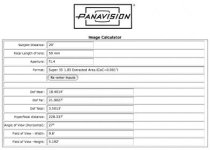
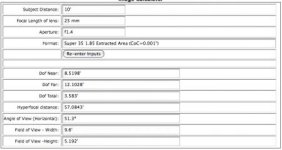
Example:

Picture 6.jpg
Picture 7.jpg

The first example is a 50mm lens 20 feet away from the subject. I changed the lens to a 25mm and moved 10 feet away from the subject. The subject will be the exact same size in the composition (however background perspective will be different)... notice the DoF is about 3.5' on both setups. They almost exactly cancel out. Ying and Yang.


You need to either

1) Stop down
2) create a shot list that includes many wide shots. Keep the subject to camera distance far away. Good bye close-ups.
3) If you can play off a split field diopter, you might get some specific shots with seemingly deeper DoF. Won't work for most shots however.
4) Pick a camera with a smaller sensor size. Thus you can get lenses with similar FoV, but more DoF.
 
Last edited:
"4) Pick a camera with a smaller sensor size. Thus you can get lenses with similar FoV, but less DoF."

Ummm.

I think you mean MORE DoF.
 
most productions seem to use an aperture range of F4 to F8 for most things. That gives a good balance between focus and background separation. They also tend to use a LOT more light than you think would be normal.

Personally I'm not a big fan of the wide-open/super shallow DOF look that people seem to favor. Just cause you can do it doesn't mean you should..

So the tricks that I've learned is that if you want the background to seem further away, use a wider lens. If you want it to seem closer, use a longer lens. You can size your talent in the frame exactly the same way but things just feel different, just like Huy and Ryan mentioned a couple replies up.

Also, it seems that a lot of pro-productions use middle lenses, somewhere between 20mm and 80mm for a lot of things. It also gives a balance between background separation and intimacy with the talent.

Don't go crazy wide either, you'll start to distort the features of people's faces, unless you want to accentuate something or make a person feel *off* somehow.
 
Ryan Patrick O'Hara;2174675 The first example is a 50mm lens 20 feet away from the subject. I changed the lens to a 25mm and moved 10 feet away from the subject. The subject will be the exact same size in the composition (however background perspective will be different)... notice the DoF is about 3.5' on[I said:
both[/I] setups. They almost exactly cancel out. Ying and Yang.

It's true that actual DOF remains unchange, however the apparent degree of blurriness in the background will be different because a wider lens will not compress the background as much, tricking the eyes into thinking that it's less out of focus, which would achieve the intended effect. It's the same trick that you can use on prosumer cameras to fake DOF, except in reverse.
 
It's true that actual DOF remains unchange, however the apparent degree of blurriness in the background will be different because a wider lens will not compress the background as much, tricking the eyes into thinking that it's less out of focus, which would achieve the intended effect. It's the same trick that you can use on prosumer cameras to fake DOF, except in reverse.

Yes, that is true with regards to the background... Barry's HVX example with the windchime (or whatever that was) is a classic example... but if you are using shallow DoF to separate things in the subject area such as two people or elements like that, it won't be as apparent.
 
Back
Top