Dara Mark's Inside Story - I'm looking for some help!

tehwriter

Member
Hello folks,

I'm new here. So, "Hello all!". I’m looking for some advice from the people who have read Dara Mark’s book, Inside Story: The power of the transformational arc. Despite having re-read it several times I’m still confused by the ‘External thematic goal’.

I understand the internal thematic goal as being the end goal within the character once they have conquered their fatal flaw. But the external thematic goal is something that I don’t quite know how to articulate. I write love stories and obviously in the book there was the example of Romancing the Stone, which had “Trust the adventure” as the external thematic goal, but to me that is also something internal that needs to be realised. It is the same with the Lethal Weapon example, which was “Value life”.

Can someone help clear up the distinction between the two and how I should be thinking when forming these two top tiers of the tree diagram she uses?

Many thanks, any help is much appreciated!

tehwriter
 
Last edited:
Excellent question.

Looking on pages 89-91 of the book, I see the internal thematic goal as (as you said and are aware) the internal character transformational arc (a subplot) necessary as in all good stories if the protagonist is to achieve the visible external goal we see at the climax and resolution, achieved or resolved in some way. The external thematic goal if I interpret it correctly is the theme of the story ('love is an adventure' in the case of Romancing the Stone) as seen visibly through the A Story plot (seen through the character's actions as they relate to the A story). As Dara talks about in her book, the protagonist's flaw that will relate to her transformational arc is generally (in the case of well crafted stories) the inverse of the external theme; so for example if a character is flawed in the sense of having a phobia of travel, is meek, lacks courage to go for adventure-- then that character's arc will be to develop and learn the lesson that courage leads to adventure. Only by going through that arc and defeating her flaw will that char be able to achieve the external goal, and thus the external theme.

My five cents. I might owe you a refund. Others can chime in.
 
Last edited:
Randall is right. The external thematic goal is the main "driver" and theme of the story. The internal arc is a reflection of the external. In some stories you can even go so far and have a protagonist loose in the external (A) story thou he succeeds in the internal (B) story.

It´s all about values are internalized and externalized. Sometimes they go hand in hand, sometimes they go vice versa, but the story still works. Check site 94 again.

Frank
 
Excellent question.

Looking on pages 89-91 of the book, I see the internal thematic goal as (as you said and are aware) the internal character transformational arc (a subplot) necessary as in all good stories if the protagonist is to achieve the visible external goal we see at the climax and resolution, achieved or resolved in some way. The external thematic goal if I interpret it correctly is the theme of the story ('love is an adventure' in the case of Romancing the Stone) as seen visibly through the A Story plot (seen through the character's actions as they relate to the A story). As Dara talks about in her book, the protagonist's flaw that will relate to her transformational arc is generally (in the case of well crafted stories) the inverse of the external theme; so for example if a character is flawed in the sense of having a phobia of travel, is meek, lacks courage to go for adventure-- then that character's arc will be to develop and learn the lesson that courage leads to adventure. Only by going through that arc and defeating her flaw will that char be able to achieve the external goal, and thus the external theme.

My five cents. I might owe you a refund. Others can chime in.


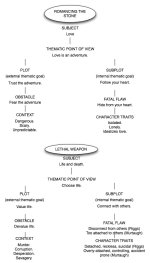
Thanks for the reply. You state that the external goal is the theme such as "Love is an adventure", but from what I am understanding, the external thematic goal is something deeper. I have created an image of two of the tree diagrams from the book. They show Romancing the Stone and Lethal Weapon with their internal and external thematic goals and everything else associated with them. Perhaps this would indicate to you what it is that I am failing to grasp. As you can see, the Internal and External Thematic Goals are something that relates to the overall 'Thematic Point of View', however, in my eyes they can both be viewed as internal changes. For example, why can't "Trust the adventure" and "Value life" be Internal Thematic Goals as they too would be something you could change internally?

I have attached said image. Thanks.
 

Attachments

  • dvx.jpg
    dvx.jpg
    80.3 KB · Views: 0
Last edited:
is it the same as Lajos Egri's "Premise" in The Art of Dramatic Writing?

Also, is this book any good? Inside Story: The power of the transformational arc
 
...You state that the external goal is the theme...?...

That is not exactly what I said, just to be clear. The external goal and the theme are different story elements, but related. I was referring in my post to the external thematic goal, not the external goal.

One way I try to sort it all out, and I am still learning myself so keep that in mind (see what others have to say on the matter, I am not a guru here by any means), is that 'inner' (theme, arc, B-story, etc) relates to emotion (meekness, courage, fear, etc) whereas 'outer' (theme, goal, etc) refers to the main A-Story and visible goal to be resolved (won or lost) by the end of the story.

We can't see inner emotions, so both the outer and inner stories (A and B respectively, or A and C depending on how you label (B or C) the inner arc subplot and the romance subplot) must be shown visibly, since this is cinema, visual storytelling. So you have to find a way to show the emotional arc (inner journey, emotional / inner theme, such as risk love in order to have a fulfilled life [now I suspect many divorce attorneys would disagree with that). Just as you have to show the outer/visible goal and its associated [external] theme as it relates to the A-story (find the jewel of the Nile or whatever, impeded by obstacles and thus conflict and thus drama). And typically both journeys (A story, B story emotional / transformational arc of the protagonist) along with a third (C story of romance) are all linked together-- success or failure, all dependent. You won't win love unless you transform, lose your flaw, learn the lesson (and return to the village with the 'magic elixir').

Don't over analyze it too much. Outline a story with a protagonist desperately wanting to achieve a goal that we will see visibly resolved by the end of the story, with dire consequences if s/he fails. And link a theme, a universal lesson in life to that (courage leads to happiness, or whatever), then give your protagonist a flaw that is the opposite of that theme (e.g. fear). Then throw in a romantic or some sort of relationship subplot (could be steamy romance, or a friendship that develops between a human and a robot, whatever) that starts around 25%.

I have also heard it said that protagonists do not always go through an inner transformation (inner theme?), not if they are true [dare i say 'action'] Hero's, like Batman. They are emotionally strong to begin with, which makes them a heroic crime fighter. Although I think some sort of inner arc can give them greater depth and make for a more compelling story.

Here is another take on theme-- by one of our very own dvxuser members, and and editor of Script Magazine. Maybe it will help a bit.
http://www.scriptsecrets.net/articles/theme2.htm


Now get busy writing :)
 
Last edited:
Thanks again for such a detailed reply. I think an issue I am having is I have started with theme before I have come up with any defined protagonist goal/thing they want to achieve. By your take on the method, which I am now seeing makes sense, I should have a thing for my protagonist to do, and then I should put the theme work on top of it.

I felt I was supposed to start with theme, and then through working out what leads from there the A-plot would be created for me because I knew what obstacles would emerge etc.

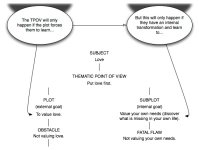
I have attached another image of what I had come up with, and as you can see I defined the external thematic goal both as a consequence of the internal thematic goal and of what I felt needed to happen for the Thematic Point of View to become true. This then caused a lot of confusion for me because I didn't know how to take the external thematic goal I came up with and tangibly put that into a story line for A plot. Instead I got this part backwards, and it should be external thematic goal is based on what the protagonist is trying to achieve, which is what you have come up with before all this theme work is done. Correct?
 

Attachments

  • dvx2.jpg
    dvx2.jpg
    55.4 KB · Views: 0
I actually like to think of Theme before the plot. Theme is what motivates me to write a story, gives it importance. You can start with theme and then mold a story around that, might even be the best way to go. Unless an A-story plot comes to mind first. You can go either way I think, just depends what your brain creates and gets excited about to begin with.

"Love is timeless, lasts forever." might be a theme that excited the writer of The Notebook and then the story was created from that. I don't know

"A farmer boy on a distant planet becomes a hero, a futuristic Knight, who destroys a Death Star to save a planet and win the love of a princess." might have been George Lucas's story idea he started with for Star Wars, to then come up with a theme of 'Feel the force, trust in the unseen'. I don't know.

See, it can work either way during the development process, depending on what moves you to start the ball rolling.

Good luck!
 
Yes I guess you can do it either way. I had trouble with the above because when I did theme first and came up with the external thematic goal of 'Value love' I just didn't know where to go from there for a plot line that was compelling or interesting.

Not to mention the fact that I'm still very lost with what kind of protagonist or co-protagonist set up I am supposed to choose for a love story. In love stories you normally have two equally well developed characters who are opposites to each other in which case I would need to have them as co-protagonist set up, which in turn means they both have to strive for the same plot goal. In Romancing the Stone they had it that she had the most character development and the final goal of getting her sister back and the lover was just a catalyst for her development.

The issue being that if both the guy and the girl are to carry the same internal struggle because everything is derived from the overall theme, then how can I make them opposites which is needed for a love story.

Lots of tricky things in this writing business! :shocked:
 
I think your theme goal is left dangling, needs expansion.
"Value love" -> "Value love in order to ___________"
Value love in order to be happy.
or
Value love in order to find love.
or
???

Yes I guess you can do it either way. I had trouble with the above because when I did theme first and came up with the external thematic goal of 'Value love' I just didn't know where to go from there for a plot line that was compelling or interesting.
...
 
I think your theme goal is left dangling, needs expansion.
"Value love" -> "Value love in order to ___________"
Value love in order to be happy.
or
Value love in order to find love.
or
???

Well that is where I thought I had to tie that in with the thematic point of view which I had chosen as "Put love first". So "value love in order to put love first", which makes sense because you can't put love first in your life unless you come to value it. However if I chose something else for the "in order to ____" part, then how do I make sure I am expressing the thematic point of view of "Putting love first" throughout?

I'm sorry for prolonging this question, but I really appreciate the help you've given and things are starting to click into place.


The "...in order to _____" is so that the "____" becomes something we can see visually in film. I can't see "value love" (well I guess that can be argued, but I am saying you can't see 'valuing' as much as e.g. 'winning' [kiss/prize/etc]) but I can see "win the love of another" (through a kiss, marriage ceremony, etc).

So, "Value love in order to win the love of another" shows an inner emotional arc a.k.a. transformational arc of not valuing love (perhaps jaded about romance) to valuing love which we SEE accomplished through winning the love of a romantic interest via a kiss, or wedding ceremony, or whatever.

I tend to think of themes (universal statements about our human condition) in that way.
Treachery leads to a downfall (I can show a downfall visually-- death by the sword, or prison, or arrest, etc)
Courage leads to happiness (I can show happiness, and courage for that matter-- the prince slays the dragon and wins the princess).
Love of money leads to an unhappy life. (I can show both, especially the ___).


Good luck!
 
Last edited:
Referring to what motivates a writer to write a story, I think it's something that comes naturally to the writer. For example, you're watching the news and there's a story about corrupt police, this ticks you off and so you come up with a story with the theme being "Deceitful governments will always get away with it". (sorry about the bad example) But then you might be at work and a customer comes in who interests you and you come up with a story around them. Or, you might have a friend who suddenly becomes famous and you come up with a story about somebody who wants to be famous? These are the three things that help ME come up with a story. External goal; Character; or Theme (the point i'm wanting to make). And from one of those, the rest come easily.

You want to write a love story. There's your external goal already, for the two to be together. Whether they are both your main characters (although I believe there is always that ONE person who is really the protagonist. Usually the one that undergoes a transformation, or at least we want them to undergo one), or whether only one is, their external goal should be to have that other person? OR, maybe your protagonist's goal is to NOT have that other person, but the audience know deep down that he is better off with her. or she with him. But that would be the main external goal, I'd say, in a romance.

External Goal: so let's say, for EXAMPLE, that your protagonist wants some girl. make him somebody whose character flaw opposes getting her. So he might be picky, he might be arrogant, he might be a player? he might be afraid of commitment, he might be too shy to tell her, he might be self conscious, better yet, he might be desperate for a companion and therefore ruining his chances by being pushy? there are many things, but they have to oppose the external goal, getting her.

Continuing on from the example that he simply wants her, THEME could then depend on what flaw you chose. So if you chose him being arrogant, your theme would be, "Arrogance leads to loneliness" (if he doesn't get her in the end) OR, if he does, "Humbleness leads to love" (humbleness being the opposite of arrogance... i think??)

Theme: OR, you could go by Theme... which, in my opinion - and Lajos Egri's - basically gives you the context of the whole story, which you will then need to fill in with content. So, for example, you chose the theme "Blind determination leads to self-destruction". Bam, you have a character who is blindly determined to reach a goal that he ends up not reaching in the end.

Character: OR, (my favourite) coming up with a story centered around a character you've thought up. Let's say he is a really shy person. Put him in a situation where he is forced to step out of his boundaries... Say he really needs to find a job before he gets kicked out, divorced, whatever. The only job he can find is being a magician where he has to get up in front of many people and perform in an exaggerated fashion. Very bad example but I hope you can see what I'm trying to highlight...

So basically what I'm saying is, don't limit yourself to just one way of creating a story. Open your mind and be ready to welcome it all in.
 
Thanks to you both for such detailed responses. I will mull over your comments and see what I can come up with. I hope others will also chime in on my original question so I can get other views/takes on it!
 
The external thematic goal if I interpret it correctly is the theme of the story ('love is an adventure' in the case of Romancing the Stone) as seen visibly through the A Story plot (seen through the character's actions as they relate to the A story). As Dara talks about in her book, the protagonist's flaw that will relate to her transformational arc is generally (in the case of well crafted stories) the inverse of the external theme; so for example if a character is flawed in the sense of having a phobia of travel, is meek, lacks courage to go for adventure-- then that character's arc will be to develop and learn the lesson that courage leads to adventure. Only by going through that arc and defeating her flaw will that char be able to achieve the external goal, and thus the external theme.

This is my interpretation as well. I believe the term External Thematic Goal refers to the THEME of the story. That's it, nothing more... nothing less. Every guru has their own terminology.

Just remember what guru spells backwards.
 
This is my interpretation as well. I believe the term External Thematic Goal refers to the THEME of the story. That's it, nothing more... nothing less. Every guru has their own terminology.

Just remember what guru spells backwards.

I think I have been misunderstanding when you both are saying the External Thematic Goal is the THEME. I have been taking that to mean that the External Thematic Goal is the Thematic Point of View. Maybe this is where I am getting confused? Are you saying the Thematic Point of View and the Theme are two different things?
 
They are the same to me. I don't use the term Thematic Point of View. I'm just a simpleton, too many words confuse me.

I think we're getting into semantics here.

THEME is my savior.
 
Last edited:
They are the same to me. I don't use the term Thematic Point of View. I'm just a simpleton, too many words confuse me.

I think we're getting into semantics here.

THEME is my savior.

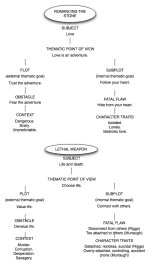
Oh right. It's a shame nobody seems to follow Dara's method more precisely, as I think this is where the confusion appears. If you look at the image attached to this post you can see that if I was to replace the External Thematic Goal with the "Theme" as you put it, then the rest of the tree would not flow on from that as easily i.e. 'Love is an adventure' is the Theme, and if you put that as the External Thematic Goal you wouldn't know what to put for the Obstacles and the therefore the Context.

This is where my dilemma comes to the fore.

I have the Thematic Point of View as "Put love first", and the subplot Internal Thematic Goal as "Value your own needs", and the plot External Thematic Goal as "Value love". As you can see, my plot external thematic goal is very different to the thematic point of view (as in Dara's examples), but I ended up choosing these two goals by sort of plucking them out of the air. I just don't understand the process for deciphering the external and internal thematic goal from within the theme. If you understand me?

People say "The external thematic goal is your theme manifested through the A-plot/external story line", but I don't know how to do that. How do I think about it in those terms?

Unfortunately Dara has not replied to my e-mails asking for some clarification, but she is very likely busy.
 

Attachments

  • dvx.jpg
    dvx.jpg
    80.3 KB · Views: 0
Back
Top