CRI 85, 91... and an x10 times price difference.

I was just looking at the specs. No mention of battery operation, power (wattage) consumption, a real beam shot off a flat surface ( this i can imagine as being spotty with 50% gradual fall-off at the far edges, as per specs).
I guess it's that 91+ CRI which makes them almost 3 grands..
 
What was wrong with it?
for starters, the mock interview with a unplugged vocal mic. and their choices of light temps for the situations they were in looked pretty wrong...
the whole thing looks as if were directed by a marketing person who had little to no actual industry experience.
 
Last edited:
for this price, this light better rock balls! and id be willing to bet that from a performance standpoint it ist much if any more effective than a $1000 diva 400
 
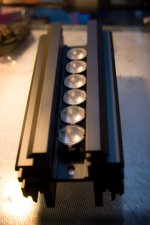
I just don't see why they are still making panel type led boxes with many small leds in them. I mean, the technology has available leds that one single led about the size of a small pea can output 850 lumens when driven at 3 amps with only 3.2 volts to drive it. To prove my point, and I am not attempting to sell or advertise the finished product, as I am just fiddling around at this time with a 7 inch wide aluminum solid one-piece frame with 6 lighting power class leds the highest efficiency to obtain with the help of TIR lenses ( total internal reflection) a measured lux figure at the proverbial 3 feet distance of well over 6000 lux. The native beam spread WITHOUT the optics is a huge 110 degrees BUT by narrowing down the beam to 60 degrees via the optics will result in the 6K lux figure even by UNDERDRIVING the leds at 2 amperes, way below their rated ceiling max. That means that this baby will consume 7 watts per led or 42 watts total to the leds at full throttle. Add another 6 watts for driver electronics efficiency factor of .85 or 85% and you now have a light that consumes UNDER 50 watts and outputting well over 6K luxes and as a bonus can be driven from 7.2 to 18 volts DC and weigh LESS than 40 ounces without the batteries, I am planing to have 2 battery sleds in the back of it for powering it from 2 Sony L 900 series camcorder batteries. Now why can't they make them like that, and for under $600.??
 

Attachments

  • C 0177.jpg
    C 0177.jpg
    73.2 KB · Views: 0
for starters, the mock interview with a unplugged vocal mic. and their choices of light temps for the situations they were in looked pretty wrong...
the whole thing looks as if were directed by a marketing person who had little to no actual industry experience.

You're more thorough than me...I never made it past the first video.
 
Add another 6 watts for driver electronics efficiency factor of .85 or 85% and you now have a light that consumes UNDER 50 watts and outputting well over 6K luxes and as a bonus can be driven from 7.2 to 18 volts DC and weigh LESS than 40 ounces without the batteries, I am planing to have 2 battery sleds in the back of it for powering it from 2 Sony L 900 series camcorder batteries. Now why can't they make them like that, and for under $600.??

It's a conspiracy I tell you...

There's only 2 issues that occur to me at the moment... there may be more... but these two jump at me right now...

1) Spectral quality.
2) 'flatness' of output over time.

Now if a LED 'bulb' could have a screw mount, so that one could just exchange when the useful life had been run...

The other issue is the fixture. To me, one of the 'significant' differences, seems to be how well made the fixture is, and the 'cheaper' suppliers are really 'crappy'...

As a note, on you picture... is that a heat sink that has fins on each side of the row of lights?
 
I just don't see why they are still making panel type led boxes with many small leds in them.
the problem ive had with the larger sized led bulb fixtures relative to the multi-mini versions. is i find it easier to work with multiple mini shadows rather than say 24 larger, more obvious ones... though ive not used yours. so you may have found a way around that without compromising output...?
 
Last edited:
Spectral quality in leds has been documented many times as having a spike/deficiency/void at certain wavelenghts/green cast/ etc. blah ! blah ! blah!.
Yes, for exacting work, and I mean exacting rendition as a full spectrum along with hi CRI...they are not. There are very expensive ones, like the ones made by Steris ( and many others) in hospital operating rooms that must have a high quality of light, regardless of price. Those are beyond our dreams ( price wise) at this time and even if they were affordable, would not be suitable in lumen output and beam angle for us videographers. I would have imagined that by now, over the years, there would have been an improvement on the quality and build of the "affordable" ones. Not so, they ( and "they" I mean the manufacturers of the myraid of cheap disposable, cookie cutter method ones) and even the higher priced models, still are doing what they do best. It's still the same old song and dance. Make them cheap, make them look HiTech, and they will come. Lighting is one of the most important consideration, and it still amazes me to see someone with a $5000 HD camera with a $79 led on top of it that runs on AA's and claims it is a really bright light. One will fork out $2000 on a razor sharp Carl Zeiss prime and boast of sharpness and contrast ,yet will spend under a C note for the all important light. Put the supplied diffuser AND the 3200K amber filter on that and see if that bright light is still bright..Hmmm.
Flatness of output over time will be an issue depending on how long you anticipate the leds to last. There is no formula to calculate that one, but they do deteriorate in quality over time, especially given the factors as heat management, improper cooling or surrounding conditions, as well as the quality of the phosphor die itself. Heat is the main killer of leds. I would imagine that led lifespan is perhaps rated under ideal conditions at minimal idling drive current, to make it appear good on specs. I would say take that figure and halve it to be on the near safe side. Even a light rated for 50K hours and in reality be more like 20K hours, will probably have the casing or mechanical/ electronics failure way before the leds themselves give up.
The aluminum heat sink has been designed with fins with calculated surface area to cope with 50W consideration and a 20% headroom for operation in adverse conditions. There are no vent holes for rain to enter, side plates will be gasketed with 125 degree Celsius sealant. You can drive a truck over this one. The dimmer pot is Vishay mil spec for 100,000 turns. Front is polycarb with 3M 906 glass like hardness and scratch resistant. Leds and driver board are classified. This light does deliver minimum 6k lux at 3 ft measured with Gossen Luna pro digital/ incident reading/w light sphere at exactly 3 feet facing the light. Reads at ASA 200 1/125 sec. @ F6.3 , that makes it EV 11.5. I just had to prove it to myself.
 
Has anyone shot with the new Comer LEDs yet? Output sounds pretty strong for a bi-colour light at that price point (i.e. similar to the larger 1x1/1000 LED fixtures).
 
No info about their strength also. The 400 probably have a 1100 lux at 1m or something similar... Comer has released a nice led with a high output: http://lacoloronline.com/product/?CM5500-Comer-CM-LED5500K-Broadcast-and-Studio-LED-Light

Ahem ... There is all the info about lumen output on the Lowel website if you can read.
It's about 6000 Lux at 0.9m/3ft. (562 Footcandles x 10.8 = 6069.6 Lux)
I'd say that is one good light output with a 91+ CRI LED fixture.


Peter
 
Yes, indeed it is a 6000 lux light. The photometric specs on that one say so, BUT.... If one notices carefully next to the graph output, it says that the beam angle of 51 degrees is achieved when the intensity drops to 50%, the foot candle reading was taken at the CENTER of the beam. This is a common measuring method which always shows a much ligher light output at dead center. Why don't they show a beam shot off a flat surface to really see the drop-off..without a diffuser ? Most led panels exhibit that same dropoff as the laws of light cannot be changed. Light intensity at the edges ALWAYS drops off, as the distance from the leds to the far edges of the beam is always more than to the center, hence the drop off. If the led optic/reflector designer takes that into consideration, perhaps a modified parabolic or aspherical lens design will channel more light to the edges and LESS light to the center for compensation, then a wide smooth beam will be the result. Not really bending the laws of light but controlling the dispersion aspect of it. Adding diffusing panels to even out the beam will result in considerable light loss, but will still exhibit a gradual roll off, but at a wider angle.
 
Hi Norman

Yep, but that's just the way it is with LED's.

Still I prefer this one (saw it at IBC last year) over the Comer hands down.

By the way. It cost only $ 1'980.- at BH which makes it even more yummy.
Compared to the lumen output of a litepanel 1x1 for about the same price it's almost a no brainer.

B&H also made a nice little video about it which is very informative imho: Link

Peter
 
Back
Top