Could this be the perfect sensor for the Blackmagic Cinema Camera Mark II? (eoshd)

lexicon

Well-known member
from eoshd:

"It is the CMV12000 scientific sensor by the european company CMOSIS. It has amazing potential in a cinema camera.

1.Super 35mm / APS-C sized (pixel size: 5.5 um)
2. 4K raw at 12bit (90fps) and 10bit (150fps)
3. 4:3 anamorphic 4,096 x 3,072 (12 MP)
4. Global shutter

CMOSIS are quite a new company, founded in November 2007. They use other company’s fabs to build their sensors but the sensor design is all in-house, with a small team of 40 people based in Belgium. CMOSIS are supplying Leica their cutting edge full frame sensor in the new M rangefinder flagship.

At the maximum resolution the aspect ratio is 4:3 like S35mm film. Perfect for an anamorphic mode. The sensor can of course crop this output onboard the sensor for a more usual 16:9, 1.77:1 or 4K2K.

The sensor is ready to be mass produced and is available off the shelf."
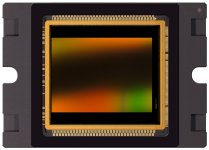
CMV12000 scientific sensor by European company CMOSIS (Black Magic Camera II).jpg

http://www.eoshd.com/content/9240/c...nsor-for-the-blackmagic-cinema-camera-mark-ii

http://www.cmosis.com/products/standard_products/cmv12000
 
The BMCC prides itself on the latitude it grabs. It ain't called the "baby Alexa" for nuthin so far. So 11 stops for an "upgrade" would be a downgrade in comparison. Speed is one thing, and that's great. But, I would rather have more latitude and greater color than higher framerates w/ a larger sensor.
 
The CMOSIS sensor has an 'expanded' dynamic range option of 90dB (about 15 stops). I assume this is some kind of HDR process like that found in the Red cameras.

Still, fantastic news that global shutter CMOS is finally breaking into the useful dynamic range arena. 11 stops is may not be great, but it sure ain't bad! Great to have options.
 
Global shutter CMOS usually has some drawbacks. On this one it is 11 stops. On the F55 it is less sensitive. It's a tradeoff because a global shutter needs more electronics on the sensor itself and that takes space.
 
How is the baseless predictions of a "cinematographer" on his blog considered industry news?

Just post about the sensor....
 
Old news, this sensor was presented long, long ago. There's even a FF version now (cmv20000). Also, that "11 stops" number is wrong: 60 dB is exactly 10 stops, and some of that may not be usable. You can get it to 15 by using one of the two available HDR modes: piecewise linear HDR, and dual-readout HDR; both create issues in the highlights (they avoid getting blown by using a faster shutter speed, which may or may not make your footage look odd). More in general, it's a sensor designed for machine vision, so it may or may not be well suited for motion picture cameras, IQ-wise. I have a CMV12000 evaluation system coming my way, I'll be playing with it for 10 days in december :) (I hope to be able to answer all these questions, but I'm not sure how much of those answers I'll be allowed to share). Oh, and I must say: not cheap! Don't expect to see this sensor on $3000 cameras.
 
Last edited:
Dual readout sets different exposure times for the odd and even columns of the sensor. It is up to the camera developer to set those times, and to merge the data from the different "fields". Piecewise linear allows you to combine 3 exposures on every pixel: the normal exposure (say, 1/50s), a faster one (say, 1/250s) and another one even faster (say, 1/1000s). All 3 exposures are recorded in just one stream of data, and they take place concurrently (one is from t0 to t3, the second one from t1 to t3, the third one from t2 to t3), so it is not exactly like HDRx from the RED world, but it is similar. Again, up to the developer to process the data and give you a nice looking image. And even if that is perfectly sorted out: having your skin tones shot at 1/50s and your highlights at 1/1000s may look perfectly fine, or may create a stroboscopic look and image quality issues, I have no idea yet. I hope I can find out in december.
 
Last edited:
How is the baseless predictions of a "cinematographer" on his blog considered industry news?

Just post about the sensor....

I came across this information about this new sensor through eoshd website, and just decided to post it here on dvxuser, so some people could know about it and eventually comment; we all benefit from that (like the referral to the Axiom project, or the interesting info that Samuel H and others provide). 'Industry news' seemed to me as the most appropriate place since this is a new sensor, a new kind of technology available. I didn't know about this sensor so I didn't have anything to say myself; it wouldn't be correct then to post about this sensor without citing the source. There is some factual information about the sensor at eoshd that I found useful. The speculative part (that it could be the next sensor for the BMC II), well, we are al adults here, aren't we?, so we can all perfectly distinguish facts from opinions or speculations.

Please don't use the fact that, for whatever reason, you don't like eoshd to complain about the way this post was formulated. I imagine you are going to complain about any post on dvxuser that refers to eoshd, no matter the content or the claims made. Maybe you should be more direct about your intentions, and formally ask dvxuser for a ban on all future referals to eoshd here (?). Come on Jay, comment here about all you know about sensors and filmmaking (which I assume is a lot), and don't be distracted by your personal feelings towards a particular blogger.
 
IMaybe you should be more direct about your intentions

I was pretty direct.... Like I said... why not just post the link to the actual sensor website and spec list?

everything else is just speculation.

I'm not a film maker, btw. Not everyone on here makes films.
 
Last edited:
hehe, very funny... the price that CMOSIS gave eoshd was "under $1700 per sensor", and it requires a very very powerful processor to cope with those 64 LVDS channels at 300Mbps. We'll be very lucky if we can get a camera with this for under $10K.
 
Just in case there was anyone left who thought EOSHD knew anything about anything.

I'd really like to ask CMOSIS what makes their sensor worth $1700 when Sony can provide similar-sized DSLR sensors for ~$50, and FF35 for ~$500.
 
For a start, Sony is not their competition, as far as I am concerned. Whatever price Sony charges for their sensors, it is irrelevant to me, since they won't even talk to me unless I sign a contract to buy tons of sensors and put the money in the line too. Basically, unless you're Pentax or Nikon or something close to that, they won't talk to you. But CMOSIS will.

And then, which $50 APS-C Sony sensor can be fully read at 75fps? 12fps, yes, but nothing above that AFAIK. I doubt they sell the sensors in their FS100 or FS700, and if they did, they wouldn't go for $50.
 
You would most definitely be using FPGAs or ASICs for the raw data, and demosaicing. Although the TI Keystone Multicore DSPs could probably handle a majority of what the sensor puts out.
 
Back
Top