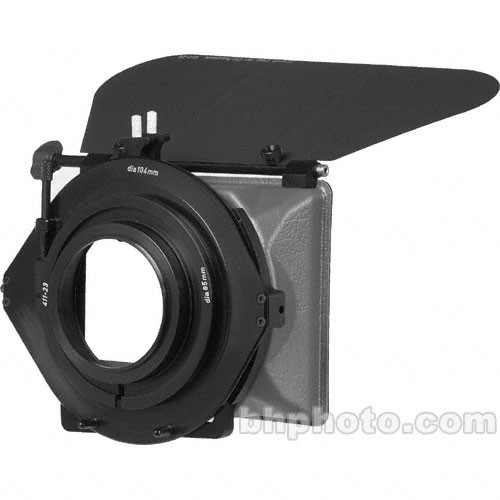
Cinetactics vs. Formatt 500

three quick questions: (keep in mind, I absolutely believe in the value of a good mattebox, however, i have NEVER owned one. So if these questions are sophomoric, I apologize).

One, what's the point of the rods? I see some with, some without? Not really sure what they do.

Also, Barry, (or anyone else for that matter) do you think the Cavision is head and shoulders above the Formatt 500?

And finally, does it matter if I get a wide angle matte box if I don't have an anamorphic adapter?

Thanks-
Rick
 
Another question...and I hope this is not a dumb one, but what is the difference between a Matte Box and a Lightweight Sunshade with French Flag? On B&H, I see the sunshades. The Chorizels are about $800.00. They LOOK like matte boxes, but are not called matte boxes.... What the F???
 
I think the Chrosziels referred to as 'Sunshades' are clamp ons, and the ones called 'Matte Box' have the rods. They're all matteboxes really. Well, I would call anything that holds filters a mattebox. If it's just a little hood to block flares, then I'd call it a sunshade (much like the one that comes with the camera).
 
Just wanted to throw in that I love my Chrosziel too... ;-)
Although yeah I think they are a little too expensive considering the price/value of the other "contestants" in this field... (though I didn't try or see any of the others live yet)
 
thisiswells said:
Hope this helps and I apologize if I wasn't helpful in the earlier posts...

Believe me, no apology necessary. Finding out answers to this stuff, to try to find out what to buy...I feel like a cop on Law and Order. I'll get a clue...which leads me to another clue...which leads me to a suspect...but that might not be THE suspect I wind up with and take to court...so, I ask around about ANOTHER suspect...
 
All right...so the research forges on. I have decided to NOT go with Cinetactics or Formatt 500. I am still weighing my other options. I like the used Vocas suggestion (if I could FIND one), but I am also confused about a few other things.

What can a "matte box" give me that a sunshade without rods can't?

For the price, I was considering this little Chorizel jobby:

http://www.bhphotovideo.com/bnh/con...737&is=REG&addedTroughType=categoryNavigation

It's considerably less than it's matte box big brother but seems to be functional. But, no rods. Also, no one disputes the quality of a Century Optics made piece of glass but why are Century Optics Matte Boxes nearly-never brought up? They any good?
 
In today's world, matteboxes are designed to hold filters. Some filters need to rotate to function (polarizers, graduateds), while others are best held in a static position parallel to the focal plane. Most budget matteboxes combine one fixed stage and one rotating stage.

Some photographers feel that they need a minimum of three filter stages to control the image in-camera, while others tend to shoot "clean", preferring to color-correct and otherwise manipulate the image in todays less expensive digital post-production environment.

Way back in the 20th century, changing your image once it was shot was an optical process, requiring the commitment of raw filmstock to modify the image
one way or another. Hence, cinematographers became specialists in selecting a filter or combination of several filters to accomplish a look in "one pass" or "in-camera". Sometimes it worked very well.

Traditionally, matteboxes played a major role in creating special effects, where one portion of the image would be matted out for double-exposure shots which were accomplished in-camera or subesequent to principal photography on an optical printer. The rectangular box you see attached to todays cameras is a direct (and barely changed) descendant of the early matteboxes used for "process" and "matte" photography.

An example would be exposing a rolling countryside in the lower frame, but leaving the horizon and sky black to add a cityscape in the distance. Effectively, the film could be rolled back in-camera with a reverse matte installed to pull off the desired effect on one strip of film.

Of course, special effects are rarely accomplished in this way anymore. Now, matteboxes are simply holders that allow for the rapid changing of filters - as many as four and more - without the hassle of threading ("stacking") multiple pieces of glass together.

A sunshade is just that - an extended visor that keeps hard light off of the front element of the lens and from entering the lens train. Sunshades do not hold filters - static or rotating - not even one.

If it holds glass, it is a mattebox - if it does not hold glass, it is a sunshade.

Should you possess a camera with a fixed front element (focusing within the train) then you can use a clamp-on mattebox / sunshade instead of one that utilizes iris rods. This is an inexpensive way to get started, but many people report that clamped boxes and shades are prone to falling off with little or no provocation.

A fully-functional, professional mattebox will weigh a significant amount when equipped with a swing-away function, three pieces of glass and french flags, side brows et-cetera.

All this weight must be kept off the lens and its somewhat fragile mount to the camera, so the mattebox is commonly "floated" against the front of the lens on iris rods. The rods support the full weight of the mattebox and accessories, keeping it precisely aligned and coupled to the camera, though it is still effectively a separate component.

e
 
Overland-

You rock. That all made perfect sense. I now know WHY the rods exist. I now know what the differences are between a matte box and a sunshade. And, I now have a better understanding concerning the variables separating matte box quality and price point.

Thanks a bunch.

Rick

PS It looks like my search begins with a Cavision and/or a used Vocas...
 
"I spent a while with 'em on email trying to sort it out, because I wanted one unit that would work on the HVX, HD100, and DVX. They said to get the 16x9 version, which accepts 4x4's and 4x5.65's, and not to get three stages because it would vignette at the widest angle"

So Barry, what lens do you have.

Luke
 
overlandfilms said:
A sunshade is just that - an extended visor that keeps hard light off of the front element of the lens and from entering the lens train. Sunshades do not hold filters - static or rotating - not even one.

If it holds glass, it is a mattebox - if it does not hold glass, it is a sunshade
.

Okay- I am apologizing to you and to GOD right now for bringing this back up...but http://www.bhphotovideo.com/bnh/con...737&is=REG&addedTroughType=categoryNavigation

This Chorizel Sunshade, holds glass. But does this mean it is a sunshade that 'acts' like a mattebox? And, would this be a good option versus the Cavision kit with the rods? I hear nothing but spectacular things about Chorizel.

Also..
[/QUOTE]A fully-functional, professional mattebox will weigh a significant amount when equipped with a swing-away function, three pieces of glass and french flags, side brows et-cetera......All this weight must be kept off the lens and its somewhat fragile mount to the camera, so the mattebox is commonly "floated" against the front of the lens on iris rods. The rods support the full weight of the mattebox and accessories, keeping it precisely aligned and coupled to the camera, though it is still effectively a separate component[/QUOTE].

Because this one does not contain rods, in your opinion, do you think it might be a little rough on the front of the camera???

Thanks so much and sorry to rehash...

Rick
EDIT: Apparently, I don't have the DUAL quote trick down...
 
275737.jpg


They can call this whatever they want, sunshade or filter holder shade, but it is a clamped-on mattebox. It holds mattes, it is a mattebox.

Chrosziel makes what many consider to be the best matteboxes available, their quality of materials and fit and finish are pretty much unparalleled. This particular one uses a clamping system and reduction ring that is entirely IDENTICAL to Cavision's system.

There is no difference whatsoever between the way this product and the Cavision box system interface to the 100a - both utilize a split plastic compression ring captured by another larger split aluminum clamping ring.

With the Cavision, this system has reportedly failed. I've never had the problem, and doing a huge amount of handheld work, I've had plenty of brushes with objects contacting the box as I move. Some people may not be clamping down on that 85mm / 72mm reduction ring tightly enough - I can't explain why others report this problem.

I use the rods and riser system for the mattebox because I want it to be a separate element from the camera and because I rely heavily on the dual handgrips in my work.

You might be the exception to this rule, but I'd bet that once you have a compressed linear polarizer, ND3, french flag and sidebrows sitting at the end of your 100a lens train, you will clearly see the need to get the weight (or perceived weight) off the camera.

If you go with the Chrosziel, just be sure that you can upgrade to a rod-mounted solution off-the-shelf and without too much financial exposure.

Transitioning from a clamped-on to a rod mount solution costs $210 with the Cavision (incl.: RS15IIm riser, 10" carbon fibre rods, t-riser to mattebox and associated hardware).

e
 
Thanks man. You've given me a lot to consider. I think I just might follow your lead and go with your original suggestion: the Cavision with Rods. It seems to be the best bang for the buck.
 
Back
Top