Cinematography lighting game

254zpea.jpg

Ok I had a go at it.
Shined one 300W Arri Fresnel with barndoors onto my brother. And shined a 650W ARRI with orange gel and some baking paper towards the camera acting as a window( added blackwrap to prevent fill on wall) . (I know the light should have been higher, the lens also probably needed too be a little wider as well).
 
I don't have any lights so I can't really play this game. So polaroid do you have any diffusion? I think that would help a lot for the above shot.
 
Well I use baking powder or a shoot trough umbrella as diffusion, I needed a flag for blicking the light if I would have diffused it. I should make one soon, as it can come in handy :)

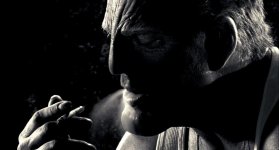
sincity117.jpg
 
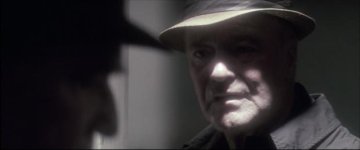
The Oh Brother shot looks like daylight or a big light bounced outside the window. You cant really fake a large source like that with a small source closer....
 
Ok its been 2 years since the last post, gear and skillset have been improved a bit since. Does anybody want to start the game again? Post a picture/screengrab of something that we can mimic!
 
I don't have anything specific in mind but I'd like to see what people's solutions are to doing soft light on large areas (not just CUs/MCUs of people. . .that I can handle) on no budget. Hard light is pretty easy to do. . .soft light, not so much.
 
I just want to say, mad props to Polaroid for the effort he is putting into this, his desire to learn, and his fearlessness in having his efforts criticized. He is actually DOING. And you learn so much more in doing than you do in observing or reading.

This exercise is always going to be challenging for anyone. Even the DP's who lit the scenes in the samples would have a most difficult time replicating them on their own, without a Gaffer and crew, and with only the tools Polaroid has at his disposal.

I commend the effort.

I have immense respect for the talent of the DP's on big budget films. But I think we often forget that they have the advantage of $300k lens packages, cameras that blow away the cameras most of us get to use, a huge crew, lighting packages that spare no expense, sets with walls that can be flown away, an Art Director, an experienced Gaffer in their ear, choice of locations, and the best post-production people in the business working alongside them in post on the grading. They work in an environment that provides them every advantage in producing quality images. A person of average skill would be able to produce vastly superior images were they provided the same set of tools and advantages that a DP on a Hollywood features enjoys.
 
I have immense respect for the talent of the DP's on big budget films. But I think we often forget that they have the advantage of $300k lens packages, cameras that blow away the cameras most of us get to use, a huge crew, lighting packages that spare no expense, sets with walls that can be flown away, an Art Director, an experienced Gaffer in their ear, choice of locations, and the best post-production people in the business working alongside them in post on the grading. They work in an environment that provides them every advantage in producing quality images. A person of average skill would be able to produce vastly superior images were they provided the same set of tools and advantages that a DP on a Hollywood features enjoys.

I hear what you are saying, although i think very few here "forget" the advantages of a big budget production, or what they perceive as the advantages.

I would counter that by saying that even with all of the toys and personnel at one's disposal, ultimately it still comes down to one person's set of choices. I don't really agree that an experienced DP would have a hard time duplicating some of those shots, especially if they were the ones who lit them in the first place. An intricate shadow pattern created by multiple gobos or from a large unit placed outside the set pushing through greens and a window is going to present a specific type of challenge to be sure.

I have to do a certain amount of this sort of thing when we do re-shoots or inserts; recreate the lighting setups in a different space and often with a much smaller crew and package. The added challenge is if one was not the DP for the original footage so you really have to get into detective mode to reverse engineer the setup. I had to do this a few months back for an added shot inserted into the pilot episode of a series:

reshoot copy.jpg

The top is a grab from the original material, shot by a different DP and crew on location with natural light coming through windows plus some added lighting. The bottom is from the new shot we did on stage with a two wall set. This was a dolly shot so the background doesn't match exactly (we would have dollied through the same setup as the top frame at some point). I actually opted to soften the backlight from the left to make it a little less harsh. We took 10-15 minutes to finesse the match but had to let go of a couple of nuances (the woman on the left is getting more fill than she did originally, but it is matched on the woman on the right).

I don't want to detract from anyone's efforts here, in fact I think that this type of exercise is extremely educational and a great way to learn lighting skills. I would suggest however that the most important aspect is understanding where the instruments should go and how they are modified, and an experienced DP is going to be able to suss that out without as much trial and error involved than one with less experience. The actual execution is less the point.
 
I would counter that by saying that even with all of the toys and personnel at one's disposal, ultimately it still comes down to one person's set of choices. I don't really agree that an experienced DP would have a hard time duplicating some of those shots, especially if they were the ones who lit them in the first place.


Maybe I was not clear- the DP's who shot those original shots would have a difficult time matching those shots using only the lights that the OP has and using a GH3 as is the OP. I didn't mean that the DP's would have a difficult time matching the shots using the same tools.

Have you ever had to match work done by another DP and the work you were hired to match was shitty? I've run into that a couple of times. The lighting in the shots I was tasked with matching had these terrible nose shadows and one of the actors was lit in a manner that caused a brow shadow. It wasn't a stylistic choice, it was just shitty lighting. I had to go against all my instinct and repeat the same shitty lighting so it would match. I had to fight the temptation to improve the lighting and reduce the unflattering aspects of it.

One time when I was doing bts on a feature film a P.A. came over to me and said "The DP wants to talk to you." . I hadn't even been introduced to the man and I had no idea what was up. Always afraid that shooting BTS has annoyed the actors or the production crew, I ask "Did I do something wrong? Why does he want to talk to me?" The P.A. says "He says he needs your advice on a lighting setup.". Knowing it is an odd request, I still can't help but think "wow. The DP of a major motion picture is wanting my advice on lighting! Little ole' me!". I am escorted over to the DP who is sitting at video village with the Director of the film. The DP sees me and says "oh, good, I need to use you as a consultant. You've shot local commercials, right?". I tell him I have. He says, with a straight face, "okay, great. We are about to do a scene where the lead actor appears in a local tv commercial. I want to recreate the look of a local spot and I need you to tell me how to make this look shitty."

That DP was Shane Hurlbut.
 
Ouch.

I'm not a real "DP" but have shot talking heads that were supposed to match stuff shot by other people, stylistically. . .when that style is weird composition, not white balanced, turned too far from the cam, etc. Do you actually match it? Do you try to make it "good"? Weird situation.
 
HA, great Shane story! Too bad that didn't come up when I was working with him, that would have been right up my alley (spent 2.5 years shooting local commercials in the 80's).

As far as matching with a few lights and a GH3...I mean, it depends really. I can't speak for anyone else but I feel like most of it is being able to dissect the shot source by source, and then you do the best with the tools you have. The more lighting experience, the easier/more accurate the dissection.

About 8 years ago I took on a little challenge of this sort: a friend invited people to shoot shorts on whatever subject they wanted and then we would all watch them in his backyard with a lot of good food and drink. My girlfriend came up with a notion that involved recreating a bunch of classic film sequences and I somewhat reluctantly took it on (I knew what a massive amount of work it would be)! I shot about half of it by myself, and the other half had one person helping me out. Lighting was an Arri kit and a couple of Diva 200's. I shot it on a Canon XHA1. I'm not going to say that the recreations were spot-on from a lighting perspective (there wasn't enough time or need to go overboard on that) but some of them are pretty damn close...the Dirty Dancing and 9.5 Weeks for example.

https://vimeo.com/173018993

and here are the reference clips

https://vimeo.com/173018992
 
That was ambitious indeed!

I find it interesting how lighting style has changed and I wonder how much of that is a result of the developments in lighting instruments vs how much of it is purely a different sensibility. For instance, in the shot where Hepburn is facing the window of the Tiffany store she is lit with a hard source. Whereas in your shot she is lit with a softer source and that is how most DP's today would light it. It really doesn't make "sense" that she would be lit with such hard light when up close to the building and facing the building. In the wide shot that follows there isn't any source to justify that hard light. Surely Planer had at his disposal the means to light her with a softer source. But he didn't. Is that because that hard light was "the look" he wanted and the look of that era of filmmaking or was it that he lacked a lighting unit with sufficient power to be bounced and still compete with the existing daylight that is lighting the background?

The hard lighting and numerous shadows of films from earlier eras is often jarring to my modern sensibility. Films that won an Academy Award for Cinematography yet have lighting that to me is ugly and would never stand today. Shadows of the actors all over the walls, bib shadows, brow shadows, and hard shadows in interiors that make no sense. A DP who lit like that today would likely be fired. I saw one of those instances just the other night when watching the original Magnificent Seven. A character is in the shade on a bright day but he has a hard shadow on the wall behind him. The DP obviously lit the actor in the shade with a hard source in attempt to reduce the contrast between the actor in the shade and an actor in full sun when they cut to a wide that includes both. If shot today a DP would likely use a large source to fill in the shaded actor.

I suppose it is a blow to the ego of DP's to know that the audience doesn't really care. The DP's who are realize it, that is. People loved those films, the Cinematography won awards, and few who saw the film even noticed the sort of thing I just referenced.
 
For instance, in the shot where Hepburn is facing the window of the Tiffany store she is lit with a hard source. Whereas in your shot she is lit with a softer source and that is how most DP's today would light it.

Boy I hate to advocate such things but we shot that fully run-and-gun, at 7:00 a.m. before the store opened (and got eventually chased away by security)! So...available light!

Yes, cinematography has changed substantially over the years. I've had a good time emulating old-style lighting whenever it's come up, kind of fun to blast the hard light in there and let the shadows do their thing.
 
From what every DP I've ever seen interviewed has said, it is not a blow to them at all that the audience doesn't care. . .they say the cinematography is something you're supposed to "feel" rather than really notice, in other words, if you notice it (and you're not some sort of artist or filmmaker), they've failed at their job by making the cinematography too distracting. You're supposed to get it on a subconscious level.
 
You can feel and notice it. I realise the DPs you're referencing think they failed if an uneducated audience member is distracted to the point where they're removed from the story. But now it seems like audiences like to at least pretend they're recognising decent Cinematography, so I don't think it's necessarily "either feel OR notice" anymore. It can be noticed at the positive end of the spectrum and be a good thing too.

This is very off topic.

StephenBills, are you going to make an attempt on the image you posted?
 
Back
Top