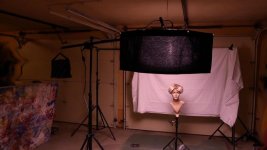
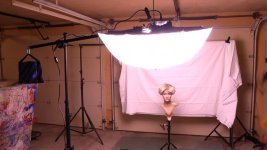
Chimera Pancake Lantern/China Ball - An Alternative

Paul F

Veteran
I am skilled in the electrical arts and have had long term experience with NEC and UL safety requirements for electrical design. Therefore, I feel comfortable designing my own equipment. However, those not skilled in this field should not attempt to design their own equipment nor attempt to copy this design. This post is for your entertainment.
.........

I don't have the Chimera Pancake light nor a china ball in my collection. They are similar in function (minus the skirt), but very different in price. I looked into buying the Chimera and found these two components:

The light fixture - $289 https://www.bhphotovideo.com/c/product/503966-REG/Chimera_9930OP_Triolet_Mogul_Base_Flood.html
The skirt - $431 https://www.bhphotovideo.com/c/product/218652-REG/Chimera_1865_Pancake_Lantern_Softbox_with.html
Total - $720

As a fabricator, that got me thinking. I had a fixture nearly identical to the Chimera - the Photoflex Starlight. I bought one with the speed ring on ebay for $60. https://www.bhphotovideo.com/bnh/co...ap=y&m=Y&c3api=1876,91438732682,&Q=&A=details

Then I saw these umbrellas on ebay - http://www.ebay.com/itm/2x-40-Photo...818341?hash=item41a2d628a5:g:05AAAOSwcL5XMqCv

I combined those and I had the equivalent of the Chimera Pancake light minus the skirt. I made up a skirt that attaches to the umbrella using button holes that hook onto the umbrellas ribs. This way, I can surround the brolly on 1/8 circle increments from 100% coverage to 12% coverage.

Light $60
Brolly $11 (two for $22)
Skirt $10
Total $81

Pros
- Price
- Finer control of the light with skirt on eighths of a circle rather than fourths using the Chimera

Con
- Who knows how good the brolly is. It may break tomorrow. But @ 2 for $22, I'll take the chance. I won't be using these often.
- I don't have the light sealed with the skirt as tightly as the Chimera. I could if I wanted to do a little more work, but eh, good enough. The big opening you see in the top is a zipper I failed to close. So that leak can be fixed.

This is a 1000w fixture.
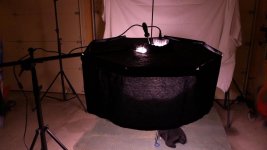
Overhead Chimera Clone 2_zpscommxg6j.jpgWideshot Eighth Moon 2_zpslrr2btak.jpgWideshot Full Moon 2_zpshl4jr9dg.jpgCloseup Eighth moon 2_zpseglybvvj.jpg
 
Last edited:
Keep an eye on it in the event that the fabric used is designed for strobe work rather than hot lights. Wouldn't want your house to burn down.
 
That's a good concern, but there's no worries based on my tests. Of course, this is just my experience and as you say, safety first.

Fabrics aren't given much consideration by UL/CSA. From what I've read, UL/CSA has two requirements;

- The material has to be 'slow burning'. Without copying the specification here, let's just say it includes most anything, be it synthetic or natural materials, including paper (i.e. China balls made of paper).
- In a room at 30C, under operation, the temperature of the material cannot exceed 90C.

I'm guessing it is nearly impossible to get fabric to 90C as it has such a low mass/density and there is so much air moving around it, the heat quickly dissipates. I did a test, and the fabric barely gets warm to the touch.

For me, the real issue could be the fabric touching the light fixture. At 1000w, temperatures could get high and cause problems. But Photoflex solved that problem by designing the lampholder with a thermal isolator (clever design). So the outside surfaces of the fixture are only warm to the touch.
 
Is that fixture designed to function pointing straight down? I've used a number of lights in the past that would burn themselves up if they were used pointing straight down for any length of time. It's a very real concern with these things and you should consult the manufacturer.
 
Mitch - Photoflex lists no guidelines about orientation. Please refer to post 3 where I describe the UL/CSA requirements and the heat characteristics of the fixture.
 
Mitch's concern is real. Forget about your PDF guides. If you are using a tungsten fixture pointing straight down or any hot light in an enclosed environment like a softbox which this is you are courting disaster.

I have a pancake. My FAVORITE lighting instrument but I would avoid using a tungsten fixture in it as the most common way to orient the pancake is downward. I use a 200W HMI Joker but that is out of your price range. I would consider using high quality LED ribbon as the fixture inside your hanging softbox lantern. Wrap the LED ribbon around a spindle or a translucent plastic pop bottle and stick it inside the softbox.

A 1000W tungsten fixture pointing down is not where you want to go.
 
Is that fixture designed to function pointing straight down? I've used a number of lights in the past that would burn themselves up if they were used pointing straight down for any length of time. It's a very real concern with these things and you should consult the manufacturer.

Sort of off topic but do some HMIs not function at certain angles (e.g. pointed straight up) for safety or is something physically limiting them?

@Paul F - what if the 200w joker is left on long enough, how is that different to a tungsten light? Is it because it could never reach those temperatures?
 
.......If you are using a tungsten fixture pointing straight down or any hot light in an enclosed environment like a softbox which this is you are courting disaster. ......

A 1000W tungsten fixture pointing down is not where you want to go.

Well then, Chimera and everyone that owns a Chimera pancake is courting disaster as it is spec'd to face straight down with a maximum of 2000 watts. I can't even warm my hands up from this fixture.
 
It is not the Chimera. It is the fixture.

You were asking for informed answers. People with experience with these units.

EDIT: I have given you a cheaper solution that is safer, lighter and even less costly to operate.
 
Last edited:
Sort of off topic but do some HMIs not function at certain angles (e.g. pointed straight up) for safety or is something physically limiting them?

A Joker is designed for this kind of use, among others. It is also a 200W HMI. Highly unusual with its low power consumption. They run several magnitudes cooler than an equivalent tungsten fixture and output about 4 times more light than an equivalent tungsten.

If you were going to use a tungsten fixture inside a pancake, there is a purpose built fixture for this purpose...

https://www.bhphotovideo.com/c/product/463407-REG/Chimera_9950_Triolet_Flood_Light_with.html

The LED solution is much cheaper, lighter and more energy efficient.
 
Last edited:
Sort of off topic but do some HMIs not function at certain angles (e.g. pointed straight up) for safety or is something physically limiting them?

@Paul F - what if the 200w joker is left on long enough, how is that different to a tungsten light? Is it because it could never reach those temperatures?

It's not clear to me why they spec plasma (HMIs) at specific orientations. But consider that the big difference is that tungsten is just a hot glowing metal wire whereas HMIs are a bulb containing plasma. The designs are quite exotic. Certainly it has to do with the design, not safety. HMI has two safety issues, UV rays and containing hot material when the lamp shatters. Each type of HMI lamp deals with these differently or not at all.

Regarding the Joker, I'd have to test it to know how it compares to the 1000w fixture I'm using. But I expect it would be an issue. A Joker doesn't have the same heat isolation that the Starlite has.
 
It is not the Chimera. It is the fixture.

You were asking for informed answers.....

Both Chimera's lantern and Chimera's light fixture spec at least 1000W in the down orientation.

I didn't ask for any answers or opinions. I was just sharing what I did as a point of interest.

Cheers,
 
That's a good concern, but there's no worries based on my tests. Of course, this is just my experience and as you say, safety first.

Fabrics aren't given much consideration by UL/CSA. From what I've read, UL/CSA has two requirements;

- The material has to be 'slow burning'. Without copying the specification here, let's just say it includes most anything, be it synthetic or natural materials, including paper (i.e. China balls made of paper).
- In a room at 30C, under operation, the temperature of the material cannot exceed 90C.

I'm guessing it is nearly impossible to get fabric to 90C as it has such a low mass/density and there is so much air moving around it, the heat quickly dissipates. I did a test, and the fabric barely gets warm to the touch.

For me, the real issue could be the fabric touching the light fixture. At 1000w, temperatures could get high and cause problems. But Photoflex solved that problem by designing the lampholder with a thermal isolator (clever design). So the outside surfaces of the fixture are only warm to the touch.

Just trying to provide helpful advice based on my nearly 40 years in the industry, having seen folks trying to save money by using inexpensive soft boxes designed for strobe work with 1K hot lights.

Here is what Photoflex says about your light....... "The StarLite is designed for use with a high heat resistant SoftBox such as the Photoflex SilverDome® NXT, OctoDome® NXT or MovieDome®. Be sure the SoftBox you are using is rated for use with hot lights as you could create a hazardous situation."

All the best!

Dave
 
Both Chimera's lantern and Chimera's light fixture spec at least 1000W in the down orientation.

I didn't ask for any answers or opinions. I was just sharing what I did as a point of interest.

Cheers,
Fixture orientation has to do with the filaments of the lamps they are designed to use. They will last longer when used in the manner they were designed for, but they will burn at any angle if you don't care about lamp life. If you search the mfg's specs on a particular lamp you can find the recommended burning position i.e. base down, horizontal or universal. I don't think I've ever used an enclosed arc lamp that didn't state it was universal.
 
Just trying to provide helpful advice based on my nearly 40 years in the industry, having seen folks trying to save money by using inexpensive soft boxes designed for strobe work with 1K hot lights.

Understood and appreciated.

Here is what Photoflex says about your light....... "The StarLite is designed for use with a high heat resistant SoftBox such as the Photoflex SilverDome® NXT, OctoDome® NXT or MovieDome®. Be sure the SoftBox you are using is rated for use with hot lights as you could create a hazardous situation."

Yes, I read that as well. If I wrote that manual, for their protection, I would delete the second sentence. It is meaningless as there is no standard for how a softbox is designed or what materials are used. The term 'hot lights' is also meaningless. Is a 60 watt light hot? How about a 500w? No one knows. UL doesn't rate softboxes for hot lights. It tests it as a system and then determines if it meets the requirements I discussed earlier. That's why you see a label on lights saying what the maximum wattage bulb can be placed in the fixture. It was tested with that wattage. Anything more than that would be.....hot.

Ok, my nerd impulses have dribbled on long enough.
 
There's a couple of ways to go. If you want something light, portable, and inexpensive, then the lightweight photography stands and booms are the way to go. That's what is in the pictures. If you want heavy duty use, the C-stands are the way to go. They are very robust, but heavy and not easy to transport for travel.

Cheap Chinese stands:
Pros - lightweight and easy to pack.
Cons - the stands tubes can get bent or break down depending upon brand. Some are better than others. Of the cheap-Chinese, the Ravelli ABSL are pretty good, but are bigger and heavier than most. I have a wide variety of these from small to large depending upon need. Sometimes you want a very short stand near the floor. I have others that go to 13'. I've never had one break, but I have had the tubes bend. But they're so bloody cheap, who cares.

Lowel makes some decent light stands, but they have an integrated light mount, which I don't like. I like stands with removable light adapters. Even better are the ones that have the latch that captures the adapter plus a screw to tighten it down. (I can't find an example).

Regarding booms, the cheap Chinese are fine. Look for one that includes a caribiner for the sand bag. This one looks good because it has a nice yoke to adjust angle, but the stand is very short. http://www.ebay.com/itm/Neewer-10ft...032400?hash=item48921d32d0:g:7hkAAOSwxg5XySOf

The yokes on cheap-Chinese stands are difficult to deal with. I very much dislike them. example: http://www.ebay.com/itm/Single-Grip...666749?hash=item43f04202bd:g:MA4AAOSwNuxXYhpk

C-stands have a much better arrangement.


I don't use C-stands for extended boom work too often. Although I will use one for an audio boom with sandbag on a leg. I find Beefy Baby or Junior/combo stands to be more stable for extended boom work.

I also find turtle base C-stands to be very easy to transport.
 
Last edited:
I already have some nice manfrotto light stands, so you are saying all I would need to purchase would be the Grip Swivel Head Bracket Clamp (yoke) and a boom arm that I can attach my light to? I just got the Came-Tv Boltzen lights and wanted to raise one up like you did for a nice hair light. Just not familiar with boom grip, sorry.
 
Back
Top