Charging in a remote location - Car Battery?

analog_addict

Well-known member
Hello,

I'm preparing for a shoot at a remote location for 7 days. There is no electricity there and you can't get a vehicle there either unless it's a 4x4.

I'm working out how I can charge my batteries for the duration of the shoot and the best solution I can come up with is using a car leisure battery. These are around 110Ah and output 12V.

I would need to charge batteries for a Canon C100, LED panels, phones and laptops.

I'm struggling a bit to work out how long the battery would last. For example if I charged a 2000mAh Sony NP-F battery, would that take the battery down to approximately 108Ah?

Has anyone ever shot in extremely remote places and how did you charge things?
 
My research suggests a generator is no good for charging batteries. Unregulated supply and also some of my batteries take a long time to charge.

A deep cycle marine battery is the same as a 'leisure' battery mentioned above. Seems like the best bet, may need 2 and then send a runner to charge one half way through the shoot.
 
Sounds like the least expensive and most reliable is a 4x4 and small honda generator. I have gone off grid for 4 days and been ok with batteries I carried in and a 12 jump start battery unit. But 7 is a while. worst case you can run the 4x4 while you charge from the lighter or accessory outlet. Not a very Green approach but could work.
 
My research suggests a generator is no good for charging batteries. Unregulated supply and also some of my batteries take a long time to charge.

A deep cycle marine battery is the same as a 'leisure' battery mentioned above. Seems like the best bet, may need 2 and then send a runner to charge one half way through the shoot.

You just need a "pure sine wave" generator to ensure that sensitive electronics will be safe. There's plenty of them around. You can get little 2000w ones that are very compact and easy to transport.

It's a vastly simpler solution than just about anything else. And will let you bring other important electrical appliances with you - like a laptop for data wrangling/reviewing footage, and more importantly, a kettle for tea/coffee that doesn't take an age.
 
... the best solution I can come up with is using a car leisure battery. These are around 110Ah and output 12V. I'm struggling a bit to work out how long the battery would last. For example if I charged a 2000mAh Sony NP-F battery, would that take the battery down to approximately 108Ah?

To get a rough estimate, you need to include the losses of the inverter and chargers in that calculation. Add 30% for a rough conservative estimate of the inverter and charger losses. That may be a bit high. It could be as little as 15%. Then derate the battery to 100Ah in the assumption that their rating is optimistic. If the temperature is cold, there will be a loss of available power. Batteries are usually rated at 25C (77F). Derate the battery capacity 5% @ 50F, 15% at 32F.
 
Also crunch numbers for buying more batteries. V-mount batteries can power the camera, LEDs, phones and laptops.

You could get a weekly hire for a boatload of batteries and it may not cost that much.

But like grug said - think about the coffee.

If you think you'll use a generator for future projects then that makes sense too.
 
These are around 110Ah and output 12V. I'm struggling a bit to work out how long the battery would last. For example if I charged a 2000mAh Sony NP-F battery, would that take the battery down to approximately 108Ah?
Multiply Ah by V to get to wh number - 110x12=1320wh for the car battery. Your Sony battery needs 2A x 7V =14wh for a full charge. So your Sony battery would use a lttle over 1% of the car battery. Actually a little more due to losses as Paul said. Good luck.
 
These are around 110Ah and output 12V. I'm struggling a bit to work out how long the battery would last. For example if I charged a 2000mAh Sony NP-F battery, would that take the battery down to approximately 108Ah?
Multiply Ah by V to get to wh number - 110x12=1320wh for the car battery. Your Sony battery needs 2A x 7V =14wh for a full charge. So your Sony battery would use a lttle over 1% of the car battery. Actually a little more due to losses as Paul said. Good luck.

Love it when Alex "chimes in" there is always great and accurate info. Buy your batteries from Dolgin, I do and have for several years. You not only get a battery but you get great after purchase service and contributions to our group as well.
IMHO
 
These are around 110Ah and output 12V. I'm struggling a bit to work out how long the battery would last. For example if I charged a 2000mAh Sony NP-F battery, would that take the battery down to approximately 108Ah?
Multiply Ah by V to get to wh number - 110x12=1320wh for the car battery. Your Sony battery needs 2A x 7V =14wh for a full charge. So your Sony battery would use a lttle over 1% of the car battery. Actually a little more due to losses as Paul said. Good luck.

Brilliant this is just the info I needed.

I think buying 2x 110Ah batteries should do the job. There is a farm a couple of miles away (who own the location) and I'm sure they would be happy to re-charge one of the batteries halfway through the shoot.

We'll also have a (cheap) generator for non-battery charging tasks.

Thanks all!
 
I would suggest opting for the generator...or renting a lot of batteries...7 days is a long time...deep cycle marine batteries are the only way to go aside from that, but you would not get by on one, if you want some redundancy built in...inverters can fail, but at vary least are inefficient, and that means your power source you're taking in will not get close to giving you the rated return...rent a proper generator and whatever goes along to support it...and what you need to get it into your location...
 
Deep cycle marine batteries are what I'm talking about with a 110Ah leisure battery. No inverters needed, everything can charge from 12V. I might buy an inverter just to run a printer.

The problem with charging batteries from a generator is that some of the batteries (Particularly the very large capacity Sony batteries), are an overnight job to charge which a generator isn't suitable for.

Thanks all.
 
You may know this, but it is dangerous to directly connect a car battery to another battery to charge it. Most batteries do bad things if improperly charged. Chargers provide a controlled current charging rate to prevent overheating/fire/explosion. A car battery has no current control. That's why I assumed you would use an inverter and the charger that came with the battery.

If you are just using it to power devices directly, no worries.
 
Last edited:
You may know this, but it is dangerous to directly connect a car battery to another battery to charge it. Most batteries do bad things if improperly charged. Chargers provide a controlled current charging rate to prevent overheating/fire/explosion. A car battery has no current control. That's why I assumed you would use an inverter and the charger that came with the battery.

If you are just using it to power devices directly, no worries.

Hi Paul,

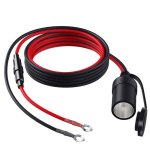
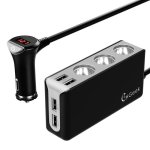
Well most of my chargers have a 12V car input (lighter socket) so I would be hooking them up via one of those. So using the following:

61TcYvqaOLL._SL1000_.jpg61MnYdaCY0L._SL1000_.jpg
 
For our US domestic shoots where we haul our equipment in a trailer, my documentary team uses lithium-ion storage batteries and a pure sine wave inverter. These are much lighter, charge much faster and have good discharge efficiency. By contrast with AGM or gel-cell batteries you often cannot obtain nearly 100% of the capacity at high discharge rates. Plus non-lithium batteries do worse in cold weather and have more self-discharge so you can't quickly grab one off a shelf and know it's still over 90%: https://starkpower.com/deep-cycle-batteries

Stark used to have a 9 aH and 20 aH 12 v version; I don't know why they no longer offer those. You have to be very careful with li-ion storage batteries and make sure they're designed for deep discharge, not some repurposed li-ion motorcycle starting battery. This 300w continuous, 600w peak sine-wave inverter is inexpensive but works well: https://www.amazon.com/dp/B01HCGO2I0/ref=cm_sw_r_cp_ep_dp_YQUJzbEH79REA

Using a proper compatible 20 amp charger, a 20 aH battery can be fully recharged in 1 hr but since we usually don't fully dischrage those, 30 min. is more typical. The 50 aH Stark li-ion battery can be recharged in about 2 hr. If using LiFePO batteries, it's vital to only use chargers that are designed for that.

Most of our 12v batteries, inverters, lights, and other equipment have been modified to use Anderson Powerpoles. This ensures compatible DC 12v interconnects across a wide range of equipment: https://powerwerx.com/anderson-power-powerpole-sb-connectors

There are some nice "turnkey" all-in-one li-ion power pack/inverter units. The RIVER EcoFlow is pretty good. It's about 450 watt-hrs and was designed by former DJI engineers: http://a.co/6byL1CS

The Goal Zero Yeti series are available from 400 watt hrs up to 1400: http://a.co/ejYIx0U, http://a.co/b2zsieO

Some of these are available with optional solar panels.

If you have a MacBook Pro from 2016 or later, these can be externally DC powered via USB-C using something like the Anker PowerCore+ 26800: http://a.co/dqRRhMz. This avoids DC/AC conversion and is more efficient.

For flying on commercial airliners, the normal FAA limit is 100 watt hours and they must be carried on the plane. RIVER is introducing a modular li-ion battery and inverter unit that stays under the FAA limit, so you have two < 100 watt-hr modules giving a total of about 200 watt hrs. That's not a lot but it's enough for some things: https://www.cnet.com/news/ecoflows-...le-power-and-still-get-past-airport-security/
 
I have used many different types of generators and years ago was a servicing diesel generator and inverter dealer. While I would highly endorse a pure sine wave system, I have never had any issues with anything using modified sine wave power supplies. Maybe I just have good luck.

My smallest generator is a Honda inverter series 1000w. This series is PSW. It is very very quiet for a generator, weighs under 30 pounds and only sips fuel. Cost new in the US is about $800. You can get lots of generators for less, but the entire Honda inverter series are simply superior products compared to anything else IMHO.

Edit: I might add that at 30 pounds, is much much lighter than any full sized auto or deep cycle type battery.
 
Last edited:
Maybe make a LiFePO4 battery pack. A little involved so if you dont have electronics experience a local electronics workshop could make this.

Use Headway 38120 LiFePO4 cells. You could do 12/24/or 48v. However 48v may get a bit unwieldy - but then again, if you are prepared to carry a 12v 110 amp/Hr battery, carrying these headway packs is a breeze.

this youtube link shows you how to do it, with a parts list. https://www.youtube.com/watch?v=nDoQoVA0hAc

another approach and talks directly to what you are trying to do https://www.youtube.com/watch?v=cvoMOK3TBNU
 
I own two leisure batteries with added 'mower connectors'

You can charge them off your 'cheap generator' I guess.

Also you could consider powering stuff from them directly

Mine run my LED panels and probably ill wire to run my monitor too.
 
Back
Top