combatentropy
Veteran
I'm excited about the new media card standard, CFexpress. Uncompressed RAW capture is finally starting to look doable, even at respectable frame rates.
10-bit 4K RAW at 24 fps = 265 megabytes/second
A respectable max frame rate might be 120 fps, which is 1.33 gigabytes/second (cue Doc Brown).
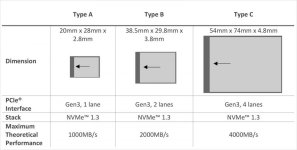
CFexpress tops out at 2 gigabytes/second
Practical speeds are always lower, but Sony announced cards at NAB with write speeds of "up to" 1.48 gigabytes/second. These are due in "early summer." So we're getting there.
Cost is another barrier. An hour of uncompressed 4K RAW is about a terabyte. These cards will at first be too expensive to use as write once. But hard drives are $50/terabyte or even less. Even solid-state drives are around $150/terabyte. (This is from me lightly searching Amazon. Y'all may be aware of yet better deals.) So, if you're willing to offload at night, it's doable.
Anyway, I'm kind of tired of codecs and the endless uncertainty. Will Prores RAW or Blackmagic RAW become the new standard? Will so-and-so finally at least put 10-bit 4:2:2 in their camera? Is HEVC too encumbered by patents? Should I use 3:1, 7:1, or 12:1 compression? Will anything be able to read the format in 20 years?
Uncompressed RAW is the easiest and coolest-running way for a camera to record. That's why the smaller companies used it: Ikonoskop, Digital Bolex...what was that other one? Anyway, Ikonoskop flat-out told me in an email that they chose uncompressed so that their camera would not need a fan.
Some of you are probably suffering from upgrade fatigue and are wondering why I'm excited about yet another card format. Didn't we just get CFast and XQD? I feel better about this one. It seems more open, more of an agreement among manufacturers, it finally is using the same protocols as current computer drives (NVMe). I feel like it will last a little longer -- if for no other reason than that there is no use left that needs more bandwidth. We video shooters are the biggest hogs
10-bit 4K RAW at 24 fps = 265 megabytes/second
A respectable max frame rate might be 120 fps, which is 1.33 gigabytes/second (cue Doc Brown).
CFexpress tops out at 2 gigabytes/second
Practical speeds are always lower, but Sony announced cards at NAB with write speeds of "up to" 1.48 gigabytes/second. These are due in "early summer." So we're getting there.
Cost is another barrier. An hour of uncompressed 4K RAW is about a terabyte. These cards will at first be too expensive to use as write once. But hard drives are $50/terabyte or even less. Even solid-state drives are around $150/terabyte. (This is from me lightly searching Amazon. Y'all may be aware of yet better deals.) So, if you're willing to offload at night, it's doable.
Anyway, I'm kind of tired of codecs and the endless uncertainty. Will Prores RAW or Blackmagic RAW become the new standard? Will so-and-so finally at least put 10-bit 4:2:2 in their camera? Is HEVC too encumbered by patents? Should I use 3:1, 7:1, or 12:1 compression? Will anything be able to read the format in 20 years?
Uncompressed RAW is the easiest and coolest-running way for a camera to record. That's why the smaller companies used it: Ikonoskop, Digital Bolex...what was that other one? Anyway, Ikonoskop flat-out told me in an email that they chose uncompressed so that their camera would not need a fan.
Some of you are probably suffering from upgrade fatigue and are wondering why I'm excited about yet another card format. Didn't we just get CFast and XQD? I feel better about this one. It seems more open, more of an agreement among manufacturers, it finally is using the same protocols as current computer drives (NVMe). I feel like it will last a little longer -- if for no other reason than that there is no use left that needs more bandwidth. We video shooters are the biggest hogs
Last edited: