CES 2019: ‘8K Is Getting Real’

A sobering thought - how about a 1 1/2 hour 8k 2 pass-VBR x265 encode with Neat Video applied? :) Probably would take a week to finish!
Yes posting 8K is a big concern for me. 4K is hard enough. Though I've been shooting 4K for years I'm only working on my 1st deliverable 4K project now and it takes heavy lifting. It's actually 3X 4K (10240 X 2160) for a tri screen. Even with 64GB RAM my workstation is struggling. Rendering 3D animations in 4K takes time - 17hrs for a 4 minute animation.

If hardware doesn't make significant leaps and bounds I wonder if networking our workstations in a render farm for 8K post would be a future possibility (like many do for 3D rendering) so the muscle of several computers can be used at once??

Hopefully 8K deliverable won't take off and be required for a loooooooong time. 8K acquisition for a 4K deliverable would be hard enough.
 
For Flat home screens, yes, 8K is overkill. For theatrical projection, 8K is probably close to the limit as to how much the eye could resolve at a normal viewing distance, except for an IMAX screen. For VR, 8K is sort of the base level of acceptable quality. I've seen 4k VR videos and it looks barely better than SD quality once you blow it up to VR size. As VR progresses into the mainstream, and it will as the technology improves, 8K capture for live events and some filmed content will absolutely be needed.
 
Consumer Electronics Show (CES) 2019, which will run in Las Vegas for four days from Jan. 8 (local time), is expected to showcase premium TV technology and advanced smart home technologies such as artificial intelligence (AI) and the Internet of Things (IoT).


Samsung Electronics, which betted on micro light emitting diode (LED) TVs of a modular structure at CES 2018, will introduce an ultra-large 8K quantum dot light emitting diode (QLED) TV at CES 2019. Its 8K QLED TV lineup currently features four types –- 65-inch, 75-inch, 82-inch and 85-inch models. The company is also expected to launch a micro LED TV for home use, which is smaller than the 146-inch model released this year.


LG Electronics will showcase an 88-inch 8K organic light emitting diode (OLED) TV unveiled at the IFA 2018, Europe's largest consumer electronics exhibition in August. Attention is also focusing on whether or not LG Electronics will take the wraps off a rollable TV. A rollable TV can be rolled up so consumers can freely adjust its screen size and ratio. LG Display showed rollable display technology at the CES 2018 in January of 2018. At the time, LG Display did not specify when it would be able to commercialize the rollable display technology.

Experts in the TV industry are expecting that Sony of Japan will also launch its 8K TV lineup at CES 2019. Sony, a traditional TV giant that once suffered a slump, signaled its brilliant revival at CES 2018 by opening a large pavilion filled with OLED TVs.

China's TCL and Hisense also joined the 8K TV race. Hisense is expected to show an 80-plus-inch 8K ULED TV.

http://www.businesskorea.co.kr/news/articleView.html?idxno=27870
 
For Flat home screens, yes, 8K is overkill. For theatrical projection, 8K is probably close to the limit as to how much the eye could resolve at a normal viewing distance, except for an IMAX screen. For VR, 8K is sort of the base level of acceptable quality. I've seen 4k VR videos and it looks barely better than SD quality once you blow it up to VR size. As VR progresses into the mainstream, and it will as the technology improves, 8K capture for live events and some filmed content will absolutely be needed.

I said early on, we will need high-res for REALLY GOOD VR. At least for the headsets. When I demo'd it, I could count every pixel in the headset. Each screen for each eye needs to be at least 4K or 8K.
 
VR gives me a headache and makes me nauseous, as it does to at least 10% or more of viewers. To me, VR is just a gimmick. A cool gimmick but it's not really a good cinematic storytelling technology, it's an experiential, immersive gimmick that is really good for only very specific audiences and uses.
 
VR gives me a headache and makes me nauseous, as it does to at least 10% or more of viewers. To me, VR is just a gimmick. A cool gimmick but it's not really a good cinematic storytelling technology, it's an experiential, immersive gimmick that is really good for only very specific audiences and uses.

To me, 3D was a gimmick. VR is actually pretty much what it was sold as. I don't look at it as a cinematic storytelling tool. I think it's great for gaming or other things that benefit from a more immersive experience(it's even been proven a great tool for medicine). I don't want "cinema" to feel "real". That's one of the reasons I can't understand why some want to shoot and display "cinema" at higher than 24 fps rates.
 
Not sure about cinema, but VR (and AR) will be the future of all retail.

They are already both an integral component of customer experiences all around the world.

IMO, 'smart homes' are being used to warm people up to the idea.
 
Regarding frame rates: frame rates affect emotion- use what works for the concept. I haven't seen anyone do it yet (perhaps I will): it's possible to mix frame rates in a single production, e.g. using a 60fps timeline and mixing 24, 30, 48, (via frame duplication) and 60fps. Think about how smooth 240(+) fps played at 60fps will look etc. To stay away from Uncanny Valley, the higher frame rate shots can be more stylized/unrealistic in any/every way possible. 24/60 etc. aren't good or bad- different emotional effects.

VR: I used to work in the game industry and wrote the first VR game for the PC, VR Slingshot (also helped develop the first decent HMD- the Virtual i-O i-Glasses). Headaches come from the 'convergence - accommodation' problem where you focus on one plane and perceive 3D on many different planes. Nausea comes from lag- when there's a disconnect between visual input and inner ear motion, the body thinks its been poisoned, so expelling the poison is the response. Back then graphics were primitive and the trackers were very laggy (and noisy).

I recently noticed how good looking the iPhone-X AR demos were, so I started doing experiments writing code. Using Swift (hadn't used it before), I was able to achieve excellent performance, including running custom fluid dynamics physics for flight simulation. I looked into the latest HMDs (Oculus, Vive) and found that the iPhone X has more pixels and a better display (Vive Pro has more pixels). Reviews for the Pimax 8K showed the 5K looked better and neither was great. Nothing really worth investing in at this point though I was curious how well the iPhone X would look driving a cheap HMD. Bought one for $35 with adjustable focus and IPD and it looks better than the Vive with the iPhone X as the display. My initial test code didn't do antialiased rendering, so it did look a bit pixelated. However after implementing MSAA it looks surprisingly good (only about 120 deg FOV though). With an Extended Kalman filter running with the iOS gryo+magnetometer (headtracker), the lag is minimal. I'm currently implementing 3D audio support, and amazingly iOS has built-in HRTF support- demos sound really good- excellent 3D spatialization! I use a wireless joystick (MFi for iOS) for control, and will experiment with voice support (also built into iOS) so the game can be played with no controller (could also support the 'magnet button' used by Google Cardboard).

During Christmas I asked my niece and nephews what they thought about VR. Not only did they think it's pretty cool, my niece has a 3D headset for her iPhone; guess she's gonna be a beta tester :). Thus in 2018 VR/AR/MR has passed the threshold of gimmick into decent experiences. I still think 15 minute or less is best (e.g. short game sessions) and as the displays and optics get better (perhaps collimation optics can reduce headaches), the minuses will continue to drop. Leap has amazing motion input ( https://www.leapmotion.com/ ), and Microsoft, Leap, and likely Apple are working on very advanced displays + input systems for AR/MR. Perhaps Samsung's quantum dot technology from their 8K TVs will propel the HMD space to 'retina level' quality in the near future. Imagine wearing 8K (or whatever's needed for 'retina') AR glasses while shooting video to pull focus!

Edit: Apple is indeed working on an AR/VR headset and planning on 8K per eye: https://www.cnet.com/news/apple-is-...lity-headset-powered-by-a-wireless-wigig-hub/
 
Last edited:
VR gives me a headache and makes me nauseous, as it does to at least 10% or more of viewers. To me, VR is just a gimmick. A cool gimmick but it's not really a good cinematic storytelling technology, it's an experiential, immersive gimmick that is really good for only very specific audiences and uses.

VR is a terrible technology for cinematic storytelling but that's not what it is for. Anyone who thinks that severely misunderstands it. And it gives you a headache and makes you nauseous because the technology isn't mature yet. I have a pretty up to date VR set up, and I've shown people who had no idea what to expect and were floored by the experience, not expecting that much progress had been made. Once the resolution improves, the field of view improves, the frame rate improves and the ergonomics of the headsets are improved it will be pretty widely adopted. There are even methods in the works to eliminate the nausea problem (subtle vibrations behind the ear have been found to nullify it). Then there will be use for live events (sports, musical acts, theater) and maybe some non-fiction stuff like documentaries where I think bigger sensors that can capture 360 degrees will be needed. No, it will never replace cinema. The whole point of cinema is to direct the audience's attention, with camera placement, movement and editing to tell a story. With VR you are locked into one viewpoint and it's up to you to decide where to look. Then it becomes theater. A VR movie will never approach the visual density or emotional impact of a film because of that. In a few seconds, a movie can switch from one point of view, to another, to another location, and back and convey an incredible amount of information in a short span of time. People are trying to figure out a viable way to tell a story in VR but I think it will never be as sophisticated as 2D cinema, and is kind of futile. Once you are in a VR space, you want to interact with stuff. It's a phenomenal gaming platform. I was off video games for a while but VR made them fun again. More intuitive. And incredibly immersive. The only relevance VR will have to movies, is for watching movies in a VR theater. The resolution isn't there yet to challenge regular movie viewing, but it's pretty cool as you can replicate the scale of an IMAX sized movie screen in your living room.
 
I just read how even porn is stepping back from VR and AR. Turns out most of the time people just wanted to look in pretty much one direction so that killed VR and while there were a few "devices" sold to go along with an AR experience, the market was... soft.

Good one Mitch!

I guess my problem is, I HATE gaming, I think it's stupid and counterproductive to society as a whole so anything that focuses on gaming is objectively bad for people (I have a 20 year old who is my living test subject and example). It's a free market and people are free to buy what they want to. But VR to me is just another excuse to put on a headset and escape reality, something that our society, much to our detriment, is completely focused on and obsessive about. I think VR is kind of cool for practical applications like virtual surgery training or touring a resort or cruise ship before you experience it. But the whole gaming/VR/AR thing is lost on me, it's the definition of pointless entertainment that is actually harmful to lives and to society. Living the "gaming lifestyle" is actually physically harmful as it fulfills the stereotype of the couch potato who doesn't get any real physical activity in their life and increases obseity, diabetes and heart disease. As with all things in the human experience, balance and diversity is the key and gaming, in general, tends to wipe out that paradigm.


But Dan, isn't a big part of going to the movies or sitting down at home to watch one(or binge on many), to provide an escape from reality for a few hours? Most people aren't watching enlighting docs, they're watching big budget, unrealistic action flicks, or fantasy or sci-fi or rom-com's... None of it close to any of the viewers real life. It's an escape. Pure entertainment.

I'm not a gamer, but I'd argue that with video games they can help with mind-hand co-ordination, muscle memory, improved reaction time, reflexes and memory. No, you're not running a marathon or lifting weights when you're playing a video game, but at least you're actively doing something(not just passively sitting there), as opposed to watching a movie when you are just sitting there doing nothing and probably eating eating a big 'ole tub of buttered popcorn(that's what I do).

Both can be entertainment for people. They're just different forms.
 
I'm with Run&Gun. Watching videos is consuming, video gaming is participating. There are a wide variety of games, but a lot of them do actually involve critical thinking. I game perhaps 5-10 hours per week. I find it moderate and not addictive, relaxing, and a good way to pass the time when there's nothing better to do, and the game I mainly play (Ghost Recon: Wildlands) involves strategy and making smart decisions on the cuff, and when dumb decisions are made, you and your friends die, and call you dumb, and then you're motivated to work smarter next time. Applied to real life, one should be constantly thinking about the choices they make and always trying to act smarter to get better results. I've been getting into airsoft which is kind of the real life version of Ghost Recon.

I found this TED talk on gaming to be interesting.


I also think what you watch matters. I'd argue that dumbed down kids shows (think PBS shows, Dora the Explorer, etc.) that are supposed to be directly educational to children are not nearly as good for them to consume as intellectually superior content like what Pixar does, for example.
 
Last edited:
Dan- perhaps take a look at NLP for some strategies to help deal with video game addiction.

Eating ‘fun’ food every now and then is fine, eat it too much and side effects become apparent. Everything in moderation, right?

Social media (and many games) were designed to be addictive (dopamine feedback loop). Many people are rebels, and as soon as they learn they are being manipulated they can more quickly break addictions.

I’m currently creating a VR game for short sessions - 15 minutes or so. It’s more of a virtual sport and is also designed to help reduce stress without typical video game constructs.

WRT 8K displays- Apple’s dual 8K headset could be the breakthrough moment (likely an AR/MR device). Note they also tried to buy Leap, so expect to see Apple’s own 3D hand gesture system (they bought the Xbox Kinect TOF 3D depth camera tech (now on iPhone X etc)).
 
I disagree with the majority opinion that these things are just an escape: art, movies, novels, sports, games. With whatever criteria you are writing off these things as a waste of time, is anything you might call "play" safe from this criticism? Do you think it's good to do anything in life that people call "fun"?

I think people get distracted by how certain things about art are unrealistic, and they write off the entire piece as unrealistic. Clearly, there are no supermen who can fly. But these differences are superficial. Just because there is no city in our world named Gotham is unimportant, unless the movie was a documentary on Geography of the United States. Movies are not documentaries about geography or even biology. If people want to learn about those things, there are documentaries aplenty. But when they go to "fiction," they are looking for something else. I don't think that they themselves can even articulate what it is. If you were to ask them, they might agree with you that it is an "escape."

But let us at least agree on the necessity of Rest. Right now I am trying my hardest to do nothing. It is Saturday. If I worked this weekend, never rested, some time next week, or the week after, I think you would start to see a real decrease in the quality of my work. So perhaps we can at least agree that rest is good. (If you don't agree even at this point, I would like to know.)

Now to take it a step further, I believe that things like movies are Rest + Encouragement. Let's take Office Space. My job as a programmer at a large corporation is overrun with bureaucracy, which I have tried and failed to make a dent in. I'm always on the look-out for some dream employer who is both stable and bureaucracy-free, but my chances are slim. Although there are many corporations, they all seem to have adopted the same monoculture. The complaints I have about my company pop up all over the place if I just google it. In the worst moments, when as best as I can tell my own employer is actively working to keep me from getting anything done, I think of shows like Office Space and 24. As silly as it might seem to you, I am encouraged that Jack Bauer and I have something in common, however superficially different it may seem.

Movies and other stories strip away or change certain superficial facts in order to focus on important problems. If they were realistic in every way, the chaos of real life would make it hard to see the important stuff. But certain things must remain realistic, and that is a clue toward what the piece is really about. Use this a test. The most outlandish superhero movie can flout all kinds of facts about biology and physics, but like every other movie it must be realistic about emotion. If the hero's friend dies, he can't laugh about it. He had better act realistically, or the fans will not like it any more than you do. Movies and fiction let us explore certain emotional situations in a safe and clearer way, to help us deal with them. We may never have lept a tall building in a single bound, but we have had people betray us. We may never be able to shoot lasers out of our fingertips, but we have suffered unrequited love.

That's one theory. Another is spectacle. I think spectacle, to a certain degree, is okay. I think all of these things are basically the same thing: witnessing a great landscape while on a hike, watching the quarterback throw a football amid several big people trying to stop him and it is caught 50 yards away by another person while running and being blocked by other big people, seeing lasers come out of someone's hands, a building blowing up. I don't know for sure what it is, but it feels like my brain is stretching in the same way I feel I need to stretch my arms when I wake up in the morning. I think maybe it's healthy, although pure spectacle for two hours never entertained anyone. A movie without an emotional plot will bore most people, and even a football game is not mere spectacle but mental strategy.

I'm sorry my theory is incomplete and maybe unconvincing. I just thought I would put in my vote that it's not just an escape into a misleadingly different world.

Yes, I think it can be dangerous if overdone, like the kids who play Fortnite for 12 hours straight and the rest of their lives suffer.
 
Trying to make 8K mainstream is like trying to convince everyone to buy a new minivan. Yes it technically contains “more” and has superior flexibility that you could use in the future, but until I have at least 3 kids there’s no way I’m buying a minivan.
 
The "trying" is only temporary. They will be mainstream eventually because there will be no other choice.

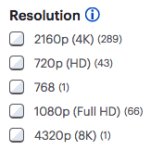
Each year, the numbers for HD TVs keep decreasing at any major electronics store (you can always find anything online):

Here's a current list from 'Best Buy' (your search results may vary even 10 minutes after this post):

BB.jpg

If you check back next year, the HD numbers will probably be in the 20s.

2-3 years from now it will be difficult to find a high-definition TV in any store while there will be hundreds of 4K TVs and probably a healthy amount of 8K options.
 
And when an 8K TV costs 200 bucks in 2-3 years, who's going to buy a 4K one?

Yea, no one.

---

8K had to start being pushed at some point...if not this year then next.

It's never too early for new technology.
 
The sets will eventuallybe in people's homes regardless, because eventually that will be the only thing available like today and HD sets. There are no more SD sets and 720 sets are bargain basement, entry level. Most people are buying either 1080 or "4K" even though probably the bulk of content being distributed by conventional means(broadcast, catv/sat) is still 720(i've done plenty of 4K acquisition for 720P networks and I still shoot a ton of 720P, too) and some people still watch SD content. A few more years and 8K screens will be in the mid-level/affordable range and people will buy them because that's whats available. Now content available to the consumer, that's another story...
 
Super large 75-85" 4K TV prices are dropping fast so by the end of the year they will be pushing 8K versions to get the prices back up.
45899348224_3679516867_b.jpg

46571218052_bf79484f04_b.jpg
 
Last edited:
Back
Top