
Navigation
Install the app
How to install the app on iOS
Follow along with the video below to see how to install our site as a web app on your home screen.
Note: This feature may not be available in some browsers.
More options
You are using an out of date browser. It may not display this or other websites correctly.
You should upgrade or use an alternative browser.
You should upgrade or use an alternative browser.
Canon EOS or FD lenses?
- Thread starter erbo
- Start date
The most important thing you have to be aware of is that none of the adapters currently available allows you to control the EOS (EF) lenses aperture. The reason is that the aperture is electronically controlled. So, you are unable to stop the lens down, which is simply unaccpetable. (Well.... there's actually a trick that allows you to do it, but it's extremely inconvenient - you need to attach the lens to the EOS body, stop it down to the desired aperture and remove the lens while keeping the aperture (DOF) preview button down.)
This reason alone is sufficient to go with FD lenses. Other reasons are:
- FD lenses are cheap and very well built (unlike plastic cheap EOS glass)
- the FD primes are great. You can get entire range of fast lenses quite cheap. And believe me - it is good to have fast lenses when using adapter as light loss becomes an issue - opening up by one stop means half the wattage of light. I recommend getting genuine Canon unless you can test the lens. I had some bad experience with other lenses that did not color-match. But be careful when getting Canon FD lenses containing thorium glass (f.ex. 35mm f2.0 with 2-16 aperture range) - it has distinct yellow cast (people love it for b&w photo, but you don't want it for video, I guess)
The FD zooms are said to be inferior to new EOS ones, but chances are you won't see the difference using it for low resolution video (compared to still cameras resolution). You can cover most lengths with three zooms - the zooms I'd recommend are 20-35 f3.5 (or cheaper 24-35), 35-105 f3.5, 80-200 f4.0 dual touch.
Redrock announced few days ago they would release LiveLens mount for their M2 Encore apdater, which allows for controlling EOS lenses aperture value. It should be out this spring, as far as I remember. So you actually might want to wait. However, unless you already have nice collection of EOS lenses I'd consider FDs.
Well here is what i know... and anyone feel free to correct me if i am wrong.
Well "FD" a mount and "EOS" is describing a type of camera. Most EOS camera use the EF lens mount. EF stands for "Electro-Focus." There is no know meaning of "FD" and canon has never confirmed that it is even a acronym for something. "EOS" means "Electro-Optical System." It is pronounced ee-oss after the Titan Goddess of dawn in Greek mythology.
Until like 1985 or 1987 canon used "FD" lens. Then Canon completely redesigned their camera system. The new system was called the EOS camera. They completely dumped the old system, including the FD lens and came out with new lens thats were compatible with the new system. The new lens were referred to as "EF" lens. The first EF lens were almost identical, as far as optics, to the FD lens. Over time, the EF lenses were improved for larger aperture, improved coatings, etc. Not they go as far as automatic focus and automatic iris control. However i have heard that the FD lens are more durable than there newer counterpart.
As far as which lens produces a better picture, the debate is on. I have always heard that the old film lens are better because the newer digital camera have certain image enhancing controls that film cameras didn't. Meaning that the manufacturers could produce cheaper lens. This could be total BS but who knows.
One thing to remember that each and every lens has its own characteristics and if you don't want to take the time to learn of the those characteristics through trial then make it simpler for yourself and pick a brand like Nikkor (Nikon) lenses. Plenty of used ones out there and no debate wether they are good or not for 35mm adapter use. I have a Canon FD 50mm 1.4 myself and am wonder to stick with canon or start picking up some Nikkor's too.
i don't know allot about canon lens, but even i know that when they switched to eos, they changed the size(it's a bit bigger), and changed the mount completely.
you will find better eos lens than fd(not sure about the cost, but eos is not really too new, so you can still find something used, and i think one or two of the lens that are amazing and not l series, with two or three l primes and maybe one or two zooms(i think one or two of the zooms are definitely better than anything from the fd lens)), i have seen a couple of adapters that either read or can change the apertrure, i think they are not released yet, but some of manufactures are trying to make them, and using a camera to change the aperture is not that bad, you only need to set it once when you set the camera, and it doesn't take that much.
of course there are other options like nikkors or 35mm still lens.
i don't know allot about canon lens, but even i know that when they switched to eos, they changed the size(it's a bit bigger), and changed the mount completely.
you will find better eos lens than fd(not sure about the cost, but eos is not really too new, so you can still find something used, and i think one or two of the lens that are amazing and not l series, with two or three l primes and maybe one or two zooms(i think one or two of the zooms are definitely better than anything from the fd lens))
Well. If you don't know a lot about Canon lens why are you so confident you can find better EOS lenses than FD? Have you ever had the experience with plastic EOS primes falling apart? Sure - you can get good EF lenses but at what price? People getting DOF adapters don't usually have budget for whole line of L lenses...
Canon FD primes are excellent and not much have been improved in their EF counterparts. Zooms are different story, though. But still you can find good zoom in FD range. For DOF adapter applications they are more than sufficient.
i have seen a couple of adapters that either read or can change the apertrure, i think they are not released yet, but some of manufactures are trying to make them
Hmmm... I only know of one manufacturer who announced such lens mount - it is RedRock. Have you really seen these other adapters?
and using a camera to change the aperture is not that bad, you only need to set it once when you set the camera, and it doesn't take that much.
Not that bad?!?! You must be kidding... What do you mean by setting the aperture once, when you set the camera? You don't touch the aperture while shooting to adjust exposure or/and DOF?!?!
For me swinging away the mattebox, removing the lens, getting my still camera body, removing its cap, attaching the lens, adjusting the DOF, removing the lens, putting body cap back in its place, mounting lens to the adapter and swinging mattebox back IS bad.
I've just sold my vibrating adapter to get rotating one only to be able to stop down past f4.0. Aperture is something I wanna change all the time and I want to be able to do it quickly.
well, you won't use it for trial and error kind of situation, you need to put the lens on the camera anyway, so you would take out the lens mount on the slr first, adjust the aperture, then mount on the camera, if it's full frame camera, then you can also use the slr to test in pre production, or before you start shooting. you will have all the information you need before you mount the lens on the camera. i'm not saying it won't be annoying compared to manual control, but it also makes a better lens as i understand. more accurate, less maintenance.
also your talking about 30+(both old canon and nikkors) years of wear and tear, beat up mechanics, glass dying, on something that was not the best in it's prime days, and the eos are built by the same people, and they are making and improving there lens. if you count how many times to you need maintenance and check if your lens is working correctly, your better off with 1-2 ef, 3-4 l series, maybe add in 1-2 zoom l, and make a set that you don't need to worry about for a very long time. you can build it up, you don't have to get the set all at once.
also your talking about 30+(both old canon and nikkors) years of wear and tear, beat up mechanics, glass dying, on something that was not the best in it's prime days, and the eos are built by the same people, and they are making and improving there lens. if you count how many times to you need maintenance and check if your lens is working correctly, your better off with 1-2 ef, 3-4 l series, maybe add in 1-2 zoom l, and make a set that you don't need to worry about for a very long time. you can build it up, you don't have to get the set all at once.
So, until the impending release of any adapter that can control the EF lens aperture, it's a wonder why anyone would choose EF lenses at all. Seems to me like you have only one choice - Canon FD or just go with Nikon. I've picked up from a few posts now that people seem to think Nikon glass is superior.
There is some *seriously* nice prime glass available in the FD range from Canon, and it's rare that the EF versions are significantly better. EF versions are often smaller, lighter, and contain more plastic. There's nothing wrong with the EF lenses, but since an adapter uses none of its special features (autofocus, electronically controlled aperture, etc.) you're paynig significantly more money for nothing. Unless you have an EOS camera you want to share them with.
That price difference is staggering on the really esoteric lenses. The FD versions are outrageously expensive, while the EF versions aren't affordable by mere mortals.
Here are most of the really nice FD lenses:
http://www.betlikeduncan.com/duncan/redrock/lenscharts/canon_fd/
I've built up that set over the decades as a still photographer, paying "steal" prices for them. I wouldn't even want to hazard a guess how much that would all be in EF, even used EF, but I bet it would hit 6 figures. And you might notice a few lenses that aren't even available as EF versions (7.5mm circular fisheye, for instance.)
Duncan
Nice collection of FD lenses Duncan. And I thought I was bad, wow!
I'm not a Canon guy, and I'm not interested in starting yet a third (fourth?) line of lenses in my small house, but I'm curious as to the history:
Are Canon FD lenses bayonet mount like Nikon/Minolta, or are they Breech lock like PL/BNCR?
Was there a change during the FD history from Breech to Bayonet?
astigmatic
Well-known member
for future proofing, i would go ef or nikon glass... especially with the advent of the dslr-video hybrids. My fd's are useless with the markII.
Are Canon FD lenses bayonet mount like Nikon/Minolta, or are they Breech lock like PL/BNCR?
Was there a change during the FD history from Breech to Bayonet?
Initially they were breech lock, then they switched to bayonet.
Here are most of the really nice FD lenses:
http://www.betlikeduncan.com/duncan/redrock/lenscharts/canon_fd/
I've built up that set over the decades as a still photographer, paying "steal" prices for them. I wouldn't even want to hazard a guess how much that would all be in EF, even used EF, but I bet it would hit 6 figures. And you might notice a few lenses that aren't even available as EF versions (7.5mm circular fisheye, for instance.)
Duncan
Wow. This is quite a collection!!!
Wonder how heavy they are

The other ones I really like are 135 f2.0 and 35 f2.0...
Last edited:
i only saw the 50/1.4, 50/1.8, the difference is huge, is that vignetting normal with the adapter?, and the lighter darkness on the left of both, is that from the adapter and stock lens.
The original M2 has a serious vignetting issue with lenses with small rear glass... this is generally only the case with wider lenses, but the 50/1.8 and 50/3.5 macro also have especially tiny rear glass and thus show awful vignetting. The just released M2 Encore update supposedly fixes all that, I am eager to see if that is the case.
The dark left edge is a result of the offset HVX200 sensor interacting with the original MicroX, which was precisely 24x36mm in size. Picture a several inch long tube but you're looking through it with your eye offset a bit from the center...you're going to get blocked vision on one edge. Panasonic isn't going to fix their camera designs, but thankfully Redrock just released a MicroX with a much bigger light path through it. So even with an offset sensor, you should be able to get a clear 24x36mm shot all the way through the several inches of optical path. I am also eager to see if that works, but there is no reason it shouldn't - that *is* the solution to offset sensors: provide enough glass for the offset to not matter, just like Panasonic provides a big enough image circle from their built-in lens for it not to matter.
Canon FD mount history: it was originally a breech-lock mount. There was a wide silver ring at the bottom that spun, and cinched the lens up against the *back* of the mount flange. Thus any wear over time was on the back of the mount, not the part determining lens collimation distance, and any resulting slack was taken up by cinching the breech ring tighter to compensate. Canon made a big deal about this vs. the bayonet mounts like Nikon, which would wear over time and allow wobble and incorrect collimation.
Unfortunately for Canon, a lot of people felt insecure about the mount. If you didn't cinch up the ring tight enough, it could theoretically spin back again and the lens would fall off. There was no reassuring CLICK and release lever like on Nikon. I have never even had a hint of that problem, but I have heard a lot of people remark on it over the years, how they hated the Canon FD mount for that reason. Canon engineers, clever bunnies that they are, eventually came up with a lens redesign that would still work on the FD flange and with the FD signalling levers and things, but would allow bayonet action with a CLICK and with a release button on the lens. Basically the center guts of the lens stick on the mount while the outer barrel of the lens at the mount end spins on it and locks in place against the innards of the lens (not the mount itself.) Starting in the late 70's they switched the entire lens line over to this mount... and simultaneously took the opportunity to add a bunch of plastic to the lens designs but that's a whole different story.
By and large it doesn't really matter which version you get. Optically most of the lenses are just as good either way. If the breechlock leaves you insecure about the lens being properly mounted, by all means get the later bayonet version. But for adapter users there is one huge difference making the breech lock versions superior: the easy ability to lock the lens into manual aperture mode. When they release the FD line it was a replacement for the FL line, which had a completely manual aperture ring located out at the nose of the lens. In order to allow people to buy the newer FD lenses for their older FL cameras (because they stopped making FL lenses), they had to provide a way for the lenses to be put into "FL mode" - and that is done by taking the larger aperture control lever on the back and pushing it counterclockwise until it clicks into place and stays. Now when you mount the lens to your adapter, the aperture ring will directly control the aperture. By the time they came out with the bayonet version of the FD mount, I guess they figured there was no downside to abandoning the FL users... there weren't any any longer! So this feature is not there on those versions of the lenses. But apparently there was some hue and cry over this issue, because they ended up making an official little plastic piece that would wedge the lever fully counterclockwise and allow manual aperture control. I believe most adapter users just wedge a little chunk of a Q-tip in there to perform the same function.
Here are the two mounts. You can see the bayonet mount has a much shorter slot for its aperture lever (at the top of the frame in these shots):
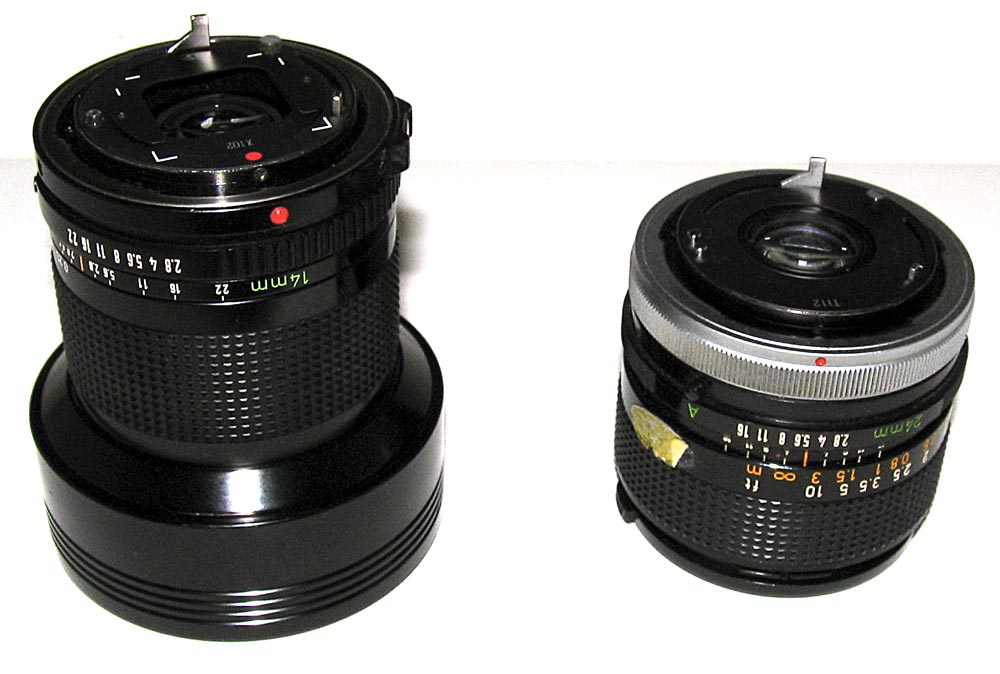
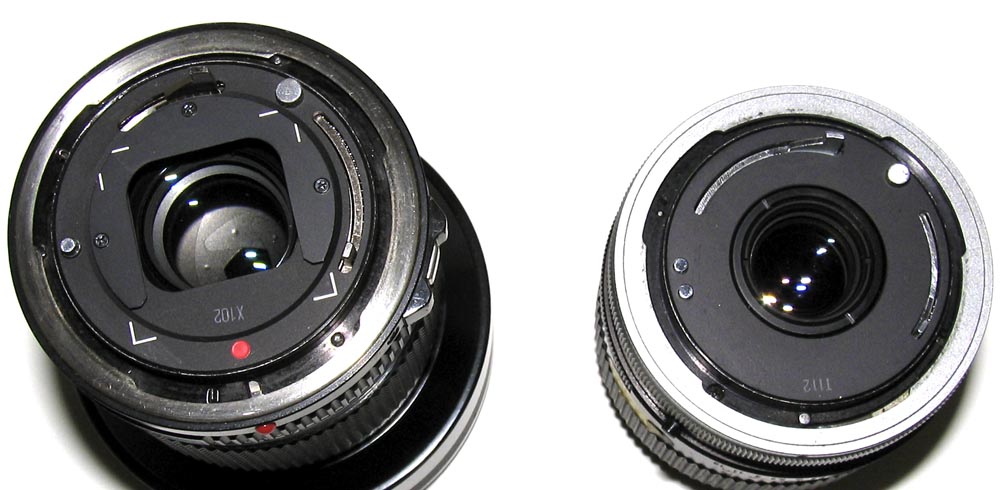
And here is the breech mount with the lever clicked into the FL mode position:

This has been today's novel on Canon lens mounts...
Duncan
Last edited:
Nice collection of FD lenses Duncan. And I thought I was bad, wow!
I'm not a Canon guy, and I'm not interested in starting yet a third (fourth?) line of lenses in my small house, but I'm curious as to the history:
Are Canon FD lenses bayonet mount like Nikon/Minolta, or are they Breech lock like PL/BNCR?
Was there a change during the FD history from Breech to Bayonet?
Wow! Awesome site....Thanks for the info, obviously you have taken a lot of effort.
Cheers, Chris:dankk2: