cablecam

Hy guys(and girls). The story started 2 and a half months ago, when a bit woozie, me and the guys from the local bike club wanted to make some great shots of an upcomming bmx dirt jump competition. So we said, at least i did, i can make a cablecam( the other option was to hang a man on a rope, and slide him along with the rider). Work started, and i made a real piece of cr@p design, but as i started to kinda fall in love with it, i began to churn up a better and better design. So, I ended up with this piece of kit: https://www.youtube.com/watch?v=k6tl...ature=youtu.be still needs some paint, and that black lower part needs to be replaced so it can handle a larger camera. Currently a large DSLR or handycam can fit in there. Because we were really cheap, and the rockethub campaign didn't work, we had to make the cablecam out of plywood, which btw is stronger than i imagined, this rig will break at around 50 kg load. Anyway, except for the rc controls servos, ball bearings and screws, everything is homemade, to very fine tolerances( no laser cutting, the money ran out). This isn't a bragging thread, i just wanted to say that with some knowledge of structures and mechanics, most people can make great stuff. I searched the web, and rigs with the same specs started at 5000 usd, which from the calculation i made, is insanely expensive. Anyway, i am seriously considering making more of these, and cranes, at some affordable prices so that not only hollywood can afford high tech rigs. Hope to have inspired some people, and help the film community along. More to come with the finished rig, and hopefully in the near future a demo reel. Cheers, and keep up the good work.
.
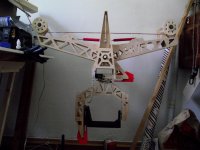
DSCF0528.jpg
 
That's a great looking piece of kit, I like the damping feature you've used! I know exactly what you mean when you said you 'kinda fell in love with it', I was the same with my Jib. I started with plastic drain pipe and was really pleased with the shots I got from it and I've been hooked on the project ever since! Well done!
 
probably. i've seen theyre crowdfunding video, i believe it was on kickstarter, but that piece of rig is too damn pricey for what it can deliver.
 
and don't get me wrong, but i feel that just putting a sticker on the rig saying "made in the usa", or "made in germany" somehow justifies a 200% increase in price for everything. I think cnc machining is great for accurate stuff, but , and i say this from experience, the only parts of a piece that need to be cnc machined, are the parts that join, the rest cand be made with a hack saw, it doesn't matter. machining the entire piece is just a waste of effort.
 
Hey man, nice to meet a fellow cable cam builder. I too have been building a system for the past 18 months. It's been quite a learning curve but we now have a pretty solid system and we're doing a redesign to make it look more aesthetically pleasing. But the functionality is not really changing. Here are some shots I took a few months back;


And here is the website - http://www.submotion.net/#!cable-cam/ck0q

Not sure if we're going to build them for other people yet. we just want to get out shooting with it but editing projects keep getting in the way...

One thing I would say is you are maybe adding too much extra weight with all the wood design.

Keep us posted!
 
Not really. It turned out quite lightweight. the heavy parts on it are the motor, batteries and gyros. Given it's total weight of 3 kg, and the fact that in theory it can support a 10kg camera safely, it's not bad for some woodwork. I could make it lighter, but the weight savings would be minor, even if i make it out of aluminium. And actually i wanted it to have some weight, so that to swiwel is less than for those tinycrap half pound goprocablecams, which swiwel like mad everytime you hit the throttle.
 
Well we're not putting GoPro's on ours and never intended to use it for that. But maybe the esc needs better programming for the GoPro to avoid the acceleration jilt. But in general, I'd say the lighter the better.
 
the lighter the better is good for handheld stuff. Here you need mass, or powerfull gyros, or both. It's not only the esc, the cable makes it rock left and right, and the small but very significant grooves( i believe they're called, the spirals on the cable) will make your cablecam vibrate. I've seen some cablecam attempts using just gravity, a piece of wood and a gopro, and the results are usually horrific, the image looks like it's shot from the back of a drunken baboon. What i want to say is, that for one cable systems, the lateral sway frequency increases proportionally with a decrease in mass and size, it works like a pendulum, the smaller the faster. I don't really know where the sweet spot is, but for these things, lighter is definetly worse. I would say 5-10 kg is a good weight, oh and for those of you interested in building you first cablecam, please do not go with the cheap and happy small rollers, you can make your own, or buy, your choice, but with small rollers and usually steel cable, you ca damage the camera, and here is why( only for steel cables): the cables have spirals, and if you make a longitudinal section in the cable, you will notice a sine like shape, so a moving object along the cable, will move along that wave, and i've calculated that at 40kmh, the vibration that is directly going to the camera, is around 500Hz. and if you want to avoid that shaking going to the camera, you will need rollers at least 10 cm in diameter, and a structure that will dampen the high frequency vibration, wood or carbon is best, aluminium is a really poor choice.
 
OK, well I was trying to give some friendly advice... Why would you want extra mass? That's just unnecessary load on the drive motor. The vibration thing is very very easily avoided with a little bit of simple engineering... Trust me, lighter is better.

I do agree with some of your points above but certainly not all. We have an aluminium design and it works perfectly, as you can see from the footage. Smooth as silk. Carbon design is something we are looking into but I wouldn't trust ply wood with a €30k camera on it. And the swinging, possibly try two cables?

Maybe you can post some actual shots from the rig?


The reason other companies are selling them at $5k upwards is because of the R&D that has gone into them. They didn't just buy all the bits and hope for a rig that works...
 
DSCF0565.jpg
and please don't ruin this thread with stuff like : i don't trust plywood. it will just say about yourself that you have a poor understanding of engineering. You can make a safe rig out of paper, IF you are able to design, calculate and manufacture it. Don't get me wrong, i don't "hate" aluminium or carbon fibre, i just believe that in this field rigs can be made with cheaper materials, without compromising anything.
 
I did read your full post and no, you didn't come off as a smart ass... Quite the opposite. You don't really help the situation with statements like "you have a poor understanding of engineering". Which is true, I'm a camera man. Hence the reason I asked a company with over 30 years of experience in designing and building packaging machines to build my rig. Glueing bits of wood together seems sketchy and adds needless weight. I guess that's the reason every other cable cam is made of Aluminium...

As I said, post some shots.
 
well, that was a long wait, sorry for that. Well, to answer your indirect question, i've made it out of wood, because it was the material of choice. Yes i've could have made it out of aluminiun, or carbon, or what ever(plastic is bad, it's really bad). I've studied architecture, and we like to make stuff our way. wood and glue gives you that option. Tto make an aluminiun cablecam that would look like i wanted it to, would be horribly expensive, and as a fact, it would be heavier than a wooden one. For these tipes of rigs, anything except plastic is good. wood in my opinion is perfect. the only troble with it is waterproofing, which can be done in a million ways. I've just used paint, but you can waterproof it for 5 bucks. I admit i posted the build to boast a bit, but more so you guys can build one, and don't become scared shitless because of some (sorry predi) clishees about the material beeing used on "professional" ones. Just let me tell you something, and you can badmouth me as much as you like: The only professional, in the "professional products", is the black paint, which i like to call "professional black" , or snob black, because in my opinion would justify a piece of crap cablecam which costs 30k+ (i'm not saying names, but we all know i'm talking about seatoskycam). just look at the crap companies throw on the market, paint the black, and voilla, you have a professional product. Horsemanure, me, or you, can make that stuff for 10% of the cost(and here is where the plywood and laser printer come in) and the same aesthetics. you just got to put your mind a bit on it, or ask a friend. Anyway, i've divagated a lot from prendis guess. No, not every cablecam is made of aluminium, and if you take a closer look, all the cablecams made from that crap, are actuallly pieces of aluminium square bar, bolted toghether, i don't say they don't work properly, but come on man, we gotta have some beauty in this life, isn't that what you guys are looking for, with your films ? And if you meant by " some shots" something filmed with it, i have a couple of clips from a competition i attended this summer : http://www.youtube.com/watch?v=V1r7sjK6edw&feature=youtu.be , and: http://www.youtube.com/watch?v=UZXB-rhmqbU&feature=youtu.be
peace out, and hail ison(or whatewer you wish).
 
Why hate on SeaToSky? They make a great product that can be taken onto any professional shoot. IMO, they are worth every penny. And you're talking as if the important thing is "how the cable cam looks", when in actual fact, it's how it functions that's important. As soon as you start to realise that you need fpv, HD transmission, wireless focus, zoom, aperture, WB, crawl speed up to 60km, stabilization, control decks yada yada. You'll realise that there is a lot more to this than just getting something to move on a wire.

Anyway, I stand by what I said. I don't think that making it from wood is a very good idea, for a plethora of reasons. But that's just my opinion.

Do you have any shots where you moved more than 10feet? Apart from the lack of movement or following the action, very impressive!
 
I don't hate seatosky, i just don't like theire skyhigh prices. And for the easthetics, i believe that if you make something, be it a a magnifying glass, you should make it as beatifull as you can, but hey, that's my opinion. In these shots the cablecam moves more than 10 feet, but there are more to come in the near future, with the image fully stabilized (the stabilizer made of wood of course :)) , hater wood :)))) , sorry, i couldn't help it). What you said about the fpv, etc, is not a problem, it is just a higher load on the motor, which btw i remade the setup to run at max 10 mph, for crawl speed and it's now capable of handling higher gradients. but this is a crappy 80w motor. one that would handle crawl to 60kmh costs around 100 bucks, so no biggie there, and 40 for a good controller. As i said, again if you know how to make it out of a certain material, you could probably make it out of rabbit legs, and the only other issue, is water, which can be dealth with, by means of a cheap paint(or an expensive one, it doesn't really matter). Probably what i meant to say is that these niche products are extremely overpriced. Cheers, and happy diy-ing.
 
Back
Top