C500 MKII Leaked on Canon Rumors

And then my client's reply...

"Dearest Sweet Eric,

I understand that RAW will require more money, time, energy, sweat, muscle, download time, upload time, hard drives, cables, sleep deprivation, dit, memory cards, computers, processing power, and rendering, but I am mostly concerned about if we shoot c.o.m.p.r.e.s.e.d. instead of RAW that if any mistakes are made on set, not by you, my sweet hunk of a DP, but, you know, like, if a PA accidentally changes the iris and then the image is not properly exposed, or if the audio mixer accidentally sets the white balance incorrectly, through no fault of your own, as I realize after the solar eclipse you filmed your eyesight has never been the same so as to notice other people messing up your perfectly set camera settings...I'm sorry, I ramble, this sentences tethers on, and you know how much you mean to me and how much I respect your opinion. The point is, I think instead of c.o.m.p.r.e.s.e.d. we should shoot RAW in case people other than you make mistakes.

Longing to see you,
Alex Foote"
 
Way back in olden times, before RED had even hinted at making a camera, I was tasked with introducing the Phantom high speed cameras to the production world. Up until that point these cameras were industrial/scientific devices only, a brick with a lens on the front hooked up to a computer. Vision Research (manufacturer of the Phantom cameras) literally did not know what the difference between a Director and a Director of Photography was, so I had quite the task in front of me.

At the time, while stills cameras offered the choice of JPEG compressed or raw files, the only other camera to offer raw data files was the Dalsa Origin, which nobody used -- mostly because it was nearly unusable (a story for a different day). In the production world people were refering to "raw footage" all the time as anything unedited or in the case of most post facilities, 1-light dalies. And most people didn't understand what compressed meant, and if fact few had heard the term codec. They just knew compressed = bad because it somehow meant "less". These were the early days, kids.

So I did it. I decided to promote the data coming out of the Phantom HD and Phantom 65 as Uncompressed RAW. I wanted to emphasize the lack of compression and I wanted to differentiate from what others were currently calling "raw". I am the one who started the convention of writing it as Uncompressed RAW.

And I have no regrets.
 
Why were the Phantom cameras never adopted as good 24p cameras? Too expensive, lacking features, image quality?

Images look great to me. Price at $110k isn't that much more than an Alexa XT at $80k.


Too expensive & lacking convenience features. Image quality is still quite high, although the dynamic range isn't quite as good as sensors that don't need to shoot insanely high speeds. It changes certain design parameters.
 
Way back in olden times, before RED had even hinted at making a camera, I was tasked with introducing the Phantom high speed cameras to the production world. Up until that point these cameras were industrial/scientific devices only, a brick with a lens on the front hooked up to a computer. Vision Research (manufacturer of the Phantom cameras) literally did not know what the difference between a Director and a Director of Photography was, so I had quite the task in front of me.

At the time, while stills cameras offered the choice of JPEG compressed or raw files, the only other camera to offer raw data files was the Dalsa Origin, which nobody used -- mostly because it was nearly unusable (a story for a different day). In the production world people were refering to "raw footage" all the time as anything unedited or in the case of most post facilities, 1-light dalies. And most people didn't understand what compressed meant, and if fact few had heard the term codec. They just knew compressed = bad because it somehow meant "less". These were the early days, kids.

So I did it. I decided to promote the data coming out of the Phantom HD and Phantom 65 as Uncompressed RAW. I wanted to emphasize the lack of compression and I wanted to differentiate from what others were currently calling "raw". I am the one who started the convention of writing it as Uncompressed RAW.

And I have no regrets.
there was a lot of “who’s on first”-like conversations surounding “raw footage”.

 
Last edited:
Perhaps. I've posted on this before and several others have agreed with my timeline. When I did this it went through an approval process at my old employers, AbelCine. Someone else there also tried to do something similar by coining "HDSLR" for stills-style cameras with HD video capabilities. It caught on for awhile but then petered out. Capitalizing Uncompressed kind of went away with disuse, but RAW is still going strong after well over a decade. I'd have to look back but I'm thinking it's been around 13-14 years now, if not more.
 
Perhaps. I've posted on this before and several others have agreed with my timeline. When I did this it went through an approval process at my old employers, AbelCine. Someone else there also tried to do something similar by coining "HDSLR" for stills-style cameras with HD video capabilities. It caught on for awhile but then petered out. Capitalizing Uncompressed kind of went away with disuse, but RAW is still going strong after well over a decade. I'd have to look back but I'm thinking it's been around 13-14 years now, if not more.

Just capitalizing raw doesn't bother me. It's the total lack of understanding that people who really should know better (i.e. people who say that they're DPs) demonstrate. Someone who contend that the choice is between compressed and raw obviously don't get it, and those who have trouble figuring out how to work with raw are obviously doing something extremely wrong considering how easy it is to work with most raw codecs these days.

I'm not saying that you should ALWAYS shoot in raw, just that you should understand the differences and tradeoffs and be able to explain those logically so that you're actually making a practical choice rather than a religious one.
 
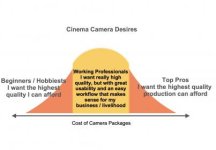
It's not sexy being in the middle of a bell curve, but I wish Canon would embrace it's "C300ness" and just build great cameras for the middle of the curve and just charge a few extra grand than everyone else for it and call it a day. Lop off the attempts at trying to be a high end player - forget 6K, forget 8K, forget R.A.W, instead continue to improve the wizardry of your autofocus, figure out IBIS, give us dual slot recording of Prores, and syncable timecode (C200 plea) and provide the middle of the curve a workhorse that's adopted industry wide.

Screen Shot 2019-08-28 at 12.45.24 PM.jpg
 
Last edited:
It's not sexy being in the middle of a bell curve, but I wish Canon would embrace it's "C300ness" and just build great cameras for the middle of the curve and just charge a few extra grand than everyone else for it and call it a day. Lop off the attempts at trying to be a high end player - forget 6K, forget 8K, forget R.A.W, instead continue to improve the wizardry of your autofocus, figure out IBIS, give us dual slot recording of Prores, and syncable timecode (C200 plea) and provide the middle of the curve a workhorse that's adopted industry wide.

View attachment 136596
Well they do do that, they have the C300 for the mid-range and those cameras have done well, while all their high end offerings have failed. I think the primary reason for the failure is image quality; they basically offer the same image as a C300, a mid-range image, and add in extra features. If the C700 had an Arri sensor and image quality in it with C700 features (triple slot recording, 10 stops of ND, auto-focus, better low light performance, etc.), then the C700 would be much more of a contender. But Canon seems to think it can just keep spewing out the same sensors and image quality and hope it's good enough for the high end, when it isn't.
 
I pretty much only shoot RAW on my C200, other than the occasional super long/ton of footage project and it's great in FCP X, workflow-wise, it's just another format and I can keep it RAW and edit or optimize it into Prores or just bring it in as Prores Proxy and worry about it all later.
When we go back to conform our Docu Series, we can go back to RAW and let our colorist go nuts with 12 bit RAW, it'll be glorious. I wish I was better at grading and coloring but even with my totally rudimentary skills, I can see that there is a tremendous amount of latitude and real detail in the RAW image, love it.
Funny enough, I don't think I have ever changed the WB after shooting. Yet. I'm sure I will eventually screw up and shoot Tungsten in daylight or vice-versa but so far...

For stills, the only JPEGs I shoot are on my phone, I switched to shooting RAW stills a decade ago. If I shot weddings or some other quick turnaround thing where I needed to shoot thousands of images, I might shoot JPEGs. But I did shoot stills of a fashion brand launch party a few months ago
and I shot about 800 RAW images and had all of the selects edited and shipped to the client the next day. I think a lot of people who freak out about RAW don't or haven't ever actually tried it, it's no big deal in stills or video, just takes up more space. Drives are cheap.

I also only really shoot RAW on my C200. I've shot a couple of one-off events where I shot MP4 with a baked in look, but those are the minority. But then THIS project was shot RAW and sent to a colorist and is typical of what I bought the camera for. For narrative or music videos, I'm not sure why I wouldn't want the highest quality my hardware is capable of (and by "hardware", I mean your entire setup including your editing rig). I've said it before: it boils down to what you're filming and the quality needed to hit your target.
 
It's not sexy being in the middle of a bell curve, but I wish Canon would embrace it's "C300ness" and just build great cameras for the middle of the curve and just charge a few extra grand than everyone else for it and call it a day. Lop off the attempts at trying to be a high end player - forget 6K, forget 8K, forget R.A.W, instead continue to improve the wizardry of your autofocus, figure out IBIS, give us dual slot recording of Prores, and syncable timecode (C200 plea) and provide the middle of the curve a workhorse that's adopted industry wide.

View attachment 136598

The bell curve graph is pretty on point in the post cellphone camera age. I may steal it for another thread if that is ok? Did you make it?
 
Well they do do that, they have the C300 for the mid-range and those cameras have done well, while all their high end offerings have failed. I think the primary reason for the failure is image quality; they basically offer the same image as a C300, a mid-range image, and add in extra features. If the C700 had an Arri sensor and image quality in it with C700 features (triple slot recording, 10 stops of ND, auto-focus, better low light performance, etc.), then the C700 would be much more of a contender. But Canon seems to think it can just keep spewing out the same sensors and image quality and hope it's good enough for the high end, when it isn't.

I've shot test footage with charts and a skin tone test with the C700, then C700FF and it looks great. But so does the C300 MKII and my C200 shooting RAW. To me, for the money, weight and size, the image doesn't look as good as an Arri Alexa or Mini or your Amira. It just lacks that little something in the knee/highlight rolloff handling and that other thing that Arris do so well, I'm not sure what to call it but it's "soft sharpness" or perhaps "sharp softness", in the same way that 35mm motion picture film responds, some call it microcontrast response but mixed with sharpness? The C700 can can be made to look very good as Russell and Tyler proved with The Calling. But it apparently wasn't enough bang for the buck for people to latch onto. I don't even know if the C700 would have caught on at a much lower price because it's not noticeably better than the C300 MKII as far as image and it's relatively large and heavy. I did like the locking EF mount and I really liked having DPAF on that kind of camera, pretty unique.
 
I would prefer for the video coming straight out of my camera's cards to be graded just how I like, so that all that is left me to do is cut it together.

Here are the reasons I lean toward Raw:

1. It is a simple and open format, unpatented, and able to be easily opened decades from today.

2. If a camera would record only uncompressed Raw, then its cooling requirements seem to be much lower. Compression takes more processing power. Ikonoskop told me in an email that the reason their camera did not compress was so that it would not need a fan. I'm sure it was also because it's also a lot cheaper to implement, once you have a fast-enough media.

3. With CFexpress I feel we have hit a mature standard that is able to handle uncompressed raw even at high frame rates. Its bus limit of 2 gigabytes per second could handle uncompressed 4K raw at 200 frames per second.

4. Solid state media eventually will be cheap enough, at least for 4K raw, which is 1 terabyte per hour.

5. Compression is not just compression. There is a pre-pass they have to do, which involves noise reduction. Otherwise the footage does not compress as well. (I'm not sure if this is the case with the compressed raw formats but it often is with the MPEG ones). So even at the higher bit rates the footage is irrevocably de-textured, and there may be some artificial sharpening baked in that is hard to get rid of.

6. The picture settings included in most cameras are still too conservative, having come from engineers and committees trying not to offend the masses. My ideal grade is "bent" more severely, with more noise visible than a lot of people seem willing to tolerate. 35mm film was said to be as noisy as the C300 at ISO 12800, and I am fine with that. Hey, some people are even adding film grain back into their video footage. Regardless, I would say honestly 99% of the footage I see online, even from Reds and Alexas, looks to me like: video. It's not how I would have graded it. And I'm not sure I can grade it the way I need to unless I have access to the untouched original.

And this is part of the reason I wish there to always be a camera that's not too crazy high in resolution. 4K is already a terabyte per hour, like I said. 8K would be four times as much.
 
2. If a camera would record only uncompressed Raw, then its cooling requirements seem to be much lower. Compression takes more processing power. Ikonoskop told me in an email that the reason their camera did not compress was so that it would not need a fan. I'm sure it was also because it's also a lot cheaper to implement, once you have a fast-enough media.

As the data rates go up, the cooling requirements will also. The reason that most raw codecs are now compressed is to keep the data rates manageable.

3. With CFexpress I feel we have hit a mature standard that is able to handle uncompressed raw even at high frame rates. Its bus limit of 2 gigabytes per second could handle uncompressed 4K raw at 200 frames per second.
And then your terabyte per hour turns into a terabyte in six minutes...

4. Solid state media eventually will be cheap enough, at least for 4K raw, which is 1 terabyte per hour.

Eventually.

5. Compression is not just compression. There is a pre-pass they have to do, which involves noise reduction. Otherwise the footage does not compress as well. (I'm not sure if this is the case with the compressed raw formats but it often is with the MPEG ones). So even at the higher bit rates the footage is irrevocably de-textured, and there may be some artificial sharpening baked in that is hard to get rid of.

Most raw codecs do not include a noise reduction pass. That's done in post.

6. The picture settings included in most cameras are still too conservative, having come from engineers and committees trying not to offend the masses. My ideal grade is "bent" more severely, with more noise visible than a lot of people seem willing to tolerate. 35mm film was said to be as noisy as the C300 at ISO 12800, and I am fine with that. Hey, some people are even adding film grain back into their video footage. Regardless, I would say honestly 99% of the footage I see online, even from Reds and Alexas, looks to me like: video. It's not how I would have graded it. And I'm not sure I can grade it the way I need to unless I have access to the untouched original.

Being able to upload a CDL or LUT to the camera and have it attached to the recorded clips is a great option, and you just explained why, basically.

And this is part of the reason I wish there to always be a camera that's not too crazy high in resolution. 4K is already a terabyte per hour, like I said. 8K would be four times as much.

And then there's also the fact that adding K won't improve mediocre cinematography :)

More than 4K is a luxury, not a need. Even 4K is too much for a lot of applications these days.
 
48638603927_c13511a262_n.jpg
 
I've shot test footage with charts and a skin tone test with the C700, then C700FF and it looks great. But so does the C300 MKII and my C200 shooting RAW. To me, for the money, weight and size, the image doesn't look as good as an Arri Alexa or Mini or your Amira. It just lacks that little something in the knee/highlight rolloff handling and that other thing that Arris do so well, I'm not sure what to call it but it's "soft sharpness" or perhaps "sharp softness", in the same way that 35mm motion picture film responds, some call it microcontrast response but mixed with sharpness? The C700 can can be made to look very good as Russell and Tyler proved with The Calling. But it apparently wasn't enough bang for the buck for people to latch onto. I don't even know if the C700 would have caught on at a much lower price because it's not noticeably better than the C300 MKII as far as image and it's relatively large and heavy. I did like the locking EF mount and I really liked having DPAF on that kind of camera, pretty unique.

It is very difficult to quantify and explain the image quality difference is between the best of the mid-range and the top end. But I definitely know it when I see it...
 
Last edited:
It is very difficult to quantify and explain the image quality difference is between the best of the mid-range and the top end. But I definitely know it when I see it...

For the most part, i believe it is dynamic range.
 
It is very difficult to quantify and explain the image quality difference is between the best of the mid-range and the top end. But I definitely know it when I see it...

So image quality = porn? ;-) Ha, ha, no I agree. For me, the best of the high end has a smoothness and organic quality when you look in the EVF or on a good monitor that the mid-level stuff just lacks. It's the classic law of diminshing returns. An Amira looks better than a C200. But does it look it's cost 800% better or 40% or 10% better, hard to say. And as Eric says, which I agree with, people doing high end production buy high end tools, largely for reliability and operational factors, not only image quality. Pick up any Arri and my C200 and the difference is immediate, the weight, construction, innovative design. And mid range cameras and low end cameras are a hindrance on a real, crewed production working set, they aren't set up for camera crews, they are set up for single operators. Big difference.
 
Last edited:
The bell curve graph is pretty on point in the post cellphone camera age. I may steal it for another thread if that is ok? Did you make it?

I did make it and feel free to use it (today was an edit day which meant that I was looking for any opportunity to not edit....)

I'm curious as to why Canon is even bothering with the C500MKII, with the FS-7 getting long in the tooth it seems like they could knock it out of the park with a C300MKIII and try to take a big chunk of that market. I shoot all of my stuff on my C200s but most of the inquiries I get for camera crew are for shows that's shooting on a FS-7 or a C300MKII. It seems for the middle part of the curve popularity/common availability plays just as big of a role as specs (if not more) - especially for multi-cam stuff.
 
Back
Top