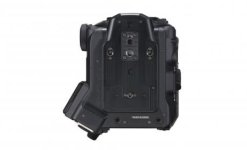
C500 MKII Leaked on Canon Rumors

Not sarcasm. As Jim wrote below, Canon is a huge sponsor of the Olympics and thus, from what I read, was able to garner itself the exclusive on the camera usage.

Think of it this way - if Coca Cola paid for the sponsorship of any major sporting event in the US, would you see Pepsi products there? If it's Bud, would there be Miller too? If there's Pizza Hut, would there also be Papa John?

I didn't pay much attention to this but, as I had mentioned above, it makes sense to me. If Canon pays big money to sponsor the Olympics - home country and all that - they want the exclusive on premises. (I assume the audience will be allowed to bring in their smartphones).

As a side note, I recall Andree posting about 1D XII's video features upon release with the conversation drifting to the point that a photog with this camera would be authorized for the photo use only. IOW, you can shoot stills but you can't record video, though the camera obviously has both features. Because the video rights belong to some TV network as big money entertainment, while the stills are technically "news".

PS. The video broadcast will have its own system, obviously.

As someone who covers professional and college sports, there's a big difference between a sponsorship deal that nets you advertising and exclusivity on what is sold there to eat and drink to fans or even provided in the media center, but that doesn't mean other brands aren't there and aren't being consumed/used. Coca-Cola is a sponsor/partner at a lot of the NASCAR racetracks, but there are drivers/teams with deals with other brands. They don't stop them and tell them that they can't bring in Pepsi, Mt. Dew, etc. to the track. Olympus sponsors the photog room at Daytona and has nice, shiny metallic prints on the walls about the room, but 99% of the cameras laying around in there are Canon or Nikon.

Yes, the broadcast side is a huge "deal" and most of it is sold off at nice discounts afterwards(most of it actually being spoken for before), BUT that has nothing to do with individuals there covering it. If Panasonic is the exclusive equipment provider for the broadcast(as they have been and as has Sony), that has absolutely no bearing on what someone from station XYZ or CBS or ABC may be shooting on, i.e: :No, you can't bring that Sony camera in here".. But different kettle of fish, as the video shot in the venues is generally limited to "the broadcast", much like the NCAA tournament here in the US.

Again, I'd have to see it to believe it. As someone who lives in the sports world and sees crazy sponsorship deals, this would be pretty much unprecedented. I can't see a lifelong "Nikon Shooter" coming into the mother fracking Olympics and shooting on a camera they may have never touched before.
 
R&G, I basically agree with you, but you know: The International Olympic Committee is different from most sports organizations. So who the heck knows what's going on.

And on the broadcast side, I think the deal for at least the last several Olympics that the International Broadcast Centre is usually supplied by Panasonic, while the US/NBC broadcast center uses a bunch of Sony equipment, including a bunch of cameras. When NBC pays something like US$1.5 Billion for just the Tokyo games, they expect a bit of slack... l I don't recall offhand how many cameras Panasonic & Sony each provide, and how they mix/pool feeds. The Internet probably knows.


But back to the C500mkII... Who here will be at IBC and can fill us in on the latest?
 
Just noticed one more thing that Canon fixed with the C500mkII..... the bottom of the dang camera! Finally will have a mounting point towards the back of the camera. Only took them about 10 years to fix this, but glad they finally did.

Screen Shot 2019-09-09 at 3.35.19 PM.jpg
 
Maths C200 vs C500?

C500, buy today $16000, sell in 5 years, $8000 - cost $8000

C200, buy today, $5000, sell in 2 years, $2500, buy used C500 $10000, sell £5000. Cost $7500 and suffer 2 years of limited spec.

That would seem to be a nobrainer for the C500 if it is still current in 5 years.

How long has my fs7 lasted? Five years.

It really does feel that this C500MKII (and the new sony cam) will be standard workhorses for the next 5 years and will be pretty safe investments, whereas everything that's come out between the C300/FS7 releases has felt like an in-between/transitional camera. Other than niche specialty cams (super high frame rates or super high resolutions) I can't really think of there being any need beyond a really solid 6K full frame camera that has most of the features/ergonomics refined from the past 5 years of feedback.

Even when I bought my C200s two years ago I had the feeling that they were in-between cameras and that whatever came next would be a much better camera to operate.

Hopefully now that Canon seems to be committed to Cinema Raw Light for the long term they'll further improve Canon Raw Development utility AND get better support from NLEs (I'm looking at you Adobe....)
 
How many of you are planning to buy the C500 Mark II?

I'm on the fence. Leaning yes, but these last 2 months have been very slow business wise which is giving me pause at pulling the trigger immediately. Would likely sell my C200 and put that towards this purchase and then keep my C200B as my B-Cam / Gimbal cam for 2-camera shoots (even though ironically the C500MKII looks to be a better gimbal cam).
 
$15,999 and then another $1600 if you want timecode in / out. Another $6k if you want the professional quality loupe. After all is said and done around $24k total. I suspect that Sony will smartly come in well under that with the Fx9 and the eyepiece / loupe will come standard as it does with the Fs7.

I'm unclear on the timecode thing. Base model it has a port labeled "Timecode", but the "Genlock" feature is only in the expansion units (you only need the $499 one for that, not the $1,600 one). Does that mean the base model will send timecode out, but not accept timecode in?

Also, for what it's worth, I use the Zacuto Z-Finder on my C200's LCD screen and it's great (and way cheaper than the $6K viewfinder).

So you could closer to where you want to be at a considerably lower price.
 
Last edited:
I'm unclear on the timecode thing. Base model it has a port labeled "Timecode", but the "Genlock" feature is only in the expansion units (you only need the $499 one for that, not the $1,600 one). Does that mean the base model will send timecode out, but not accept timecode in?

Also, for what it's worth, I use the Zacuto Z-Finder on my C200's LCD screen and it's great (and way cheaper than the $6K viewfinder).

So you could closer to where you want to be at a considerably lower price.

I haven't really dug in deep, but if it's like the C's that do have TC(and most "cine" cameras currently with TC) it's switchable and functions as either IN or OUT at any given time.
 
Yeah, it appears it has timecode on the base model, so if you need genlock then you need the extension, while the C300 Mark II has genlock on the base model. I never use genlock, which I guess is for live multi-cam shooting, so lack of genlock doesn't bother me.


I just noticed; it looks like the BPA battery port has hardly any indentation, so your BPA batteries are really going to stick out a lot, which is kind of a pain. I definitely prefer BPA over Anton Bauer as the whole point of the C-series for me is to have a smaller camera setup.

Not that it really matters to me, but I wonder if that will affect gimbal setups.
 
I think the only reason anyone should buy this camera is if there's enough demand from the people giving you work. I don't see how any emotion can come into it if your work comes from people requesting a certain type of camera - let it go!

Backing a camera to be the next standard, even with pretty good evidence on your side is way too risky. I'd wait until the sony equivalent comes out then after a YEAR see which one has become the most popular industry standard within the local market (or global market if that's how you're employed).

EDIT - if it's a split landscape e.g. "it's all c500 IIs and fx9s around here" then there's more room to go with your preferencee. You should probably just own both at that point anyway!

If you're working directly with a client and have the luxury of being able to use whatever camera you like, I think it's a terrible way to spend money.
 
I just noticed; it looks like the BPA battery port has hardly any indentation, so your BPA batteries are really going to stick out a lot, which is kind of a pain. I definitely prefer BPA over Anton Bauer as the whole point of the C-series for me is to have a smaller camera setup.

I saw that too. That's the main reason I loaded up on BP-a30 batteries over bp-a60s - they're flush with the back of the camera.
 
I just noticed; it looks like the BPA battery port has hardly any indentation, so your BPA batteries are really going to stick out a lot, which is kind of a pain. I definitely prefer BPA over Anton Bauer as the whole point of the C-series for me is to have a smaller camera setup.

Not that it really matters to me, but I wonder if that will affect gimbal setups.

Good catch, hadn't noticed that. I only use the BP-30 batteries on gimbal work (and handheld work), which looks like it wouldn't be flush like it is on the C200, but would also not stick out enough to effect anything too much.
 
Last edited:
I think the only reason anyone should buy this camera is if there's enough demand from the people giving you work. I don't see how any emotion can come into it if your work comes from people requesting a certain type of camera - let it go!

Backing a camera to be the next standard, even with pretty good evidence on your side is way too risky. I'd wait until the sony equivalent comes out then after a YEAR see which one has become the most popular industry standard within the local market (or global market if that's how you're employed).

EDIT - if it's a split landscape e.g. "it's all c500 IIs and fx9s around here" then there's more room to go with your preferencee. You should probably just own both at that point anyway!

If you're working directly with a client and have the luxury of being able to use whatever camera you like, I think it's a terrible way to spend money.

The interesting thing is, it's not actually producers who really determine what camera will be in demand. Here's how it works. Producers typically don't know the technical side of cameras very well, while cameramen do. Producers request the cameras that are popular and they have experience with. Meanwhile, cameramen keep up with the latest trends and technical side of new cameras. A cameraman sees a new camera that will make their job easier and provide better results, they buy it. Say, an FS7 owner buys an FX9. Producer still asks for FS7, but his go to cameraman now has FX9, so he settles for that, even if it won't match as well with the rest of the show shot on the FS7, because he wants to stick with this cameraman, who assures him it's a better and newer camera. Producer gets experience with the camera on set, sees the footage, and realizes some benefits over the older tech FS7. Now, producer has another shoot coming up, and he's now looking for FX9 owner/ops, because of his previous experience with the newer and better tech, that the cameraman started simply by buying and using the camera.

So, it's the cameramen who decided first and foremost what cameras become popular, and then it takes a year or two for the producers to catch up. If you bought the camera early on in it's rising popularity, then you may benefit of being well versed and with lots of portfolio with the camera by the time it's fully popular and being specifically requested.

I guess the only real risk is misjudging what will become popular.

Allow mw to offer another scenario, which I'm all too familiar with.

New camera comes out.

Bill gets booked for a gig, hear's all about the amazing shoot with A-list talent at incredible location, offers to supply amazing new camera or better yet throw in an Amira for a great rate.

Producer states they have a C100, or a 5D MKII, and ALL cameras have to be dummed down to match that.

Bill...(swears, rents crappy camera, cashes check).
 
I just noticed; it looks like the BPA battery port has hardly any indentation, so your BPA batteries are really going to stick out a lot, which is kind of a pain. I definitely prefer BPA over Anton Bauer as the whole point of the C-series for me is to have a smaller camera setup.

Not that it really matters to me, but I wonder if that will affect gimbal setups.

Powering accessories is the one issue that'll need some definite investigation. The camera only has one proprietary 'video' out port, which can either be used with the included 720p touchscreen or the 1080p EVF from the C700 (neither has any kind of image/power passthrough, so you can only run one at a time).

So using the camera with BPA batteries you could only do the most streamlined of setups (camera + EVF or camera + touchscreen) without any additional accessories, or you'll need accessories (like external monitors) that have their own battery plates.

SWIT do make BPA dummy batteries, that include a single DTAP port and a DTAP to DC power cable that includes DTAP passthrough (so you draw power from a second DTAP cable that feeds into the camera-to-DTAP cable... which on the whole sounds a little messy (albeit workable if all you need to do is power a single teradek, or onboard monitor): https://digitalfilmmaker.net/swit-battery-kit-canon-c200-c300-mark-ii/

On the whole I suspect the BPA battery slot has been included primarily with gimbal use in mind (a compact, low-profile way to power the camera when it's gimbalised and space/weight is at a premium). Hopefully, Canon will introduce some updated BPA models that include a DTAP port (or better yet, two) - this would help you to keep the camera as light as possible for minimalist camera builds.

For more conventional production, you'll have to add a v-mount/ab-mount plate or the extension module. For my money the EU-V2 extension module is a little too light on power outputs (one DTAP, one 24v 2amp output). Assuming your batteries have DTAP ports of their own, that still only gives you direct ports for three accessories (and having to add DTAP splitters is added gack that nobody wants). So because of this, and the because the module doesn't really offer anything else that I'd need often, I'd opt for a straight battery plate instead. Which will take up less space overall, and with a beefy unit like the Wooden Camera 'Pro' plates, you get 3 DTAPs in addition to whatever's on your battery itself.

Hopefully someone builds an clean v-mount battery plate module, that includes at least three DTAPs, can sit flush with the back of the camera, and can power the camera directly (without having to feed a DTAP cable into the camera's DC in).
 
Allow mw to offer another scenario, which I'm all too familiar with.

New camera comes out.

Bill gets booked for a gig, hear's all about the amazing shoot with A-list talent at incredible location, offers to supply amazing new camera or better yet throw in an Amira for a great rate.

Producer states they have a C100, or a 5D MKII, and ALL cameras have to be dummed down to match that.

Bill...(swears, rents crappy camera, cashes check).
I guess if you still do jobs at labor rate. Most of my income comes from gear rental, so I turn down labor rate only jobs. If they want a 5D or C100, I'm sure there's other people out there who will do it. If they want me, the choice is C300 or Amira.
 
I'm feeling deeply, deeply tempted by it.

It does everything I need a camera to do. The size and weight are as good as the Alexa Mini, but in terms of rigging and ergonomics (the thing that irks me most about the Mini) it's miles ahead. The 5 steps of ND are the most convenient setup out there (outside of the Venice and the FS7ii's variable system). Being able to switch between 4k full-frame and 4k S35mm means I could hold on to my Zeiss CZ.2 zoom (which isn't really working for me on my S35mm cameras) whilst selling the Sigma 18-35mm I've been using to cover the wide-end. Which means that with the one compact zoom I'd have a 17-80mm range (in S35mm terms) without having to swing a lens (which would cover me for 99% of the shots I do). And the crazy high ISO performance means working off a T/2.9 zoom lens is no trouble at all.

Also, not taking the hit on selling my Zeiss - would cover probably half the cost of the C500ii just by itself.

It's a hugely appealing camera to me. With the image quality of the C700 FF, I can use it as an A-camera on the features, series and commercials I shoot. And with the compact size and comprehensive feature set built into the base body, it will work great for the few solo documentary-style shoots I do as well.

The only iffy issue is power distribution for accessories, but that's pretty easily solved with one of Wooden Camera's Pro v-mount plates with 3 DTAPs built in.

Also, it's the same price as a Sony F5! Less, when you factor in the need for the R5 or R7 for raw recording with the Sony!

I'm pondering it pretty seriously.

Canon did well to break it down to modules and effectively lowered the entry barrier for owning the camera. The cost of mounts appear to be harsh. However, the logic of canon appears to force people to buy only if you need. If you have projects that need the mounts then buying is no brainer.

I know my clients and don't think I can tell them that I will shoot for them in a BMD 6K. With a small form factor the BMD 6K has its space. I am very jittery about having only one card. So a C200 shooting CRL is tough for me. I have had life changing experience of losing my RAID and backup due to power fluctuation and getting into depression. So despite having a 1DXII (which I always fear to use for clients due to having only one card slot) I don't use it much for clients. So I don't find the C500 Mark II has any comparison with any existing camera based on my need for redundancy and quality.

The C500 Mark II is clearly for the documentaries, features and commercial space. Having spent for house, I have to figure out the cash as I always love to buy in cash.

Instead of spending $700 on the viewfinder, I think I have to either buy a better one or avoid. Will have to take a call on that.

I hope Wooden Camera will come out with a new battery plate with DTAPs customised for the C500II.

PS: I had more or less made up my mind to get one BMD6K, which I still may get later, but now the priority is the C500II so collecting coins and breaking the piggy banks will start now.
 
I guess if you still do jobs at labor rate. Most of my income comes from gear rental, so I turn down labor rate only jobs. If they want a 5D or C100, I'm sure there's other people out there who will do it. If they want me, the choice is C300 or Amira.

I think you got downvoted because you make it sound like being paid for labor alone is for chumps who haven't gotten to your level yet. Ironically I think of the very high end as not even bothering to own gear they use for the biggest jobs. How many ASC members actually shoot studio jobs with a camera they own and rent to the studio? I'd bet 0%.

(I'm sure many own a personal camera)
 
Back
Top