building a post audio studio?

Perception of all-in-one room vs. control room/studio

Perception of all-in-one room vs. control room/studio

Thanks! Very helpful stuff.

I think in regards to the all-in-one room vs control room/studio thing, there is the issue of client's perception. I personally like the idea of all in one, but creating the perception that it is a professional (not home) studio is important.
 
Last edited:
I have decided to do the booth if possible. I don't want to have to deal with the problems of isolating the equipment, squeaky chairs, etc. to do recordings. My room designer is coming in this week to take a look!
 
Last edited:
I'd ask him can he specify and cost his ideas for your studio. You should have a budget in mind, no use letting him rave on for an hour
to find it's out of your range. Watch out, I remember advice I got many many years ago was, think of a figure then double it :(

To save time, draw him a floorplan to scale with a description of the building and wall construction. You might be able to do this in a couple of stages?

Ask him can you record the interview, so you can make notes later.

Cheers.
 
We had a real builder/ architect for the building but most of the studio specifics we did ourselves. Not so much because we were experts but because the architect really didn't understand or want to put in the time to understand. Budget is an issue. The one thing we didn't spend enough time thinking through was wiring troughs and conduits. We planed them and we were smart enough to lay in some pull lines so we could add more BUT we didn't add enough. Make sure you can expand with out having to rebuild. For instance leave some string/ pull lines in the troughs so you can pull more lines through. AND when you add a line tie a string to the head so when you pull a line you still have a pull line in place. ALWAYS leave a string in your troughs/ conduits so you can ull a new line through. And NEVER assume you have thought of all the possibilities, because the miniute you do you will find something new you needc to pull through the trough to the ???
 
diagrams

diagrams

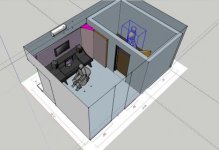
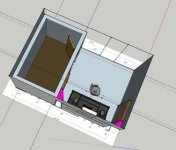
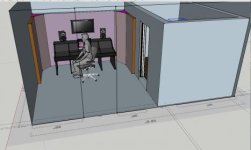
I got the studio designer in there and we've made up plans for the room. It looks like we'll be able to get 2 people in the booth and 3 people in the control room (including me.) A small but still usable setup. Here's the latest gear list:

neumann tlm 193
altiverb 7 native
hd omni thunderbolt pt 11
glyph gtp50 2tb x 2
rack for hard drives
blue sky pro desk mkiii 2.1 speakers/sub


have a 27" i7 iMac and senn 416 mic
have a bunch of headphones that should be fairly isolated for booth
(sony mdr-7506, akg k271, senn hd-280, ath-m50)
have izotope rx 2
have 15 and 25 ft mogami xlr cables for mics

will also need a display for booth (22"?) and bigger display for the CR (32"?)
swivel arm for booth tv
hdmi splitter
Thunderbolt to HDMI Adapter
mogami 2534 cables for speakers
avid artist control / mc euphonix 4 fader
neumann ea-1 shock mount
mopads
crucial 32gb ram
true systems p solo mic pre

mountain lion osx upgrade
some sort of omni mic for talkback (pick up whole room)
(have an fmr rnp pre I could use to power this)
source elements talkback plug-in

AC (looking at cheap AC only mini split system from home depot if it's available, otherwise mitsubishi or fujistu?)

again, the focus of this studio will be ADR and mixing for low budget indie films, also sound design and music editing. Maybe also some music recording/mixing.

For ADR, I like the idea of getting a good quality full range sound using the neumann 193 / true systems p solo, and then adjusting the sound to match production. But if needed I will try to use my 416 (and maybe a lav) instead to match production sound. I'm just not sure how well it will work in such a small booth.

attached are the latest diagrams:


Screen Shot 2013-07-12 at 6.23.01 PM.jpgScreen Shot 2013-07-12 at 6.18.50 PM.jpgScreen Shot 2013-07-12 at 6.22.27 PM-1.jpg
 
My thoughts take it or leave it...

The AC system will be louder than you think.

For a studio with a main emphases on ADR, I do not see any real ADR software. And your P-Solo mic pre & TLM 193 are not going to match with the original production.

Not trying to be an A-hole here, just trying to help, as I have been doing this for a very long time.

Want to stay in business?

Then before you start your business, question your potential clients. If you are going to serve the low end indie film community, then meet with them, introduce yourself, let them know you are starting a business to serve their needs. Ask them what mic/pre combos they are using, and let them know you will have these on hand to match their original productions. I would also question your potential clientele as to their expected ADR and or audio post budgets, to see if it is really going to be a viable business before you start.

All the best!

Dave

Thanks Dave,

I appreciate the comments. I am trying to figure this all out before I jump in. Maybe the AC can be shut off during recording. Also looking at the quietist possible solution which might be a mitsubishi mr slim. As for ADR software, what do you recommend I look at? I thought maybe I could just use Pro Tools. I imagine most productions are just going to want to replace a few lines here and there and not ADR the whole thing. Maybe I'll end up doing more mixing than ADR. I am getting that the TLM 193 / P-solo won't match production sound. Maybe I could just use that for VO or music, or skip it for now. I do have a 416 which I believe may work okay in the booth since it will be treated and dead. I could possibly use it with a Sound Devices 402 mixer since I think this is a common combo for location recording. The OMNI has it's own mic pres as well that could be suitable.

Good suggestions regarding questioning clients. This operation will be connected to my friends film studio, so I'm going to ask him to pass out a questionnaire.
 
Last edited:
Rule of Thumb: For ADR, especially where it is to be intercut with audio recorded on location, use the same mics as the location recording. For VO and narration, use studio mics.
 
Any form of cassette style aircon, means your ceilings need to be higher, and you need to isolate them because they vibrate. You need to isolate the feed and returns because they too can carry noise in and out.

I assume you're going to use video monitoring, with some kind of talkback speaker? - Make sure your monitoring is two way - so they can see you as well as you seeing them.
 
Rule of Thumb: For ADR, especially where it is to be intercut with audio recorded on location, use the same mics as the location recording. For VO and narration, use studio mics.

I keep seeing this recommendation here but my experience in big budget films has been that that is not what is done. And personally I think it's kind of a rule that sounds good but doesn't make much sense if you look at it close. For instance you can't match the sound of the voice unless you match the environment it was recorded in. The voice will sound different in different rooms and your recording in a space far deader than any set. The actor is not going to be in the same state of excitement and health etc and all of that is also going to alter their tone. And you can't have them moving around unless you get someone in the booth to boom them. All of the above makes the idea of "matching" pretty far fetched. Now I have worked on shows where we did go for matching and recorded ADR in locations, including exteriors but you still have to fiddle with it in editorial.

I also have never had a director question mic choices. What I see most are large diaphragm studio mics for ADR and also large dynamics like RE20 and Heil PR40. I'm not saying it's bad to match but I don't think it matters much. Maybe if your not doing any real sound post, but then you shouldn't really be doing ADR either.
 
I will join the others in recommending you make sure you have or can get some clients that can pay. I can't imagine a small facility that is going to focus on ADR for low budget films making ends meet. I think at minimum you need to be trying to go soup to nuts with the low budget films. Most have set aside almost nothing for sound post and ADR is going to be a small piece of that tiny pie.

As for the design. You need a window in there. Not being able to see into that booth will cost you time and frustration. At least you can put one in the door, though moving the door to the end and putting a larger window center would be better. Another option that works pretty well is to get a double paned sliding exterior door (like a patio door). The thick double panes ones are quite sound proof and will give you a lot of visibility and you don't loose space to the door swing.
 
I keep seeing this recommendation here but my experience in big budget films has been that that is not what is done. And personally I think it's kind of a rule that sounds good but doesn't make much sense if you look at it close. For instance you can't match the sound of the voice unless you match the environment it was recorded in. The voice will sound different in different rooms and your recording in a space far deader than any set. The actor is not going to be in the same state of excitement and health etc and all of that is also going to alter their tone. And you can't have them moving around unless you get someone in the booth to boom them. All of the above makes the idea of "matching" pretty far fetched. Now I have worked on shows where we did go for matching and recorded ADR in locations, including exteriors but you still have to fiddle with it in editorial.

I also have never had a director question mic choices. What I see most are large diaphragm studio mics for ADR and also large dynamics like RE20 and Heil PR40. I'm not saying it's bad to match but I don't think it matters much. Maybe if your not doing any real sound post, but then you shouldn't really be doing ADR either.


I have done ADR work for big budget films when the actor was in my area and they needed new loops, and every single time the microphone to be used was specified.

If we do not stock it, we rent it.
 
I will join the others in recommending you make sure you have or can get some clients that can pay. I can't imagine a small facility that is going to focus on ADR for low budget films making ends meet. I think at minimum you need to be trying to go soup to nuts with the low budget films. Most have set aside almost nothing for sound post and ADR is going to be a small piece of that tiny pie.

Exactly, running credit checks on new clients will be foremost and weighing up the payment deals they offer.
In some situations I'd be arranging for payment after each session.

I agree with using the same mics but the intended lower level clients probably won't know the difference only the results,
and that goes for most areas with the new studio.

Even the actors probably won't have much ADR experience and the clue there will be how clever and fast the OP is, in editing various ADR takes together.

Cheers.
 
I have done ADR work for big budget films when the actor was in my area and they needed new loops, and every single time the microphone to be used was specified.

If we do not stock it, we rent it.

As I said I'm going off my experience. Some practices I have noticed vary a bit regionally and it's always possible I have only worked on films that have gone a non standard route?

I was referring to low budget films when I said mics had not been specified.

And I still think the logic is seriously flawed and probably comes from when folks were recording to mag and editing with razorblades. There are a number of practices and "standards" in film sound that make no sense from an engineering/ science/ acoustics point of view that are still done because, well that is the way you do things.

RE: the OP considering the above you had better quiz some future clients because if they are going to require something you are going to need to provide it whether it makes any sense or not.
 
Question to the folks who are using the same mic. So if the scene was done with a wireless lav are you wiring up the actor and taping the lav under clothing etc? It's a serious question. As I mentioned I have not seen people worry about matching mics for ADR so I'm wondering how far folks who do worry go.

I have had basically a free hand with the low budget films I've done. And while I haven't worried at all about matching mics I have played around with matching environments and that has made things fit smoother. Trying to match the bounciness of a set or the the really dead but open ambience of an exterior shot I have found is pretty difficult with software tools, and something that doesn't get eaten as much as I would like by doing full background tracks. The hardest part of matching, in my experience, after performance is the "dirt" of the original location. If you don't "degrade" the signal appropriately it ends up sounding like an old film shot on a sound stage.

Of course if the scene was in a soft room and was miced close the booth is just about the right environment, so how big a pain it is depends a lot on the original tracks you are trying to match. And I could see with really clean production tracks having the same mic might get you a little closer, so...

Most micro budget films, and though the OP said "low budget" what he is describing is "micro budget" (Hollywood "low" is under $20 mill or so), have OK to pretty awful production tracks.


Cheers
SK
 
Back
Top