Broadcasting from home during Coronavirus

They could still position his face higher in the frame. Maybe they were fighting to keep the logo on the TV in-frame

100% all about the logo. And because it wasn't a real built set and they were working with what they had [a corner wall (or two adjacent objects creating one) and shooting high to low for the face], that's most likely the best balance they could achieve.

___

On the note about productions scaling back and/or looking at this new normal as a viable option for the future, I hate to say it but it should have been done a while ago. Everyone wastes way too much money on production. You of course should still have high-quality, big money value - but a lot could be saved on lots of content that truly doesn't need it.
 
I ran a few tests today to broadcast myself and it's easy when you have all the gear at home and used used to work with it. But for someone not technical savy I'd say it quickly becomes to complicated.
 
On the note about productions scaling back and/or looking at this new normal as a viable option for the future, I hate to say it but it should have been done a while ago. Everyone wastes way too much money on production. You of course should still have high-quality, big money value - but a lot could be saved on lots of content that truly doesn't need it.

Had a similar conversation yesterday with a friend who has been in the business 10-20 years longer than me and we both said that when this is "over", neither one of us think that it will be 'business as usual'. They're going to see what they got away with that cost them almost nothing to do, compared to how it was done, and that people still watched. There are a lot of us that used to make a nice living doing a whole lot of Live Shots/talkbacks for the networks, but those really started to disappear about 4-5 years ago when they figured out they could use Skype. And this is at the network level, not local. I used to probably do at least 1-2 LS's a week, almost always as a two-man crew. I was probably doing 50-100 dedicated talkbacks/LS's a year(meaning that was it. we weren't covering an event or anything else. we showed up, did the LS with the person and left), plus all the countless ones from events we were covering. Now, if I do a LS, it's usually from an event we are there covering(like a football game). Dedicated talkbacks/LS's are few and far between, now. I'd probably be surprised if I did more than 10 in a year, now. And I'm probably being generous with myself at 10.

Now keep in mind that was BEFORE all of this started happening.
 
The thing about basic video production is exactly that...it's basic. Most people can be taught the main fundamentals rather quickly.

Are people going to start shooting Hollywood films? Of course not. But a camera on a tripod with a mic plugged into it, decent framing, and throwing some light (any light) on what you need lit up is mindless for these types of productions in question.

In the old days when camera operation was compared to rocket science by some, it was a luxury service. But today you really don't need to pay someone $2500/$5000/$10,000 to do it not only because it's a waste of money but it's not necessary with modern, inexpensive technology.

In a lot of these cases, most people are only interested in the information; they do not care how you look. (That doesn't mean Colbert should have a show in his living room, but just saying.)

As soon as phones get really, really good (where you don't have that compressed look), it's really a wrap.
 
On the note about productions scaling back and/or looking at this new normal as a viable option for the future, I hate to say it but it should have been done a while ago. Everyone wastes way too much money on production. You of course should still have high-quality, big money value - but a lot could be saved on lots of content that truly doesn't need it.

I think you're probably right, although production value never hurts. Why do news anchors have to be good-looking if all the viewer cares about is the information? But everything is cost/benefit and keeping up with what the competition does.

But yeah I got hired in February by a UK-based app to shoot lit straight-to-camera interviews with experts in NYC. Their idea is to present a video library of informational videos with a nice, consistent look. My immediate reaction was - how are you going to compete with YouTube? I watch hours of experts on there and I don't care how it looks, most of the time I'm just listening anyway and the audio quality is way more important.

We were scheduling the 2nd shoot when covid shut us down so I haven't found out if their business model is sustainable.
 
Production value should always exist - and sometimes it's more special when you're not saturated with it so much - but a lot of content doesn't need the best-of-the-best, at all times. (YouTube is a great example.)

As far as looks, I meant more for video production than attractive appearances. Naturally, usually good-looking and good-sounding anchors have those jobs, but I meant people won't care if some content is presented from a phone, or there is a microphone in the shot, or you're a little underexposed, or overexposed; not everything has to be perfect.

Especially in a world where more and more and more is needed everyday.

Before you finish one video, you're already being fed the next one.
 
As far as looks, I meant more for video production than attractive appearances.

Sure but aren't these interrelated? You can make somebody look a lot better with good lighting, even if they look good to begin with. And the quality and the style of the set and graphics imbue the anchor with an aura of power and knowledge.

But definitely I agree that there are a lot of places where it makes sense to cut corners. But if the production is flush with cash, you can spend some money there. Cost/benefit.

Apple is spending a ton on Apple TV programming. But they have a ton of cash and the competition for that lucrative market is stiff.
 
ha...not everyone looks the same to everyone even with all of the $$$ in the world.

But as mentioned above, just hitting them with some light is usually good enough (and will eliminate the undesirable shadows). One soft panel, even a small one, does so much.

___

The current big production value of the news is nice, and it's been done that way forever and that's another reason why it hasn't changed in so long (just works and is ingrained in our minds that that's how it's supposed to be).

But slowly over time - whether it's for cutting back costs directly or indirectly - as people watch less TV and continue reading online or watching videos on their phones, or tuning into major broadcasts only at certain times less and less (evening news), the way content is delivered could also continue to change into the future based on smart homes and holography.

Picture waking up and having a robot/voice tell you what's going on in the world (like Alexa but more advanced) as you get ready for your day. Just audio coming out of every room, screens forming and disappearing as you walk through your house. It's in your car, in the stores, etc.

Everything is connected.

I know it's science fiction for the most part for now, but it won't be forever.
 
And there are also the actual advancements in production and post-production.

Light field technology/plenoptic cameras will be able to capture so much information, and artificial intelligence will produce accurate images that are so pleasing that all you may need is a simple box with a lens that has one button on it to record and all of the editing is done live (through the cloud)...for regular humans who will need to connect with other humans and tell them what's happening on the planet (and other content) these days.

So back to the OP...things like broadcasting from home and video conference calls may be as easy as using your smart phone.

Eventually machines will do all the work.
 
Interesting you guys bring this up, I know its relevant to whats going on now with the virus but I have also thought about this over the past few years. Like most of us, I can light and build a nice looking
talking head shot. But in shooting documentaries and in the documentary style, I've found myself dumbing down some of my production values simply because in many types of documentary style filmmaking,
crafting a shot that's too good looking, too slick, too professionally lit somehow can make an interview look disingenuous?

I've seem some documentaries or documentary style shoots where every single shot looks perfectly lit and crafted. And to me, often, not always, but often, I don't take the speaker or the film seriously.
If it begins looking really slick, I often tune out because it looks like a commercial or promo/marketing video instead of a real film with authentic locations. I'm not sure what this is, am I just too jaded to
media? Or does anyone else feel this way, they like to see a little or sometimes even a lot of "roughness". For clients, I still try to make it look polished and slick, but I find for my own film projects, I often
reign myself in from making everything look too perfectly lit or too slick. I shot some really, pretty rough looking stuff for our docu series and it's some of the best stuff storywise.
 
the way content is delivered could also continue to change into the future based on smart homes and holography.

Picture waking up and having a robot/voice tell you what's going on in the world (like Alexa but more advanced) as you get ready for your day. Just audio coming out of every room, screens forming and disappearing as you walk through your house. It's in your car, in the stores, etc.

Everything is connected.

I know it's science fiction for the most part for now, but it won't be forever.

Sounds hellish to me to be surrounded by media following me around. But I guess it makes sense. And becomes normal. I like to feel more in control than enveloped. But for some, sure.

Is this your personal hunch or are you reading about home holograms in trade journals somewhere?

Did you see about the AI newscasters in China and Japan?
https://www.google.com/url?sa=t&sou...BMAN6BAgIEAQ&usg=AOvVaw0sr_NrXIdJT8yPZKxzAAYX

It's still a bit creepy valley. But there's a chance that some types of production will have very little principal photography at all in the future...

I've read that the future of customer service is mostly AI, with human agents available as a sort of concierge VIP service. Maybe the same will be true in news and some other segments. But if the audiences prefer humans, it's a no-go.
 
And there are also the actual advancements in production and post-production.

Light field technology/plenoptic cameras will be able to capture so much information, and artificial intelligence will produce accurate images that are so pleasing that all you may need is a simple box with a lens that has one button on it to record and all of the editing is done live (through the cloud)...for regular humans who will need to connect with other humans and tell them what's happening on the planet (and other content) these days.

So back to the OP...things like broadcasting from home and video conference calls may be as easy as using your smart phone.

Eventually machines will do all the work.

Is there a case to be made that the data produced by a plenoptic camera would.be prohibitively large? I mean, in theory if you're collecting a bunch of light field data at high resolution and RAW then you can beam it somewhere and they can adjust it all in post and probably even relight the subject. But will it be too much data if you're shooting in volume? So much stuff I shoot needs to look good out of the box or with a 1-pass LUT, plus needs to not be 5TB of data/day... could having a skilled operator still be cheaper than maxing out the camera/post pipeline?
 
Interesting you guys bring this up, I know its relevant to whats going on now with the virus but I have also thought about this over the past few years. Like most of us, I can light and build a nice looking
talking head shot. But in shooting documentaries and in the documentary style, I've found myself dumbing down some of my production values simply because in many types of documentary style filmmaking,
crafting a shot that's too good looking, too slick, too professionally lit somehow can make an interview look disingenuous?

One of the few things I took away from hifalutin college theory classes was the "rhetoric of the real" which was how you use technique to imply that what you're showing really happened. It could be shooting something in one take or it could be cutting together multiple angles seamlessly. It could be shaky Blair witch camera.

So yeah I agree that in a documentary I'm aware of the style of the source material and what that says about how it was made. Is your average viewer? Maybe less so, but still at the back of their mind. But I think you're right on the money with that approach. That sounds smart.

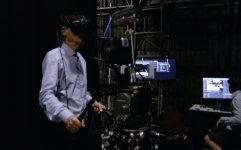
Apparently on the new Lion King they used regular film equipment and tripods to live action film inside a virtual world. There was a shot where a lion jumped out of frame and the camera operator lagged behind the lion. So they shot it again so the op could shift the frame right as the lion jumped. But they ended up using the too-late shot move because it implied spontaneity and REALITY.

But for audio - I think that's so back-of-the-mind that nobody will question why your doc sounds so good, though they might be annoyed if it sounds bad. Am I wrong? Does the same rule apply to audio?
 
It’s impossible for me to use my thoughts and feelings as a reference to what the audience will like/accept, because this is what I do for a living. When you spend your entire career trying to make things look good or at least make chicken salad out of chicken $h!t, it’s hard to get on board with bad quality, even for the sake of making it “feel real”. I just find it hard to watch really badly shot interviews in docs, because a lot of the time it would have taken very little to make it better. I guess it really bugs me, because I know all the times I’ve shot interviews off the shoulder and I had nothing at my disposal but framing and which way I leaned to tweak the composition and framing and got good results.

The crap that’s being turned out now, would it have been accepted 20 years ago? I think the democratization of photography has kneecapped this industry. Everyone can afford to buy a camera know and everyone thinks that they’re a photographer, but they’re not. Most suck and their work sucks, BUT because they think their sucky work is good and they see other sucky work on “TV” they think it’s good/acceptable, because that looks like the sucky stuff they were doing.

Re: The Lion King. My understanding is the movie is 100% CGI. What was shot was just for reference to help recreate/model the environments, animals, etc.
 
Last edited:
Sounds hellish to me to be surrounded by media following me around. But I guess it makes sense. And becomes normal. I like to feel more in control than enveloped. But for some, sure.

Is this your personal hunch or are you reading about home holograms in trade journals somewhere?

Did you see about the AI newscasters in China and Japan?
https://www.google.com/url?sa=t&sou...BMAN6BAgIEAQ&usg=AOvVaw0sr_NrXIdJT8yPZKxzAAYX

It's still a bit creepy valley. But there's a chance that some types of production will have very little principal photography at all in the future...

I've read that the future of customer service is mostly AI, with human agents available as a sort of concierge VIP service. Maybe the same will be true in news and some other segments. But if the audiences prefer humans, it's a no-go.

Is there a case to be made that the data produced by a plenoptic camera would.be prohibitively large? I mean, in theory if you're collecting a bunch of light field data at high resolution and RAW then you can beam it somewhere and they can adjust it all in post and probably even relight the subject. But will it be too much data if you're shooting in volume? So much stuff I shoot needs to look good out of the box or with a 1-pass LUT, plus needs to not be 5TB of data/day... could having a skilled operator still be cheaper than maxing out the camera/post pipeline?

I haven't been reading anything about holograms but they of course exist now and I imagine will only continue to be developed. Makes a lot of sense to present data/information like that.

AI is the future for everything.

Any kind of technology that takes the human out of the equation will exist. There will be no pipeline plugs in the future that exist now 10-20-30 years later. In the 1980s, it was probably hard to imagine shooting 8K on 4TB SSDs but it eventually becomes normal 40 years later. So setting up a light field camera or having one built into a robot or a wall or a moving object or whatever may exist and it will do everything for you.

It will frame you, focus you, light you, color you; whatever you programmed it to do. And if you don't like the results you can personally provide your human touch and change it all later in post.

As the world continues to move faster and faster, I believe humanity will become more disconnected with each other. Homo sapiens will become more like the machines they are engaging with. So they eventually might not need a human connection anymore to provide them the news.

I know it's all crazy talk now, but life really changes. There is no doubt that machines will continue to be taught to do anything and everything.

But where's the fun in that...? ; )
 
It’s impossible for me to use my thoughts and feelings as a reference to what the audience will like/accept, because this is what I do for a living. When you spend your entire career trying to make things look good or at least make chicken salad out of chicken $h!t, it’s hard to get on board with bad quality, even for the sake of making it “feel real”. I just find it hard to watch really badly shot interviews in docs, because a lot of the time it would have taken very little to make it better. I guess it really bugs me, because I know all the times I’ve shot interviews off the shoulder and I had nothing at my disposal but framing and which way I leaned to tweak the composition and framing and got good results.

The crap that’s being turned out now, would it have been accepted 20 years ago? I think the democratization of photography has kneecapped this industry. Everyone can afford to buy a camera know and everyone thinks that they’re a photographer, but they’re not. Most suck and their work sucks, BUT because they think their sucky work is good and they see other sucky work on “TV” they think it’s good/acceptable, because that looks like the sucky stuff they were doing.

Re: The Lion King. My understanding is the movie is 100% CGI. What was shot was just for reference to help recreate/model the environments, animals, etc.

Funny post! A couple things

What is "good" and "bad"? People used to put vaseline on their lenses. Styles change. Things look dated today that looked fashionable decades ago. Sometimes you want a sharp lens, sometimes a soft lens, different filters. So maybe you only use natural light or only one light for a documentary interview so that you limit the production value but make it look less artificial or constructed? And yeah, there's some amazing photojournalism that is just beautiful and all they had to work with was camera placement and framing.

The Lion King (I haven't seen it) was crazy because it was all CGI *BUT* they had real dollies and camera equipment that they operated while looking into that virtual world.

"Even though we could repeat the action by pressing a button over and over again, there were times when we would make little mistakes and the animal would jump out of frame because he jumped too quickly or something, and we would oftentimes perfect it and then go back, "No, no, take three where we screwed up a little bit actually feels better," because it really does make you feel like they were real animals and that you didn't get a chance to do it again. So, it's a little bit of second convolution thinking. It's like, "Well what feels more real? The mistake or perfecting it and not having the mistake?"'

https://nofilmschool.com/caleb-deschanel-lion-king-interviewscreen_shot_2019-10-18_at_4.16.01_pm.jpg
 
Last edited:
Back
Top