Bringing up the energy during interviews

I shoot a lot of interviews. One of the challenges I often deal with is bringing up the energy with the interviewees. Sitting in front of a camera is not easy.

I like sitdown interviews because people don't move off of their mark. Standing helps bring up the energy for many people.

I also usually turn off all the house lights when I'm lighting so I don't mix an ambient exposure. even though I keep my lights dim, it still comes across very strong to the subjects because the contrast between the lights and the interviewer is very stark which makes the lighting appear really bright. One trick I've found is that I'll bring an extra light to wash the room behind the camera (but not bight enough to really impact the image) this makes it easier on my subjects eyes.

I stress to my cleints that they shoudl not provide actual questions to anyone ahead of time because people often overprepare and really struggle during the interview. Just giving them general topics and telling them not to write anyting more than bullet points really makes a difference (when people listen).

What tips (technical or otherwise) do you guys use to get the interviewers energy up, feeling comfortable and natural.
 
Thats a tough one. So much of it just depends on the person. I’ve done multiple things with people that are used to being interviewed and they’re just as awful now as they were in the beginning, because that’s who they are and nothing is going to change them. Unfortunate, but true. And then many other adapt and improve. A lot of times it’s just putting the person at ease and making them feel relaxed and allow them to have fun with it(depending on subject matter). Let them know that it’s recorded, not live, so they can stop at any time and if they mess-up or don’t say what they want, they can do it over.

Bullet points/talking points is a great thing to tell them. I’ve worked with so many people that in the beginning try to recite a “script” verbatim, instead of just naturally talking. Yes, sometimes there does have to be a script and it has to be adhered to, but I understand the situations that you’re talking about and it probably doesn’t.

Also, sometimes it’s necessary to actually put a light on the interviewer to help the subject see them, especially in dark/dramatically lit interviews. And sometimes that helps the interviewer so they can see their notes/questions, as well.
 
Before shooting someone I have them talk for a bit about a topic that they're genuinely interested in / comfortable with ("Do you have kids / pets / what kind of music are you into?" types of questions), and I tell them I'm "we're just going to chat about those so I can set levels". This helps establish a rapport and develop a little confidence. If they suddenly lock up during the interview or drop into performance mode, I remind them of the way it felt to speak naturally and encourage them to get back to that.

Don't adopt this strategy unless you're naturally good with strangers. I've seen it completely backfire when someone robotically asked "do you have children" and it made the interviewee profoundly uncomfortable. Have to be able to put someone at ease, first.
 
Agreed for the most part what has already been said. There could be an entire book written about this (maybe there is? or should be anyway).
From my 25+ years of experience - often the person asking the questions - as well as the person behind the camera - can make the entire difference. And it's becoming a bit of a "lost art" in my opinion - good interviewers mostly listen - truly listen - not just wait to ask the next question-- and there is a huge difference between those two things. I've shot interviews where the interviewer is condescending to the interviewee - or will literally cut them off in the middle of a thought (or sentence) to try & get them to say what they are wanting to hear - or be more "excited", "enthusiastic" or with more "energy". And from that point on, I could literally see the interviewee lose confidence in themselves, the interviewer and the process. Developing trust & a comfortable rapport either before or especially during the interview can certainly do wonders for people less-than-comfortable being on camera. And I always feel that during a good interview, it's my job on camera to simply disappear.

As far as "energy" specifically, I would assume the people you are talking to are excited and happy to be talking about the subject matter being asked. And this seems like a no-brainer but again, I've been in situations where the person being interviewed is being asked questions they don't really want to discuss - or don't feel comfortable doing so on camera. If the interviewer is actively listening - often this will take them to other questions that truly draw the person in more, automatically making them more engaged in the entire process.

Forget about all the technical aspects for a moment and think about being interviewed for a job or just having a conversation with someone. We all know when someone isn't really listening to us - and most of us tune out once that happens. All the best soft lighting in the world won't help if the person asking the questions isn't engaged.
 
I too mostly agree with what has been written. But a few other things I'll do (I mean, beyond being prepared, making people comfortable, and other such essentials) include:

1) Have some caffeinated drinks and sugary snacks.
Everything labeled so they know what they're getting, but sometimes a little snack can seriously help.

2) Try to avoid 2pm interviews.
The post-lunch sleepies are a real thing.

3) Open doors & windows (if possible) & turn on HVAC during set up, and again just before rolling.
When CO2 & temperature increase, energy can decrease. Getting fresh oxygen into the sometimes stuffy rooms and offices I end up in can really really help. Sometimes for longer interviews when there's a break, we'll try to bring in as much fresh air as possible, too.


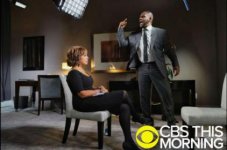
Sometimes, though, you don't need to bring up the energy:

interview.jpg
 
Some interviewees are terrified of forgetting things once the interview begins. For these folks I bring a teleprompter rig with the subject's notes as white-text-on-black bullet-points in an actual PowerPoint presentation, and then hand them a small remote to control what slide they see on the teleprompter. It's more gear to drag around, but it goes a long way to help to calm nervous subjects. ( I also think having the PPT remote makes them feel like they are in control of the process )
 
I too have shot and interviewed thousands of subjects over two and a half decades. A lot of it is context.

Corporate interviews can be tough because corporate people exist in a dog eat dog world where the perception of them and their actions are often under a microscope
and whether it is real or just a delusion, a lot of corporate people think that a bad interview or soundbite can derail their career or their perception amongst management.
So they become uptight and fearful on camera and sound like robots or highly nervous. The worst are the ones trying to "read a script" of their response and hit the 12
bullet points their boss told them they had to include, to get in our/my department's point. In a lot of organizations, there are also inter-department and departmental
and group rivalries. I find that these can be the toughest to get past because you, as the producer/interviewer, don't even know what these rivaliries and pressures
are or that they even exist. The best you can do is try to get them to be "coversational", not "presentational".

REMIND them that this is an interview, it's not a performance. It's not live, it will be edited and we are only going to use your best soundbite.
You can also remind them in video, 'it's more about how you say it than if you hit every point perfectly, like a television pro would'. You can remind them that they aren't an actor and nobody will want to see them try and act,
they just want them to be their own, relaxed and "real" selves. But frankly, with a lot of high-strung corporate people, there is NOTHING you can say or do that, a lot of corporate people freak the hell out at the thought
of going on camera and there's nothing anyone can do to change their freak out status.

As far as Hollywood celebs, actors, directors, writers and producers, that's usually a whole other ball game and they can be difficult to get a good interview from as well. Once again, context is key. The worst is when
these people are being told or required by a publicist, manager or agent and they don't want to do it. Hollytwood is full of Narcissists so you often have to use flattery, reassurance and frankly, some brown nosing to
get what you want or need from certain actors especially, because that's how directors have treated them, they have indulged their Narcissism as a work ethos. The trick is to provide these confidence builders without
appearing to be a brown noser or kiss ass, which is an art unto itself. You occasionally get the consumate professional, I've interviewed some A listers who are so nice, professional and easy to work with, they make it a
pleasure to interview them. Sharon Lawrence, Drew Barrymore, Tony Shalhoub, Peter Jackson, Dennis Franz, Tom Hanks all come to mind. All genuine, super easy to work with and gave killer interviews with hardly any prompting.

But I have interviewed plenty more who are the exact opposite where I had to just bite my tongue, grovel a little and hope for the best. Once again, a lot of the end result is from drama being played out that has
little to nothing to do with your interview. It's always best to interview someone who has a vested interest in the success of the interview and the product that it is part of or product that the interview is promoting.
That factor alone, the success or failure of their project based upon this interview will get them out of their pre-conceived fears and ideas.

For those who are terrified of forgetting things, you can always break it down, bite by bite. Let them go through their checklist and tell them you will prompt them for each point they want to get across and if need be
they can be broken down even into sub points. Get their responses until their heart is content. Then, don't use what will probably be the most stilted and bad delivery you've ever heard and circle back around, go through your notes and
use the phrases, "Tell me what that means to you?", "Why's that important", "Out of those twelve things we talked about, what are the number one and two takeaways? What do you want the audience to remember a week after seeing this video?"
They key is to get them past their bullet points and to talk about them and why those points are important to them and to the audience. The other nuclear option I keep on hand is if they just won't be real and are just reciting a bunch of meaningless (to the audience)
nonsense, I hit them with, "This point you mentioned, pretend I am the audience and based upon how you explained it, I'm not convinced, SELL ME on it and why it matters to you. How do you FEEL about it?" I've actually had some really bad interview quotes that
were awkward and stilted with the talent being super nervous, then I hit them with the "SELL ME" and "how do you FEEL" and have uncovered, real, authentic and heartfelt answers that were brilliant in the cut.

I DESPISE teleprompters for interviews, although they can be a Godsend for direct to camera presentations. Anyone can write down their bullets/topics on a Post It on their knee, (assuming their knee is out of frame?) and then take a breath,
establish eye contact with you, the interviewer and then deliver their sound bite or paragraph. The other key, especially for non pros is to get them to engage with you and have a conversation with you, rather than talk at you. The trickiest skill
is getting them to paraphrase a bit of the question into their answer so the bite can be used without your setup, that its a complete thought that stands on its own. The other tough one is typically execs, scientists and engineers where they
have to tell you, "The answer to that is in three parts with sixteen sub paragraphs. Part 1 is..." It can be a real challenge to get techno nerds to speak in soundbite friendy form, they have a tendency to string huge paragraphs together with
connective statements like "furthermore, moreover, etc." or worse yet, numbered points. These kinds of interviews can make an editor consider suicide because the intonation is all wrong and no extracted statement will stand on its own,
you can tell its taken from a huge paragraph and doesn't work on its own.

It can be exceedingly difficult for people to just list out single thoughts, separated from the next single thought by a pause because few people speak that way in conversation. Usually I will parrot back to them their response and then
tell them that was a great thought, but can I have you say it as a single thought, then pause, then add the next single thought? It gives the editor a place to edit the thought." This is a problem because most public presenters, especially the
not very good ones, are terrified of letting through one second of silence if they are speaking live so they "Uhh", "Umm" and use unnecessary connective statements reflexively and it's VERY difficult to get them to STOP doing that for camera. If you listen to most
powerful public speakers, they deliver a single thought and often pause for applause and effect. Think about Kennedy, MLK, Bill Clinton, Ghandi, etc. They spoke in declaritive statement soundbites that are still quoted today. They would say something powerful, then stop, then say another
sentence that was powerful, then stop. Not saying your interviewee can or should do this but it gives you some ideas about alliteration and how to present a powerful thought succinctly, it's all about confidence, alliteration and ending a statement on a downbeat that closes the thought, not an
upbeat, or worse question mark that sounds like they are going to say something else before stopping.
 
Last edited:
  • Like
Reactions: KJL
For those who are terrified of forgetting things, you can always break it down, bite by bite. Let them go through their checklist and tell them you will prompt them for each point they want to get across and if need be
they can be broken down even into sub points. Get their responses until their heart is content. Then, don't use what will probably be the most stilted and bad delivery you've ever heard and circle back around, go through your notes and
use the phrases, "Tell me what that means to you?", "Why's that important", "Out of those twelve things we talked about, what are the number one and two takeaways? What do you want the audience to remember a week after seeing this video?"
They key is to get them past their bullet points and to talk about them and why those points are important to them and to the audience.

I originally got the teleprompter for a job where I was hired to shoot an executive talking for 2 minutes about a new project the company was launching. On my first attempt I shot 17 takes over three hours, and every take had problems. I returned for a second attempt 2 weeks later, this time with the teleprompter and the PPT bullet-points, and the executive nailed it on the second take. With the teleprompter he was far more relaxed in front of the camera. For corporate interviews I find bullet-point reminders very effective at keeping people on topic while still allowing them to use their own words to get their message across. There's no script involved and the finished interview looks pretty natural.
 
I originally got the teleprompter for a job where I was hired to shoot an executive talking for 2 minutes about a new project the company was launching. On my first attempt I shot 17 takes over three hours, and every take had problems. I returned for a second attempt 2 weeks later, this time with the teleprompter and the PPT bullet-points, and the executive nailed it on the second take. With the teleprompter he was far more relaxed in front of the camera. For corporate interviews I find bullet-point reminders very effective at keeping people on topic while still allowing them to use their own words to get their message across. There's no script involved and the finished interview looks pretty natural.

Whatever works man! I just find when non-pro talent "reads" the prompters and has never had training and practice, it's too easy to get "typewriter eyes" where their eyes and sometimes their whole head is moving top left to lower right, very distracting.
Reading from prompter properly is an art and the people who are really good at it are taught to either break up their intense staring at prompter with visual asides or
to learn how to speed read from one line and let the operator bring the new copy into that space so they don't have to move their eyes/head up and down the page.

With corporate exec/spokesperson having to nail written copy and it's too much or memorize or they are incapable of it, prompters can reduce the pain a lot. I personally prefer talent who uses ear prompter,
much smallers, quicker, simpler and less expensive than prompter and operator but it's definitely an acquired talent to be able to smoothly ear prompt. But when it works, it's genius. Really good for Steadicam/gimbal work.
 
Whatever works man! I just find when non-pro talent "reads" the prompters and has never had training and practice, it's too easy to get "typewriter eyes" where their eyes and sometimes their whole head is moving top left to lower right, very distracting.

I've only seen "typewriter eyes" when people are reading from either a script or a large block of text. With bullet-points, that are usually one to three words long, I can't tell that they are reading anything.

The only real flaw with the teleprompter is that you can have lots of eye contact between your subject and their audience, which can feel a little intimate. The better speakers know how to tone this down.

Reading from prompter properly is an art and the people who are really good at it are taught to either break up their intense staring at prompter with visual asides or
to learn how to speed read from one line and let the operator bring the new copy into that space so they don't have to move their eyes/head up and down the page.

Again, I don't use a script, so my subject is only reading a few words at most. It's the equivalent of glancing at a big reminder list on the wall behind the camera.

With corporate exec/spokesperson having to nail written copy and it's too much or memorize or they are incapable of it, prompters can reduce the pain a lot.

That's why I never use scripts. Nobody has to nail any written copy, but they do have to nail specific topics within their interview. The teleprompter definitely helps amateurs perform better in these situations.
 
Back
Top